

When I first started homebrewing over a decade ago, I was perfectly content with extract brewing. The simplicity, consistency, and relatively quick brew day made it an ideal entry point into the world of beer making. But after a couple of years and dozens of batches, I found myself craving more—more control, more understanding of the brewing process, and, ultimately, more flavor possibilities. That’s when I made the leap to all-grain brewing, a decision that transformed my beer and deepened my appreciation for this ancient craft.
All-grain brewing represents a significant step forward in your homebrewing journey. Instead of using pre-made malt extracts, you’ll work directly with malted grains, extracting fermentable sugars through a process called mashing. This approach gives you unprecedented control over your beer’s character, from its mouthfeel and fermentability to subtle flavor nuances that simply aren’t possible with extract brewing.

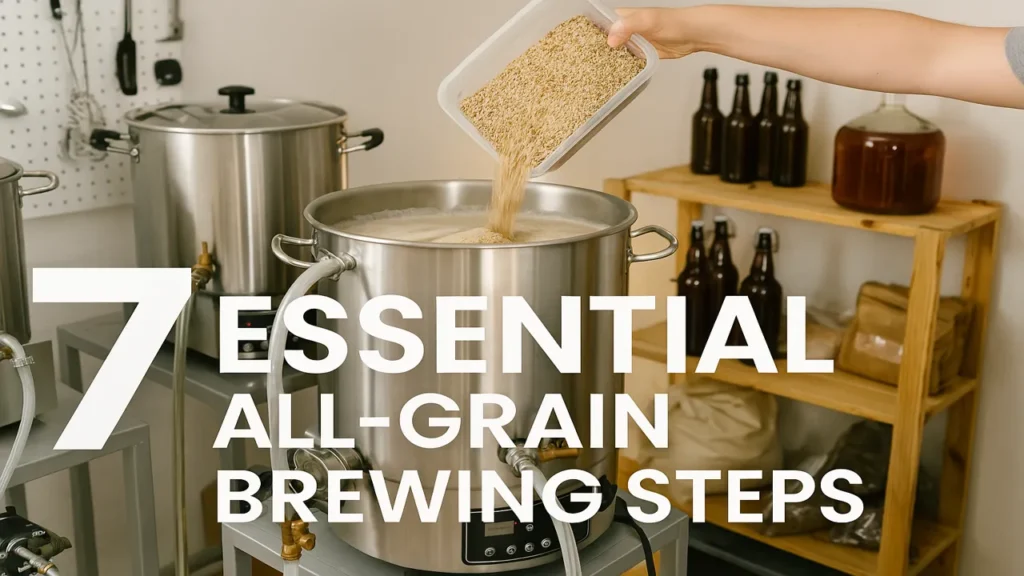
If you’ve been considering the move to all-grain brewing but feel intimidated by the additional equipment, techniques, and time commitment, this comprehensive guide will walk you through everything you need to know. We’ll explore the essential equipment, break down the step-by-step process, troubleshoot common issues, and share practical tips that I’ve learned through years of brewing and countless conversations with fellow brewers.
Understanding the All-Grain Advantage
Before diving into equipment and procedures, it’s worth understanding why so many homebrewers eventually transition to all-grain brewing.
Complete Control Over Your Beer’s Character
Extract brewing, while convenient, limits your control over several key aspects of beer:
- Fermentability profile: Extract manufacturers have already determined how fermentable your wort will be, directly impacting your beer’s final gravity and body.
- Malt character complexity: While specialty grains can add some complexity to extract brews, the subtle interplay of base malts is largely predetermined.
- Freshness factors: Malt extract oxidizes over time, potentially introducing off-flavors before you even begin brewing.
In contrast, all-grain brewing puts these variables firmly in your hands. By controlling the mash temperature, grain bill selection, and water chemistry, you gain the ability to fine-tune your beer’s character with remarkable precision.
“The difference between extract and all-grain brewing is like the difference between using cake mix and baking from scratch,” explains John Palmer, author of the seminal brewing text “How to Brew.” “Both can produce excellent results, but baking from scratch gives you control over every ingredient and process.”
Expanded Style Possibilities
Certain beer styles virtually require all-grain methods to achieve authentic results:
- Czech Pilsners: The soft, rounded malt character comes from specific decoction mashing techniques.
- Belgian Saisons: The highly fermentable wort necessary for authentic saisons is difficult to achieve with extracts.
- German Hefeweizens: The precise balance of clove and banana notes depends on specific mashing protocols that affect ferulic acid rest.
According to a survey by the American Homebrewers Association, over 80% of award-winning competition beers are produced using all-grain methods, highlighting the technique’s impact on beer quality and character.
Economic Considerations
While the initial equipment investment is higher, all-grain brewing offers significant cost savings over time:
- Typical 5-gallon extract batch: $25-45 in ingredients
- Equivalent all-grain batch: $15-30 in ingredients
This 30-40% savings adds up quickly. For brewers producing 20+ batches per year, the equipment costs are typically recouped within the first year.
Essential All-Grain Brewing Equipment
Transitioning to all-grain brewing requires some additional equipment beyond your extract brewing setup. Here’s what you’ll need:
The Mash Tun
The mash tun is where you’ll mix your crushed grains with hot water to convert starches into fermentable sugars. You have several options:
Cooler-Based Mash Tun
- Pros: Excellent heat retention, affordable, easy to find
- Cons: Difficult to heat directly, limited temperature adjustments
- Cost: $50-100 for complete setup
Direct-Heated Mash Tun
- Pros: Allows for step mashing, temperature adjustments
- Cons: More expensive, requires heat source, more complex
- Cost: $150-300+ depending on size and features
For beginners, an insulated cooler with a false bottom or manifold is usually the most cost-effective starting point. A typical 10-gallon cooler can handle most 5-gallon batches.
“Don’t feel pressured to start with expensive equipment,” advises brewing consultant Randy Mosher. “Many award-winning brewers still use simple cooler-based systems because they work consistently well.”
Hot Liquor Tank (HLT)
This vessel holds your hot water for mashing and sparging. While any pot can serve this purpose, dedicated HLTs typically include:
- Temperature gauge
- Volume markings
- Optional heating element
For starting out, your brew kettle can double as an HLT if you plan your brewing sequence carefully.
The Boil Kettle
Most extract brewers already own a suitable boil kettle, but all-grain brewing typically requires a larger volume:
- 5-gallon batches: Minimum 8-10 gallon kettle
- 10-gallon batches: Minimum 15 gallon kettle
The additional volume accommodates the full pre-boil wort volume without risking boil-overs.
Grain Mill
Properly crushed grain is critical for efficient extraction. Options include:
Manual Grain Mills
- Pros: Affordable, no electricity required
- Cons: Requires physical effort, slower
- Cost: $75-150
Electric Grain Mills
- Pros: Fast, consistent, less physical effort
- Cons: More expensive, requires power
- Cost: $150-500
Many homebrew shops offer grain crushing services if you’re not ready to invest in a mill. However, freshly crushed grain produces noticeably better results, making a mill a worthwhile investment for serious brewers.
For a comprehensive breakdown of milling equipment options and best practices, the in-depth equipment guides at Brew My Beer offer excellent information tailored to different brewing setups and budgets.
Additional Equipment
Several other tools make the all-grain process smoother:
- Wort chiller: Essential for rapidly cooling larger wort volumes
- Digital thermometer: Precise temperature monitoring is critical
- pH meter or strips: For monitoring mash pH
- Large mesh bags: For simplified mashing and grain handling
- Brewing software: Helps calculate water volumes, temperatures, and recipes
The 7-Step All-Grain Brewing Process
Now that you understand the equipment needs, let’s walk through the all-grain brewing process step by step:
Step 1: Recipe Formulation and Preparation
All-grain brewing begins well before brew day with thoughtful recipe development:
Grain Bill Design
- Base malts: Usually 75-90% of the grain bill, providing most fermentable sugars
- Specialty malts: Adding color, flavor, and body
- Adjuncts: Unmalted grains or other fermentables for specific characteristics
Water Considerations
- Volume calculations: Typically 1.25-1.5 quarts of water per pound of grain for the mash
- Sparge water: Additional water for rinsing sugars from the grain
- Chemistry adjustments: Tailoring mineral content to beer style
Equipment Preparation
- Cleaning and sanitizing (especially critical for post-boil equipment)
- Setting up your brewing station for efficient workflow
- Measuring and marking water volumes
According to Brewer’s Friend, proper preparation can reduce brew day stress and improve consistency significantly. Their water volume calculator is particularly helpful for new all-grain brewers.
Step 2: Milling the Grain
Proper grain crushing is crucial for extraction efficiency:
Mill Gap Settings
- Typical settings: 0.035-0.045 inches (0.9-1.1mm)
- Too fine: Risk of stuck mash and astringency
- Too coarse: Poor extraction efficiency
Milling Best Practices
- Mill immediately before brewing for freshness
- Inspect crush quality: Husks should remain largely intact with endosperm broken into small pieces
- Consistent feed rate for uniform crushing
“Think of grain crushing like grinding coffee beans,” explains brewing educator Ashton Lewis. “You want to expose the interior without pulverizing it to dust.”
Step 3: Mashing
The mash is where brewing science truly begins—enzymatic activity converts grain starches into fermentable sugars:
Mash Temperature Considerations
- Lower temperatures (148-152°F): More fermentable wort, drier finish
- Higher temperatures (154-158°F): Less fermentable wort, fuller body
- Rest temperatures: Specific rests target different enzymes
Single Infusion Mashing (Beginner-Friendly)
- Heat strike water to approximately 168-172°F (depending on grain temperature)
- Add crushed grain, mixing thoroughly to avoid clumps
- Verify temperature hit your target (typically 150-154°F for many styles)
- Cover and maintain temperature for 60 minutes
- Optional: Perform iodine test to verify starch conversion
Advanced Mashing Techniques
- Step mashing: Multiple temperature rests for specific enzymatic activity
- Decoction mashing: Removing and boiling portions of the mash
- Mash pH adjustments: Using acids or salts to optimize enzymatic activity
Research published in the Journal of the Institute of Brewing demonstrates that mash temperature differences as small as 2°F can significantly impact fermentability and beer body, highlighting the precision all-grain brewing offers.
Step 4: Lautering and Sparging
After mashing, you’ll separate the sweet wort from the spent grain through lautering (draining) and sparging (rinsing):
Vorlauf (Recirculation)
- Collect the first runnings in a separate container
- Return this wort to the top of the grain bed
- Repeat until wort runs clear, establishing a natural filter bed
Sparging Methods
- Batch sparging: Add all sparge water at once, stir, then collect
- Continuous sparging: Slowly rinse grains while collecting wort
- No-sparge brewing: Skip sparging altogether (less efficient but faster)
Sparge Water Temperature
- Ideal range: 168-175°F
- Too hot: Risk of extracting tannins and astringency
- Too cool: Reduced extraction efficiency
“A slow, controlled sparge often yields better extraction without tannic astringency,” notes master brewer Jamil Zainasheff. “Patience during this step pays dividends in your final beer quality.”
Step 5: The Boil
The boil serves multiple crucial functions in all-grain brewing:
Primary Purposes
- Sanitizing the wort
- Extracting and isomerizing hop compounds
- Driving off unwanted volatile compounds (like DMS)
- Concentrating the wort to target gravity
- Precipitating proteins (hot break)
Boil Vigor and Duration
- Standard boil time: 60-90 minutes
- Rolling but controlled boil: Vigorous enough to circulate but not boil over
- Maintaining 10-15% evaporation rate per hour
Hop Additions
- Bittering: Added early (60+ minutes)
- Flavor: Added mid-boil (15-30 minutes)
- Aroma: Added late (0-10 minutes)
According to experienced brewer and author Gordon Strong, “The boil is where many all-grain brewers actually lose quality. A proper boil sets up everything that follows.”
Step 6: Cooling, Pitching, and Fermentation
After the boil, the process mirrors extract brewing, though volumes are typically larger:
Wort Cooling
- Immersion, counterflow, or plate chillers to rapidly reduce temperature
- Target: Below 80°F as quickly as possible to minimize contamination risk
Yeast Considerations
- Proper pitching rates: Often underestimated in homebrewing
- Oxygenation: Critical for healthy fermentation
- Temperature control: Even more important with all-grain’s nuanced flavors
Fermentation Monitoring
- Tracking gravity changes
- Temperature management
- Timing for potential dry hopping or other additions
The White Labs Yeast Calculator provides excellent guidance on proper pitching rates for various beer styles and starting gravities.
Step 7: Packaging and Conditioning
While packaging doesn’t differ significantly between extract and all-grain brewing, some considerations become more prominent:
Carbonation Calculation
- Account for higher attenuation variations in all-grain brewing
- Adjust priming sugar based on final gravity achieved
Style-Specific Conditioning
- Certain styles benefit from extended conditioning
- Temperature control during conditioning impacts final clarity
Troubleshooting Common All-Grain Issues
As you transition to all-grain brewing, you may encounter several common challenges:
Efficiency Problems
Low Efficiency (Under 65%)
- Possible causes: Poor crush, inadequate stirring, improper pH, rushed sparging
- Solutions: Adjust mill gap, improve mash mixing, measure/adjust mash pH, slow down sparge
Inconsistent Efficiency
- Possible causes: Varying crush quality, inconsistent water chemistry, measurement errors
- Solutions: Standardize milling procedure, document water adjustments, calibrate equipment
Stuck Mashes or Slow Runoff
Causes
- Over-crushed grain
- High percentage of gummy adjuncts (oats, wheat, rye)
- Improper manifold or false bottom setup
Solutions
- Add rice hulls for problematic grain bills
- Recirculate more gently
- Adjust crush for future batches
Missing Target Gravity
Too Low
- Causes: Poor efficiency, measurement errors, unexpected absorption rates
- Solutions: Extend sparge, add small amount of extract to adjust, adjust calculations for next batch
Too High
- Causes: Over-sparging, higher efficiency than calculated, excessive evaporation
- Solutions: Dilute with pre-boiled, cooled water; adjust calculations for future batches
Advanced All-Grain Techniques to Explore
As you gain comfort with basic all-grain brewing, several advanced techniques can further enhance your beer:
Water Chemistry Adjustment
Water composition dramatically impacts beer character. Consider:
- Adjusting calcium, sulfate, and chloride levels to highlight hop or malt character
- Using acid additions to achieve optimal mash pH (5.2-5.6)
- Creating water profiles that match traditional brewing regions
The Bru’n Water Spreadsheet provides an excellent resource for calculating water adjustments.
Decoction Mashing
This traditional German technique involves:
- Removing a portion of the mash
- Boiling this portion
- Returning it to the main mash to increase temperature
Benefits include enhanced malt flavor, improved efficiency, and traditional character in certain styles.
Parti-Gyle Brewing
This historical technique creates multiple beers from a single mash:
- Collect high-gravity first runnings for a strong beer
- Use later runnings for progressively lighter beers
- Efficiently produce multiple distinct beers in one brew day
Transitioning Smoothly from Extract to All-Grain
If you’re ready to make the jump to all-grain brewing, consider this strategic approach:
Hybrid Methods First
Before going full all-grain, consider these intermediate steps:
Mini-Mash (Partial Mash) Brewing
- Mash a small portion of grain (2-4 pounds)
- Supplement with malt extract
- Requires minimal additional equipment
- Teaches mashing principles with less complexity
Brew-in-a-Bag (BIAB)
- Full-volume mashing in your brew kettle
- Uses a large mesh bag to contain grain
- Eliminates the need for a separate mash tun
- Simplifies the sparging process
“These intermediate methods provide an excellent bridge to all-grain brewing,” suggests homebrewing expert Brad Smith of BeerSmith. “They allow you to learn mashing principles while minimizing equipment investment and process complexity.”
Start With Forgiving Styles
Some beer styles are more forgiving for new all-grain brewers:
- American Pale Ale: Balanced profile masks minor flaws
- English Brown Ale: Malt-forward character hides efficiency variations
- Oatmeal Stout: Dark color and robust flavor conceals clarity issues
Save delicate lagers and Belgian styles until you’ve mastered the basics of all-grain brewing.
Document Everything
Detailed record-keeping becomes even more critical with all-grain brewing:
- Water volumes and temperatures
- Exact times for each step
- Gravity readings at multiple points
- Efficiency calculations
- Sensory notes on final beer
These records allow you to refine your process with each batch, gradually improving consistency and quality.
The Intangible Rewards of All-Grain Brewing
Beyond the technical advantages, all-grain brewing offers rewards that aren’t immediately apparent:
A Deeper Connection to Brewing Heritage
Working directly with malted grain connects you to brewing traditions that span millennia. The basic processes you’ll use aren’t drastically different from those employed by brewers centuries ago.
Enhanced Appreciation of Commercial Beer
Understanding the intricacies of all-grain brewing gives you a deeper appreciation for professional brewers’ art and science. You’ll taste beers with a more educated palate, recognizing the technical achievements behind exceptional examples.
Community and Knowledge Sharing
The all-grain brewing community is exceptionally generous with knowledge. Local homebrew clubs, online forums, and brewing competitions provide opportunities to learn from experienced brewers and share your own discoveries.
Your All-Grain Journey Begins
Transitioning to all-grain brewing represents a significant step in your brewing evolution. While the learning curve may seem steep, the rewards—better beer, greater control, deeper understanding, and reduced ingredient costs—make it well worth the effort.
Remember that every all-grain brewer started exactly where you are now. Each batch, successful or challenging, builds your knowledge and refines your process. Be patient with yourself, embrace the learning opportunities that even problematic batches provide, and celebrate the unique satisfaction that comes from guiding your beer from raw grain to glass.
As you embark on your all-grain brewing journey, remember that the most important ingredient isn’t found in your grain bill or water chemistry calculations—it’s the passion and curiosity that drive you to explore this endlessly fascinating craft. Welcome to the next level of homebrewing.
Author:
John Brewster
john.brewster@brewmybeer.online
Lead Brewer & Recipe Expert with over a decade of experience experimenting with different beer styles. After working at three craft breweries and winning several regional homebrew competitions, John now dedicates his time to developing innovative recipes and teaching brewing techniques.