


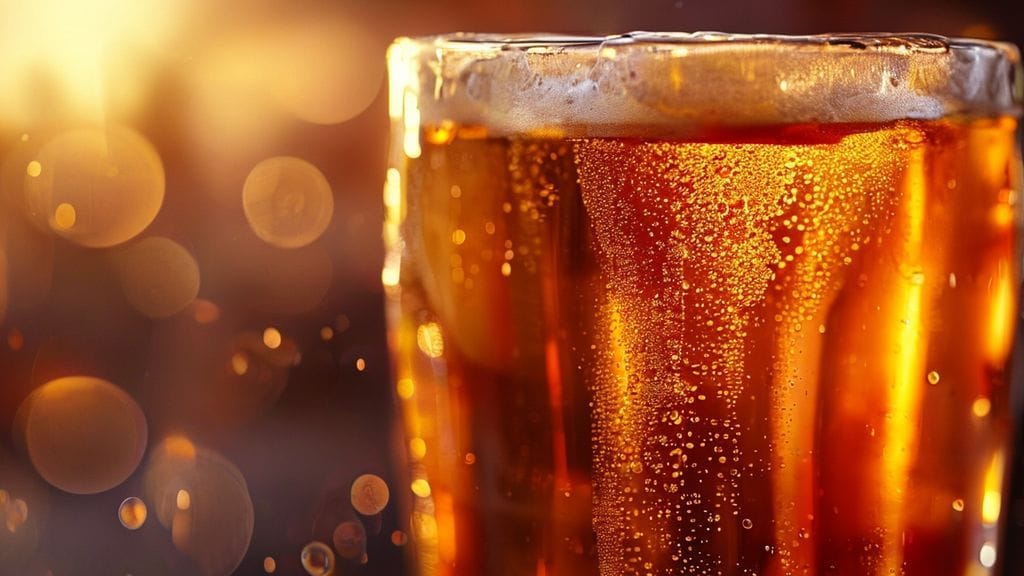
Cloning Brooklyn Lager at home demands precision, patience, and an understanding of nuanced malt and hop interplay. This guide delivers a tested, data-driven methodology to replicate its distinctive amber hue, balanced malt profile, crisp finish, and signature hop aroma, ensuring your brew captures the essence of this iconic lager with specific gravity, temperature, and ingredient details for optimal results.
| Metric | Target Value |
|---|---|
| Original Gravity (OG) | 1.052 |
| Final Gravity (FG) | 1.012 |
| Alcohol By Volume (ABV) | 5.2% |
| International Bitterness Units (IBU) | 28 |
| Standard Reference Method (SRM) | 12 |
| Mash Temperature | 66°C (151°F) |
| Fermentation Temperature | 12°C (54°F) |
| Lagering Temperature | 0-2°C (32-35°F) |
When I first set out to clone Brooklyn Lager, I made the rookie mistake of underestimating the subtlety of balance. My initial batches were either too bitter, too malty, or lacked that characteristic crispness I admired. It took me years of tweaking, countless hydrometer readings, and an almost obsessive attention to fermentation temperatures to truly understand what makes this beer shine. I learned that cloning a classic isn’t just about matching ingredients; it’s about replicating the processes that craft a specific sensory experience. This isn’t a simple ale, my friends; this is a lager, and it demands respect for the process. Through trial and error, I’ve honed this recipe to be as close to the real deal as I’ve ever brewed, focusing on precision that separates a good homebrew from an exceptional clone.
The Math: Calculating Your Clone’s Core
Precision in brewing starts long before the mash paddle hits the grain. For a complex lager like this, understanding your ingredient contribution and process efficiency is paramount. I always start with the numbers, calculating my expected gravities, bitterness, and color. For a 20-liter (5.28-gallon) batch, here’s how I break down the core components:
Grain Bill Breakdown (20L Batch)
Achieving that specific malt character and color requires a careful blend. Here’s my proven ratio:
| Grain | Weight (kg) | Weight (lb) | Percentage (%) | Color (SRM) |
|---|---|---|---|---|
| Weyermann Barke® Pilsner Malt | 3.50 | 7.72 | 75.0% | 1.5-2.5 |
| Weyermann Munich I Malt | 0.75 | 1.65 | 16.1% | 6-9 |
| Briess Crystal Malt 60L | 0.25 | 0.55 | 5.4% | 60 |
| Weyermann CaraRed® Malt | 0.15 | 0.33 | 3.2% | 40-50 |
| Total Grains | 4.65 kg | 10.25 lb | 100.0% |
Hop Bitterness Calculation (IBU)
For my bitterness calculations, I generally rely on the Tinseth formula, adjusted for my system’s typical utilization. To achieve **28 IBU**, I find this hop schedule works perfectly for a 20L batch:
- **30g Northern Brewer Hops (8.5% AA)** at 60 minutes.
- **15g Cascade Hops (6.0% AA)** at 15 minutes.
- **20g Cascade Hops (6.0% AA)** at 0 minutes (flameout/whirlpool for 10 minutes).
Example IBU Contribution Calculation for Northern Brewer (simplified):
IBU = (Hop Weight (g) * Alpha Acid % * Utilization % * 7490) / (Boil Volume (L) * (1 + (Gravity Correction Factor – 1) * (Boil Gravity / 1.050)))
For the 60 min Northern Brewer, assuming 25% utilization for my system and an average boil gravity of 1.045:
IBU ≈ (30 * 0.085 * 0.25 * 7490) / (23 L * (1 + (1.045/1.050 – 1) * 0.2)) ≈ **20 IBU**
I then add the contributions from the 15-minute and flameout additions, which have lower utilization but contribute significant aroma. This detailed approach ensures I hit my target IBU with consistency. This granular approach is vital for replicating commercial brews on a homebrew scale, and it’s something I always emphasize at BrewMyBeer.online.
Yeast Pitching Rate
For a lager of this gravity, proper yeast pitching is non-negotiable. Underpitching leads to extended fermentation times and off-flavors (acetaldehyde, diacetyl). I always aim for **1.5 million cells/mL/°P** (Plato) for lagers. Given our target OG of 1.052, which is approximately 13°P, for a 20L batch:
Total Cells Required = (Volume in mL) * (Plato) * (Pitching Rate)
Total Cells = (20,000 mL) * (13 °P) * (1.5 x 10⁶ cells/mL/°P) = **3.9 x 10¹¹ cells** (390 billion cells).
This typically means pitching 2-3 liquid yeast smack-packs or vials, or building a significant starter (2-3L for liquid yeast). I prefer using a starter to ensure peak cell viability.
Step-by-Step Execution: Brewing Your Brooklyn Lager Clone
This is where patience and precision truly pay off. Follow these steps meticulously, and you’ll be rewarded with a spectacular lager.
- Water Treatment: Start with quality water. I aim for a balanced profile for this style: Calcium (Ca2+) 50-75 ppm, Magnesium (Mg2+) 5-15 ppm, Sulfate (SO42-) 75-125 ppm, Chloride (Cl–) 50-100 ppm, and a residual alkalinity close to zero. Adjust with gypsum, calcium chloride, and lactic acid to target a mash pH of **5.2-5.4** at mash temperature.
- Mashing: Mill your grains well but avoid pulverizing the husks. Mash in with 12 liters (3.17 gallons) of water at **71°C (160°F)** to achieve a stable mash temperature of **66°C (151°F)**. Maintain this temperature for **60 minutes**. This single-infusion rest provides a fermentable wort while retaining body. My trick for consistency? A well-insulated mash tun and a temperature probe that reaches the center of the grain bed. Mash out by raising the temperature to **76°C (168°F)** for **10 minutes**.
- Sparge: Begin sparging with 18 liters (4.75 gallons) of water heated to **77°C (170°F)**. Collect approximately 23 liters (6.07 gallons) of pre-boil wort. Monitor your run-off, ensuring it remains clear. My goal is a pre-boil gravity of around 1.045-1.047.
- Boil: Bring your wort to a vigorous boil.
- At **60 minutes** (from the start of the boil), add **30g Northern Brewer Hops**.
- At **15 minutes**, add **15g Cascade Hops** and 1 tsp Irish Moss (or 1/2 tsp Whirlfloc) for clarity.
- At **0 minutes** (flameout), add **20g Cascade Hops**. Allow these to steep for 10 minutes as you begin chilling (whirlpool addition).
- After 60 minutes, turn off the heat.
- Chilling: Chill the wort rapidly to **10°C (50°F)**. I use an immersion chiller and aim to get below 20°C in under 20 minutes to minimize DMS formation and prevent cold-side oxidation. Transfer the chilled wort to your sanitized fermenter.
- Yeast Pitching & Fermentation: Aerate the wort thoroughly (oxygenation is key for lagers!). Pitch your prepared lager yeast (e.g., White Labs WLP830 German Lager or Wyeast 2124 Bohemian Lager) ensuring you hit that **390 billion cell** target. Ferment at a stable temperature of **12°C (54°F)** for 10-14 days.
- Diacetyl Rest: Once fermentation activity subsides and gravity is within 2-3 points of your target FG (usually around 1.014-1.015), raise the temperature to **18°C (64°F)** for 2-3 days. This critical step allows the yeast to reabsorb diacetyl and its precursors, preventing butterscotch or buttered popcorn off-flavors. Verify the absence of diacetyl with a forced diacetyl test before proceeding.
- Crash Cooling & Lagering: After the diacetyl rest, gradually reduce the temperature by 2-3°C per day until you reach **0-2°C (32-35°F)**. Maintain this lagering temperature for a minimum of **4-6 weeks**. This extended cold conditioning is paramount for clarity, flavor maturation, and smoothness. I’ve learned that rushing this step invariably leads to a less refined beer.
- Packaging & Carbonation: Rack the clear lager into a sanitized keg or bottles. For kegging, force carbonate to **2.5-2.7 volumes of CO2** at 2°C. For bottling, prime with 125g (4.4 oz) of dextrose per 20L batch to achieve a similar carbonation level, and allow 2-3 weeks at room temperature for conditioning before chilling.
Troubleshooting: What Can Go Wrong and How I Fix It
Even with meticulous planning, brewing can throw curveballs. Here are a few common issues I’ve encountered with lager clones and my solutions:
- High Diacetyl (Buttery Taste): This is the bane of many lager brewers. It typically stems from underpitching, insufficient aeration, or, most commonly, skipping or rushing the diacetyl rest. My fix: If detected, warm the beer back up to **18-20°C (64-68°F)** for several days, giving the yeast a chance to clean it up. Prevention is better – ensure proper pitching rates and always perform a diacetyl rest.
- Cloudiness/Haze: Lagers are expected to be brilliantly clear. Haze can be protein haze (from insufficient hot/cold break or poor lagering), chill haze, or yeast haze. I always use Irish Moss/Whirlfloc in the boil, chill rapidly, and extend lagering. If persistent, a gelatin fining (1/2 tsp in 1 cup of 70°C water, added to the fermenter at lagering temps) after primary fermentation can work wonders.
- Sulfur Aroma (“Rotten Egg”): A common characteristic of some lager yeasts, especially when fermentation is stressed or too cold. It often dissipates with extended lagering. If it persists, ensure adequate yeast health, proper pitching rates, and slightly higher fermentation temperatures (e.g., start at 12°C, then let it free rise to 14°C at the end of primary before the diacetyl rest).
- Stuck Fermentation: This usually comes down to poor yeast health, underpitching, or nutrient deficiencies. My first check is always temperature. If it’s too cold, gently warm it up a few degrees. If that doesn’t work, rouse the yeast by gently rocking the fermenter. In extreme cases, a fresh packet of highly viable yeast, rehydrated properly, may be needed.
Sensory Analysis: The Heart of the Clone
After all that work, the moment of truth arrives. Here’s what I look for to confirm I’ve nailed the Brooklyn Lager clone:
- Appearance: A radiant, brilliant amber, verging on copper, with exceptional clarity. When poured, it should form a persistent, dense, off-white head that leaves delicate lacing on the glass. There should be no visible haze or particulates, a testament to proper cold conditioning.
- Aroma: The initial sniff reveals a captivating blend of floral and spicy hop notes, courtesy of the Cascade and Northern Brewer. This is beautifully underpinned by a clean, bready, slightly toasty malt backbone. There’s a subtle caramel sweetness that adds complexity without being cloying. I’m looking for a total absence of fermentation by-products like diacetyl or acetaldehyde.
- Mouthfeel: Medium-bodied, with a smooth, almost creamy texture from the carbonation. It should feel crisp and refreshing, finishing dry without any lingering stickiness. The carbonation level of **2.5-2.7 volumes of CO2** provides a gentle effervescence that lifts the flavors.
- Flavor: The taste mirrors the aroma precisely. A clean, balanced malt profile of toasted bread and light caramel sweetness greets the palate, immediately followed by a firm, but not aggressive, hop bitterness that cleanses the mouth. The floral and slightly citrusy notes from the Cascade hops shine through in the finish. It’s a harmonious interplay, where no single element dominates, leading to a remarkably drinkable and satisfying lager. The finish is notably crisp and clean, inviting the next sip. This balance is what makes it so appealing, and it’s what I strive for in every batch I share on BrewMyBeer.online.
What’s the ideal lagering schedule for this clone?
After the diacetyl rest, I recommend a gradual crash to 0-2°C (32-35°F) over 3-5 days. Then, hold at this temperature for a minimum of 4-6 weeks. I’ve found that extending this period to 8 weeks often yields an even smoother, cleaner, and more polished beer, with superior clarity. Patience is truly a virtue here.
Can I use a different lager yeast?
While I highly recommend WLP830 or Wyeast 2124 for their authentic German/Bohemian lager profiles which align perfectly with Brooklyn Lager, you could experiment with other clean lager strains like WLP833 German Bock or Fermentis SafLager W-34/70. Just be aware that each yeast has unique fermentation characteristics and flavor contributions, so sensory results may vary. Always verify optimal fermentation temperatures for your chosen strain.
How important is water chemistry for a lager clone?
Water chemistry is absolutely critical for lagers. Its clean, crisp profile means there’s nowhere for off-flavors or imbalances to hide. Adjusting your water to a balanced profile with adequate calcium, moderate sulfates and chlorides, and targeting a mash pH of 5.2-5.4 ensures proper enzyme activity, optimal hop utilization, and a clean finished product. Don’t overlook this; it can make or break your lager.