


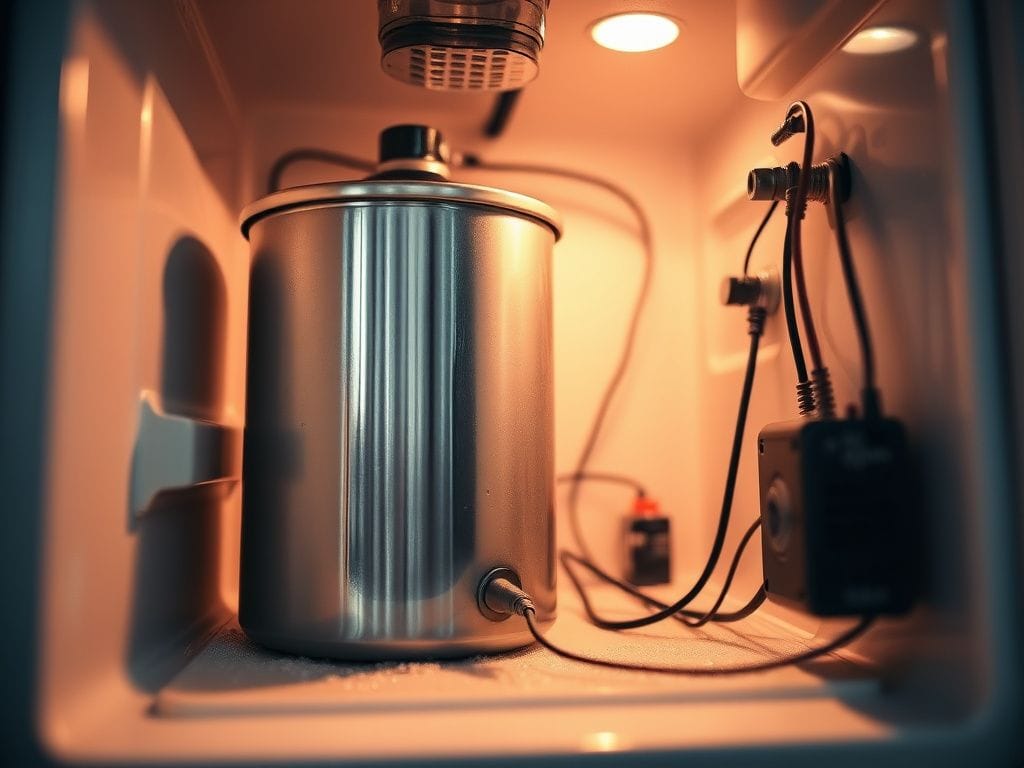
Optimize fermentation kinetics by converting a mini-fridge into a precise temperature-controlled chamber. This guide details component selection, wiring schematics, and calibration protocols for maintaining optimal yeast activity, mitigating off-flavors, and achieving consistent, high-quality beer. Master critical environmental parameters for superior batch integrity and repeatable brewing success.
Critical Components for Fermentation Chamber Construction
The efficacy of a temperature-controlled fermentation chamber hinges on the robust selection and precise integration of its constituent elements. This table delineates the core components, their functional requisites, and critical technical specifications for optimal system performance.
| Component | Primary Function | Technical Specification | Selection Criteria | Notes/Best Practices |
|---|---|---|---|---|
| Mini-Fridge/Freezer | Enclosure; Primary Cooling/Insulation | Internal Volume: 50-150 Liters; Max Fermenter Fitment: 6.5 Gal Carboy or 7.9 Gal Bucket; Defrost Type: Manual preferred (less internal temp fluctuation); Compressor Location: Rear-mounted preferred (clear internal space). | Internal dimensions must accommodate fermenter(s) plus necessary headspace for airlock/blow-off tube. Energy efficiency rating. Avoid models with excessive internal shelves/compartments that restrict space. | Ensure unit functions reliably prior to modification. Clean and sanitize thoroughly. Verify door seal integrity. |
| Digital Temperature Controller | Precise Temperature Sensing & Logic Control for Cooling/Heating | Input Power: 100-240VAC, 50/60Hz; Output Relay Current: 10A/120V (min); Temperature Range: -50°C to 99°C (-58°F to 210°F); Sensor Type: NTC Thermistor; Dual Relay: Heating & Cooling. | Models like Inkbird ITC-308 or STC-1000 are industry standards. Look for user-programmable hysteresis (differential), compressor delay protection, and calibration offset. UL/CE certifications are critical. | Consider models with an external waterproof probe. Mount externally for accessibility and to prevent moisture damage. Understand PID vs. ON/OFF control (most are ON/OFF for simplicity). |
| Heating Element | Temperature Elevation within Chamber | Power Output: 25W-75W; Voltage: 120V (matched to mains); Type: Fermentation Heat Wrap, Ceramic Heat Emitter, or Low-Wattage Incandescent Bulb. | Must provide gentle, even heat without creating hot spots. Safety is paramount; choose components designed for continuous operation. Avoid high-wattage sources that cause rapid temperature swings. | Heat wraps offer excellent surface area contact. Ceramic heaters are durable. Incandescent bulbs (e.g., 25W appliance bulb) are cost-effective but less efficient. Always position to avoid direct contact with fermenter plastic. |
| Temperature Probe / Thermowell | Accurate Measurement of Fermentation Temperature | Probe Material: Stainless Steel (food-grade); Probe Length: 6-12 inches (to reach fermenter core); Thermowell Material: Stainless Steel (304 or 316L); Seal: Food-grade silicone/EPDM. | Immersion directly into the fermenting wort via a thermowell is the gold standard for accuracy. Air temperature sensing is an acceptable, simpler alternative but less precise. | Clean and sanitize thermowell thoroughly before each use. Ensure probe is fully immersed in liquid for precise readings. Avoid air pockets in thermowell. |
| Electrical Components | Safe Power Distribution & Connection | Wire Gauge: 14-16 AWG stranded copper for main power; Outlets: NEMA 5-15R (Standard US 3-prong); Enclosure: NEMA rated plastic/metal box; Safety: GFCI receptacle recommended. | All components must be rated for the electrical load. Use insulated connectors (e.g., Wago, crimp terminals) for secure connections. A dedicated GFCI outlet significantly enhances safety. | Adhere to local electrical codes. If unsure, consult a licensed electrician. Proper strain relief on all cables entering/exiting enclosures is vital. Label all connections clearly. |
Fermentation Temperature Control: Key Calculations for Precision Brewing
Mastering fermentation temperature is not merely setting a value; it involves understanding the underlying physics and controlling the energetic dynamics within the chamber. These calculations are fundamental for precise, repeatable brewing.
1. Temperature Differential (Hysteresis) Calculation:
The controller’s differential (often labeled HD for Heating Differential, CD for Cooling Differential, or collectively as Hysteresis) dictates the permissible temperature fluctuation around your setpoint. This minimizes premature cycling of the compressor and heater, extending component life and maintaining a stable environment.
Example: For an Inkbird ITC-308 set to 18.0°C (64.4°F) with a Heating Differential (HD) of 1.0°C (1.8°F) and a Cooling Differential (CD) of 1.0°C (1.8°F):
- Heating Activation Threshold: Setpoint – HD = 18.0°C – 1.0°C = 17.0°C
- Cooling Activation Threshold: Setpoint + CD = 18.0°C + 1.0°C = 19.0°C
This establishes an operational range of 17.0°C to 19.0°C. For critical phases like lagering or fermenting sensitive strains, a tighter differential (e.g., 0.5°C) might be employed, accepting increased component cycling in favor of enhanced temperature stability.
2. Estimating Heat Energy for Wort Temperature Adjustment:
Understanding the energy required to modify your wort’s temperature helps assess the capabilities of your cooling/heating elements and anticipate operational times. The specific heat capacity of wort is approximately that of water.
The fundamental formula for heat energy (Q) transfer is:
Q = m × c × ΔT
Where:
- Q = Heat energy in Joules (J)
- m = Mass of wort/beer in kilograms (kg). Approximately 1 liter of wort is 1 kg.
- c = Specific heat capacity of wort/beer, approximately 4180 J/kg·°C (Joules per kilogram per degree Celsius).
- ΔT = Absolute change in temperature in degrees Celsius (°C).
Practical Application Example: Cooling Wort for Fermentation
Suppose you have 23 liters (approx. 23 kg) of wort at 28.0°C (82.4°F) that needs to be cooled down to a fermentation setpoint of 18.0°C (64.4°F).
- Mass (m): 23 kg
- Specific Heat (c): 4180 J/kg·°C
- Temperature Change (ΔT): |18.0°C – 28.0°C| = 10.0°C
Q = 23 kg × 4180 J/kg·°C × 10.0°C = 961,400 Joules (or 961.4 kJ)
This calculation reveals the total heat energy that the mini-fridge’s compressor must extract from the wort. A mini-fridge’s cooling capacity, typically measured in BTUs/hour or Watts, will determine how quickly this energy can be removed. For instance, a small mini-fridge might have a cooling capacity of around 50-100 Watts (approx. 170-340 BTU/hr). To remove 961.4 kJ (which is 267 Wh), a 100W cooling system would theoretically take 2.67 hours of continuous operation (excluding losses to ambient air and internal heat generation from fermentation). This highlights why pre-chilling wort to near fermentation temperature is crucial before transferring it to the chamber.
3. Yeast Metabolic Heat Generation:
Fermentation is an exothermic process. Yeast metabolism generates heat, especially during the vigorous primary fermentation phase. This internal heat can elevate wort temperature several degrees above ambient, potentially exceeding the chamber’s air temperature. While not a direct calculation, understanding this phenomenon is critical:
- For every 1° Brix (or Plato) of sugar fermented, approximately 20-25 kcal/liter of heat is generated.
- A typical 1.050 OG (12.5°P) wort fermented down to 1.010 FG (2.5°P) involves a 10°P drop. This could generate around 200-250 kcal/liter. For 20 liters, that’s 4,000-5,000 kcal, or roughly 16,700-20,900 kJ over the fermentation duration.
This substantial heat output underscores the necessity of a robust cooling system and, ideally, a thermowell for accurate wort temperature monitoring, as the air temperature within the chamber may not reflect the actual temperature within the fermenter.
The Definitive Master-Guide: Converting a Mini-Fridge into a Temperature-Controlled Fermentation Chamber
Precision temperature control is arguably the most impactful factor in achieving consistent, high-quality beer. Uncontrolled fermentation temperatures lead to a cascade of undesirable outcomes: off-flavors such as fusel alcohols, diacetyl, and excessive esters; sluggish or stalled fermentations; and inconsistent attenuation. By converting a standard mini-fridge into a dedicated fermentation chamber, brewers can mitigate these risks, allowing yeast to perform optimally and facilitating a vast expansion of stylistic possibilities, from crisp lagers to complex Belgians. This guide provides a granular, technical overview for constructing and operating such a system, ensuring professional-grade results.
1. Foundational Principles of Fermentation Temperature Control
Yeast are living organisms, and their metabolic activity is acutely sensitive to temperature. Each strain possesses an optimal temperature range where it produces the most desirable flavor compounds and attenuates efficiently. Deviations outside this range can stress the yeast, leading to the production of:
- Fusel Alcohols: Higher alcohols (e.g., propanol, isobutanol, isoamyl alcohol) produced at excessively high temperatures. They impart harsh, solvent-like, or burning sensations.
- Diacetyl: A buttery or butterscotch flavor, often a precursor to fermentation issues. While a small amount is acceptable in some styles, high levels are a defect. Yeast reabsorbs diacetyl, but this process is temperature-dependent.
- Esters: Fruity aromas (e.g., ethyl acetate, isoamyl acetate) are desirable in many ales but can become overwhelming or inappropriate at elevated temperatures. Conversely, too low a temperature can suppress ester formation when it is desired.
A controlled environment permits precise manipulation of these metabolic pathways, ensuring the yeast ferments cleanly and predictably. This is fundamental to crafting superior quality beer.
2. Component Selection and Technical Rationale
The success of your fermentation chamber begins with informed component selection. Each element plays a critical role in the system’s overall performance and longevity.
2.1. The Mini-Fridge/Freezer Enclosure
Technical Considerations:
- Internal Volume: The primary constraint. Ensure it accommodates your largest fermenter (e.g., 6.5-gallon carboy, 7.9-gallon bucket, or multiple smaller vessels) with adequate headspace for airlocks or blow-off tubes. Measure carefully.
- Compressor Hump: Many mini-fridges have a raised section at the bottom rear to house the compressor. This can severely limit usable space. Look for models with a flat bottom or a rear-mounted compressor that does not protrude significantly internally.
- Defrost Type: Manual defrost units are often simpler and cheaper, and their cooling coils are less prone to being damaged by modification. Auto-defrost units can introduce unwanted humidity and internal temperature fluctuations during defrost cycles.
- Insulation: Evaluate the door gasket for airtightness. A poor seal will lead to inefficient cooling/heating and higher energy consumption.
Modification Potential: For larger fermenters, some units may require door shelf removal or even cutting a small section out of the door plastic to allow for a taller airlock. Plan these modifications before purchase.
2.2. The Digital Temperature Controller
This is the brain of your system. Models like the Inkbird ITC-308 or STC-1000 are prevalent due to their cost-effectiveness and dual-relay functionality.
Technical Features:
- Dual Relay: Essential for simultaneous control of both heating and cooling elements. One relay activates the cooling (fridge compressor), the other the heating element.
- Hysteresis/Differential: Programmable setting that defines the acceptable temperature swing around your setpoint. A tighter differential offers greater precision but causes more frequent cycling; a wider differential reduces wear on components.
- Compressor Delay Protection: A crucial setting (e.g., 3-5 minutes) that prevents the compressor from short-cycling, which can damage the motor. The controller ensures a minimum delay between cooling cycles.
- Calibration Offset: Allows fine-tuning of the probe’s reading against a known accurate thermometer.
- Alarm Functions: High/low temperature alarms can alert you to deviations.
- Probe Type: NTC thermistor probes are common. Ensure it’s waterproof if intended for immersion.
PID vs. ON/OFF: Most affordable brewing controllers are ON/OFF (bang-bang) controllers, meaning they simply turn the heating/cooling element fully on or fully off when a threshold is met. PID (Proportional-Integral-Derivative) controllers offer more sophisticated, modulated control but are generally more expensive and complex to tune. For most homebrewing applications, an ON/OFF controller with a small hysteresis is entirely sufficient.
2.3. The Heating Element
Fermentation is exothermic, but often ambient temperatures are too low, or specific fermentation schedules require warming (e.g., diacetyl rests, warmer ale fermentations). A low-wattage heat source is ideal.
Recommended Types:
- Fermentation Heat Wraps: These flexible silicone or plastic wraps gently warm the fermenter directly. They typically range from 25W-40W and provide even heating.
- Ceramic Heat Emitters: Used in reptile husbandry, these produce radiant heat without light. They are robust and come in various wattages (e.g., 40W-60W).
- Low-Wattage Incandescent Bulbs: A simple, inexpensive option (e.g., 25W-40W appliance bulb) in a suitable fixture. However, they are less efficient and generate light, which can degrade hops.
Safety & Placement: Always ensure the heater is positioned to avoid direct contact with plastic fermenters, which could melt. Place it below or alongside the fermenter, ensuring adequate air circulation. Never use high-wattage space heaters, as they can rapidly overheat the fermenter.
2.4. Temperature Probe and Thermowell
Accurate temperature measurement is paramount. The probe’s placement significantly impacts this accuracy.
Probe Placement Options:
- Immersion in Thermowell (Gold Standard): A stainless steel thermowell inserted directly into the fermenter through a stopper or lid allows the probe to measure the actual wort temperature. This accounts for metabolic heat generation and provides the most precise control. Ensure the thermowell is properly sealed and sanitized.
- Taped to Fermenter Side: The probe can be taped to the side of the fermenter, insulated with foam or bubble wrap. This provides a decent approximation of wort temperature, though it will lag slightly.
- Free-Air Sensor: The probe simply hangs freely inside the chamber. This measures ambient air temperature, which is significantly less accurate than wort temperature, especially during active fermentation when the wort can be several degrees warmer than the surrounding air due to exothermic reactions. Use of an internal circulation fan (see 2.6) can help minimize this differential.
Material: Stainless steel probes and thermowells are preferred for durability and ease of sanitization. Ensure any probe used for immersion is fully waterproof.
2.5. Wiring & Electrical Safety
This is a critical safety aspect. If you are uncomfortable with basic electrical wiring, consult a qualified electrician or purchase pre-wired controllers.
Key Principles:
- Wire Gauge: Use appropriate wire gauge (e.g., 14-16 AWG stranded copper) for the current draw.
- Enclosures: Mount all electrical connections in a suitable electrical box (e.g., NEMA rated plastic junction box) to prevent accidental contact.
- GFCI Protection: Always plug your entire system into a Ground Fault Circuit Interrupter (GFCI) outlet. This protects against electric shock in the event of a fault, especially crucial in humid brewing environments.
- Strain Relief: Ensure all cables entering and exiting enclosures have proper strain relief to prevent accidental disconnection or damage to internal wiring.
- Clear Labeling: Label all wires and outlets clearly (e.g., “Cooling,” “Heating,” “Power In”).
2.6. Internal Air Circulation Fan (Optional but Recommended)
A small computer fan (e.g., 80mm or 120mm, 12V DC with an adapter) can be installed to circulate air within the chamber. This equalizes the internal air temperature, reducing stratification and ensuring more uniform cooling/heating, especially if using an air-temperature probe.
Placement: Position the fan to blow air around the fermenter, ideally drawing from the bottom and expelling towards the top, or across the cooling fins. Ensure it doesn’t impede fermenter placement.
3. Construction and Assembly Protocols
Methodical assembly ensures both functionality and safety.
3.1. Pre-Assembly Checklist
- Gather all components: Mini-fridge, temperature controller, heating element, probe/thermowell, electrical box, outlets, wire, plugs, wire connectors, tools (wire strippers, screwdrivers, multimeter).
- Read manuals for all components, especially the temperature controller and mini-fridge.
- Plan the layout: Where will the controller be mounted? How will wires enter/exit the fridge?
3.2. Mini-Fridge Preparation
- Cleaning: Thoroughly clean and sanitize the interior.
- Defrost: Ensure the unit is fully defrosted and dry if it’s been in storage.
- Drainage: If the mini-fridge has a drain hole, consider capping it or ensuring it drains outside the chamber to prevent unwanted temperature fluctuations or moisture ingress.
- Internal Modifications: Remove shelves, crisper drawers, or other obstructions. If necessary, trim internal plastic (e.g., door shelves) to fit your fermenter.
- Grommet Installation: Drill a small hole (e.g., 1/2″ or 3/4″) on the side or top of the fridge for the controller probe wire and the heater/fan power cord to pass through. Install a rubber grommet to protect wires and maintain the seal. Avoid drilling near cooling lines (often visible as bumps or lines on the internal walls).
3.3. Controller Wiring and Enclosure
This section outlines typical wiring for an Inkbird ITC-308, which simplifies the process with pre-wired plugs and receptacles. For STC-1000 or similar bare-wire controllers, a custom outlet box is required.
For an Inkbird ITC-308 (Pre-wired Model):
- Power In: Plug the Inkbird directly into a GFCI wall outlet.
- Cooling Outlet: Plug the mini-fridge’s power cord into the Inkbird’s “Cooling” receptacle.
- Heating Outlet: Plug the heating element’s power cord into the Inkbird’s “Heating” receptacle.
- Probe: Insert the probe into the dedicated port on the Inkbird.
- Routing: Route the probe and heater/fan power cords through the grommeted hole into the fridge.
For a Bare-Wire Controller (e.g., STC-1000, or wiring a custom box for ITC-308 without pre-wired plugs):
- Safety First: DISCONNECT ALL POWER before wiring.
- Build an Outlet Box: Obtain a project box (e.g., plastic electrical enclosure), a male plug (for wall power), and two female receptacles (one for cooling, one for heating).
- Wiring Diagram (General STC-1000 Example – Refer to Specific Controller Manual):
- Line (Live) from Wall Plug: Connect to L terminal on both receptacles AND the L terminal on the STC-1000’s input.
- Neutral from Wall Plug: Connect to N terminal on both receptacles AND the N terminal on the STC-1000’s input.
- Ground: Connect the ground wire from the wall plug to the ground terminals on both receptacles and ensure any metal box is grounded.
- STC-1000 Output: Connect the cooling output (e.g., Terminal 5) to the switched live (hot) terminal of the “Cooling” receptacle. Connect the heating output (e.g., Terminal 6) to the switched live (hot) terminal of the “Heating” receptacle.
- Power to STC-1000: Connect Live and Neutral from the main power input to the STC-1000’s power terminals (e.g., 1 & 2).
- Verification: Double-check all connections with a multimeter for continuity and correct polarity.
3.4. Heater and Fan Installation
- Heater: Place the heating element at the bottom or side of the chamber, ensuring it’s not obstructed by the fermenter. Secure it if necessary (e.g., using zip ties or mounting tape for heat wraps).
- Fan (if used): Mount the fan using zip ties or screws to circulate air. Ensure its power adapter (if 12V DC) is plugged into one of the controlled outlets or directly into a dedicated power source.
3.5. Probe Placement
- Thermowell: If using a thermowell, sanitize it, insert it into the fermenter, then insert the probe into the thermowell. Ensure the probe tip is fully submerged in the wort for maximum accuracy.
- External/Side Taping: If taping, secure the probe firmly to the fermenter side, ideally midway up the liquid level. Insulate the probe and contact point with a small piece of foam or bubble wrap to shield it from ambient air temperature fluctuations.
4. Calibration and Commissioning
Before entrusting your wort to the chamber, meticulous calibration and testing are essential.
4.1. Probe Calibration
Even factory-calibrated probes can drift or have slight inaccuracies. Verify its reading against a known accurate thermometer.
- Ice Bath Method: Immerse the probe tip and a known accurate thermometer into a slushy ice bath (distilled water and crushed ice). The temperature should be 0.0°C (32.0°F). If your controller reads differently, use its calibration offset function to adjust.
- Warm Water Method: Use a precisely measured warm water bath (e.g., 20.0°C) with a calibrated reference thermometer for comparison.
4.2. Controller Parameter Configuration
Access the controller’s menu (refer to its manual) and configure the following:
- Setpoint (SV): Your target fermentation temperature (e.g., 18.0°C for an ale).
- Cooling Differential (CD) / Heating Differential (HD) / Hysteresis: Start with a value like 1.0°C (1.8°F). This means cooling activates at Setpoint + 1°C, and heating at Setpoint – 1°C. Adjust this based on observed stability.
- Compressor Delay (PT): Set this to 3-5 minutes (e.g., 3m). This prevents the compressor from rapid cycling, which can cause damage.
- High/Low Temperature Alarms (AH/AL): Configure these to alert you if the temperature deviates significantly.
- Temperature Unit (CF): Select Celsius or Fahrenheit.
4.3. Initial Test Run
Run the empty chamber for at least 24-48 hours before loading it with wort.
- Monitor Stability: Observe how well the chamber maintains the setpoint. Note the temperature fluctuations and the frequency of heating/cooling cycles.
- Adjust Hysteresis: If the temperature is too erratic, try tightening the hysteresis. If components are cycling excessively, widen it slightly.
- Verify Functionality: Ensure both heating and cooling elements activate as expected.
5. Operational Protocols & Advanced Fermentation Strategies
With the chamber commissioned, you can now optimize your fermentation schedules.
5.1. Yeast Health and Metabolic Control
Precise temperature control fosters robust yeast health, minimizing the production of off-flavors. During the lag phase and early primary fermentation, consistent temperature is crucial for healthy cell division and initial flavor compound formation. Later in fermentation, temperature manipulation can fine-tune the flavor profile.
5.2. Fermentation Schedules
Your chamber unlocks the ability to execute complex fermentation schedules.
- Ale Fermentations: Start at the lower end of the yeast’s optimal range (e.g., 18°C) to produce cleaner profiles. As fermentation progresses, you can gradually raise the temperature (e.g., 1°C per day) to ensure full attenuation and encourage yeast reabsorption of diacetyl.
- Lager Fermentations: True lagers demand strict cold fermentation (e.g., 10-14°C) followed by an optional diacetyl rest (a brief rise to 18-20°C for 24-48 hours to allow yeast to clean up diacetyl) before lagering (cold conditioning) at near-freezing temperatures for extended periods. This level of control is impossible without a chamber.
- Cold Crashing: After fermentation and diacetyl rest (if applicable), drop the temperature to 0-4°C (32-39°F) for several days. This causes yeast and other particulates to drop out of suspension, resulting in clearer beer and faster conditioning.
5.3. Seasonal Adjustments and Environmental Factors
Ambient room temperature will affect the chamber’s performance. In a hot garage, the cooling element will work harder; in a cold basement, the heater will be more active. If your chamber struggles to maintain temperature, consider additional external insulation for the fridge or moving it to a more temperate location.
5.4. Maintenance
- Cleaning: Regularly clean the interior to prevent mold or bacterial growth.
- Probe Sanitization: If using a thermowell, sanitize it rigorously before each use.
- Electrical Checks: Periodically inspect wiring for damage or loose connections. Test the GFCI outlet monthly.
5.5. Troubleshooting Common Issues
- Temperature Fluctuations: Check probe placement (is it immersed?), adjust hysteresis, verify door seal, ensure fridge condenser coils are clean.
- Controller Errors: Consult the manual for error codes. Common issues include sensor disconnection (E1/E2) or over-range readings.
- Components Not Activating: Check power connections, ensure the controller is plugged in, verify the heating/cooling device is plugged into the correct controller receptacle, and check fuses/breakers.
- Excessive Compressor Cycling: Increase compressor delay, increase hysteresis.
6. Benefits and Impact on Beer Quality
The conversion of a mini-fridge into a fermentation chamber offers immediate, tangible benefits to your brewing process and the final product.
- Consistency and Replicability: By controlling temperature, you eliminate one of the largest variables in brewing. This means repeatable results for your favorite recipes and greater confidence when experimenting.
- Superior Flavor Profiles: Off-flavors like fusel alcohols or diacetyl are drastically reduced or or eliminated. Yeast produces its intended flavor profile, leading to cleaner, crisper, and more balanced beers. Specific BJCP Style Guidelines often stipulate narrow fermentation temperature ranges to achieve characteristic profiles.
- Expanded Style Repertoire: Lagers, true pilsners, clean California Common beers, and specific Belgian styles (where controlled temperature ramps are crucial) become achievable. Cold crashing becomes a precise and controlled process.
- Yeast Management: Healthier yeast translates to more complete fermentations, better attenuation, and potentially easier harvesting for future generations.
- Professional-Grade Results: This setup bridges the gap between basic homebrewing and professional craft brewing, delivering a level of control previously accessible only to commercial operations. Discover more ways to enhance your home brewery by exploring our comprehensive resources.
Conclusion
The conversion of a mini-fridge into a temperature-controlled fermentation chamber is a pivotal upgrade for any aspiring or serious homebrewer. It represents a relatively modest investment of time and resources for an exponential return in beer quality, consistency, and creative freedom. By understanding the technical underpinnings, adhering to safe assembly practices, and mastering the operational protocols outlined in this guide, you equip yourself with a tool capable of elevating your brewing craft to its highest potential. Brew with precision, brew with confidence, and enjoy the fruits of perfectly controlled fermentation.