

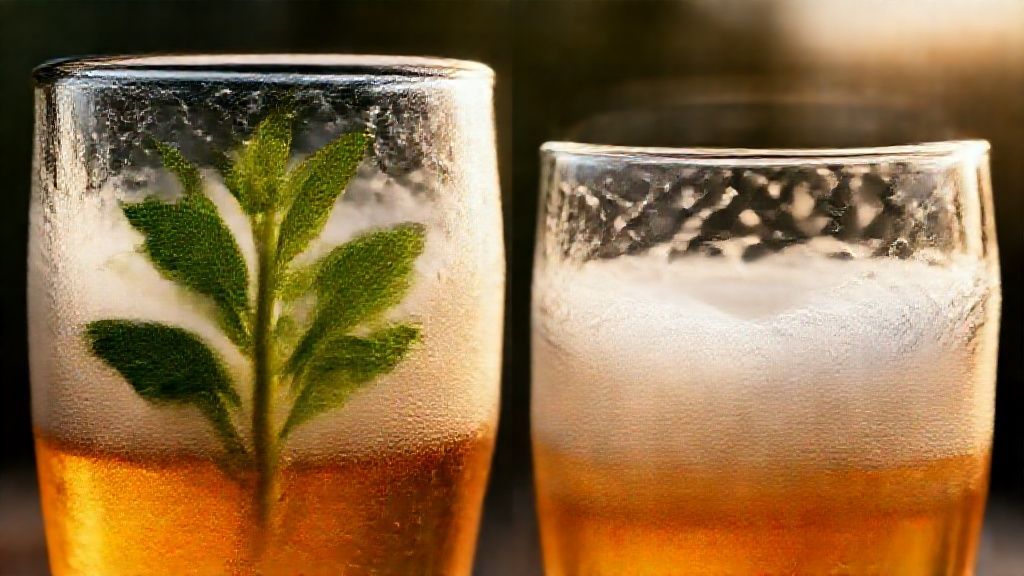
Choosing between a Ginger Beer Plant (GBP) and traditional brewing yeast for your hard ginger beer means fundamentally different fermentation journeys and end-product characteristics. My experience shows GBP delivers a complex, nuanced profile with unique microbial notes, while yeast provides predictable attenuation, cleaner flavors, and greater control over ABV. Both methods yield excellent results, but their processes and sensory outcomes are distinct.
| Metric | GBP Hard Ginger Beer | Ale Yeast Hard Ginger Beer |
|---|---|---|
| Target Original Gravity (OG) | 1.045 – 1.060 | 1.050 – 1.070 |
| Target Final Gravity (FG) | 1.005 – 1.015 (variable) | 1.000 – 1.008 (predictable) |
| Estimated ABV Range | 4.0% – 6.0% | 5.0% – 8.0% |
| Fermentation Time (Primary) | 5 – 10 days | 4 – 7 days |
| Ideal Fermentation Temp | 20°C – 25°C (68°F – 77°F) | 18°C – 22°C (64°F – 72°F) |
| Culture Type | Symbiotic Community (Bacteria & Yeast) | Monoculture Yeast (e.g., Saccharomyces cerevisiae) |
| Flavor Profile Tendency | Complex, tart, slightly funky, rustic ginger | Clean, crisp, pronounced ginger, often fruitier (ale) or neutral (champagne) |
| Carbonation Method | Bottle priming with sugar (secondary GBP activity) | Bottle priming with sugar (residual yeast activity) |
The Brewer’s Hook: My Journey into Hard Ginger Beer Fermentation
When I first ventured into hard ginger beer, I, like many homebrewers, gravitated towards what I knew best: brewing yeast. It was predictable, reliable, and my batches came out consistently good. My first significant mistake, however, was thinking that yeast was the *only* way to achieve a complex, boozy ginger concoction. I remember a particularly clean batch I made with a neutral ale yeast – technically perfect, but it lacked a certain something, a depth I couldn’t quite pinpoint. It was crisp, bright, and ginger-forward, but almost too “clean,” like a professionally made soft drink with alcohol added. I started hearing whispers about the Ginger Beer Plant (GBP) from other fermentation enthusiasts, a mysterious culture touted for its unique flavors and symbiotic nature.
My initial foray into GBP was messy. I didn’t understand its needs, underfed it, and ended up with a sluggish, sour batch that barely attenuated. It was a learning curve, to say the least. But after much experimentation, countless batches, and meticulous note-taking, I discovered the true magic of GBP: the nuanced, almost effervescent complexity that a monoculture yeast simply can’t replicate. It wasn’t about one being “better” than the other; it was about understanding the distinct character each brings to the final product. Now, when I design a hard ginger beer, the first decision I make isn’t about the ginger quantity, but about the *fermentation culture*. It fundamentally dictates the sensory profile I’m aiming for.
The Fermentation Math: Calculating Your Hard Ginger Beer’s Potential
Understanding the math behind your hard ginger beer is crucial for consistency and achieving your target ABV. Whether you’re using GBP or yeast, the principles of specific gravity and sugar conversion remain the same.
ABV Calculation Manual Guide
The most common formula for calculating Alcohol by Volume (ABV) from specific gravity readings is:
ABV % = (Original Gravity - Final Gravity) * 131.25
Let’s illustrate with an example for both methods:
- GBP Example:
- Original Gravity (OG) = 1.055
- Final Gravity (FG) = 1.010
- ABV % = (1.055 – 1.010) * 131.25 = 0.045 * 131.25 = 5.91%
- Yeast Example:
- Original Gravity (OG) = 1.065
- Final Gravity (FG) = 1.003
- ABV % = (1.065 – 1.003) * 131.25 = 0.062 * 131.25 = 8.14%
Sugar Concentration for Target OG
To hit your target Original Gravity, you need to know how much sugar to add. Sucrose (table sugar) contributes approximately 46 gravity points per kilogram in 10 liters of liquid (or 4.6 gravity points per kilogram per liter). For example:
If you want to hit an OG of 1.050 (50 gravity points) for a 5-liter batch:
- Target Gravity Points = 50
- Volume = 5 liters
- Total Gravity Points needed = 50 * 5 = 250
- Sugar factor for sucrose (approx.) = 46 gravity points per kg per 10L, so 4.6 gravity points per kg per 1L.
- Total sugar (kg) = Total Gravity Points needed / (4.6 * Volume in Liters) – *correction needed for consistent units*.
Let’s simplify: 1 kg of sucrose in 1 liter of water will yield an SG of approx. 1.385. This is too concentrated. For brewing, we think in terms of how much sugar for a given *volume of finished wort* to reach specific gravity.
A more practical approach: Approximately 250 grams of sucrose per liter will yield an OG of around 1.100. So, to hit 1.050 in a 5-liter batch, you need approximately:
- Target OG points = 50
- For 1 liter, you’d need roughly 50/1000 * 250g = 12.5g of sugar per liter for 1.050.
- For a 5-liter batch, you would need 12.5g/L * 5L = 625 grams of sugar. (This is a rough estimate and will vary with other wort constituents and sugar purity, always verify with a hydrometer).
This allows me to scale my recipes accurately, ensuring my hard ginger beer hits its intended strength, whether I’m working with GBP or a precise yeast pitch.
Step-by-Step Execution: Brewing Hard Ginger Beer Two Ways
Here, I’ll walk you through my preferred methods for brewing hard ginger beer, highlighting the critical differences between using a Ginger Beer Plant and traditional yeast.
Method 1: The Ginger Beer Plant (GBP) Approach
This method yields a complex, traditionally flavored hard ginger beer with a unique microbial tang.
- Prepare the Ginger Base:
- Grate or finely chop 100-150g fresh ginger (no need to peel if organic).
- Juice 2-3 lemons.
- In a large pot, combine 4-5 liters of filtered water, the ginger, lemon juice, and 500-750g granulated sugar (sucrose). Adjust sugar based on your target OG; for 5L, 625g gives around 1.050.
- Bring to a boil, then reduce heat and simmer for 15-20 minutes. This extracts flavor and dissolves the sugar fully.
- Remove from heat, strain out the ginger pulp, and allow the liquid to cool completely to below 25°C (77°F). Cooling rapidly in an ice bath is ideal to prevent contamination.
- Reactivate/Prepare GBP:
- Ensure your GBP is active and healthy. I typically feed mine a mixture of 1 tbsp sugar and 1 tbsp grated ginger in 250ml of water every 24-48 hours.
- Gently rinse 50-100g of active GBP grains (the ‘plant’) in clean water if they’ve been stored in a sugary solution.
- Inoculation:
- Pour your cooled ginger wort into a sanitized fermentation vessel (e.g., a glass carboy or food-grade bucket).
- Add the rinsed GBP grains to the wort.
- Seal the fermenter with an airlock.
- Fermentation:
- Place the fermenter in a stable environment between 20°C – 25°C (68°F – 77°F).
- Fermentation will typically begin within 24-48 hours, showing gentle bubbling in the airlock. GBP fermentation is often slower and less vigorous than yeast-only fermentation.
- Allow to ferment for 5-10 days, or until bubbling significantly slows and your hydrometer reading stabilizes at your target FG (e.g., 1.005 – 1.015).
- Bottling & Secondary Fermentation:
- Carefully strain the fermented ginger beer to remove the GBP grains (which can be reused immediately for your next batch or stored).
- Add priming sugar to achieve desired carbonation. For a 5-liter batch, 30-40g of dextrose (corn sugar) is a good starting point for moderate carbonation. Dissolve it in a small amount of hot water, cool, and add to the bottling bucket.
- Bottle into clean, strong glass bottles (swing-tops or crown-cap).
- Allow to condition at room temperature (20°C – 22°C or 68°F – 72°F) for another 3-7 days. Check carbonation regularly by gently opening one bottle.
- Once carbonated, transfer to cold storage (2°C – 5°C or 35°F – 41°F) to halt further fermentation and improve clarity.
Method 2: The Ale Yeast Approach
This method provides a cleaner, more predictable hard ginger beer, allowing for greater control over the final flavor profile and higher ABV.
- Prepare the Ginger Wort:
- Grate or finely chop 150-200g fresh ginger (can be slightly more for a stronger ginger punch).
- Juice 3-4 lemons.
- In a large pot, combine 4-5 liters of filtered water, ginger, lemon juice, and 700g – 1kg granulated sugar. I often push sugar content higher here to achieve a stronger final product.
- Bring to a boil, reduce heat, and simmer for 20-30 minutes.
- Strain out ginger pulp. Take an OG reading with your hydrometer.
- Cool the wort rapidly to 18°C – 22°C (64°F – 72°F) using an immersion chiller or an ice bath. This is critical for yeast health and preventing off-flavors.
- Sanitization & Yeast Pitching:
- Ensure your primary fermenter, airlock, and all tools are meticulously sanitized.
- Transfer the cooled wort to the fermenter.
- Rehydrate your chosen yeast strain according to manufacturer instructions. For a clean, crisp ginger beer, I recommend a neutral ale yeast like Safale US-05 or a champagne yeast (e.g., Lalvin EC-1118 for very dry, high ABV).
- Pitch the rehydrated yeast directly into the wort.
- Seal the fermenter with an airlock.
- Fermentation:
- Maintain a stable fermentation temperature between 18°C – 22°C (64°F – 72°F). Temperature control is paramount for clean yeast fermentation.
- Primary fermentation will typically be vigorous, with strong airlock activity within 12-24 hours.
- Allow to ferment for 4-7 days, or until airlock activity ceases and your hydrometer reading is stable (e.g., 1.000 – 1.008) for two consecutive days.
- Bottling & Carbonation:
- Siphon the fermented ginger beer into a sanitized bottling bucket, leaving behind any yeast sediment.
- Add priming sugar. For a 5-liter batch, 40-50g of dextrose is typical for a good carbonation level.
- Bottle into clean, strong glass bottles.
- Allow to condition at room temperature (20°C – 22°C or 68°F – 72°F) for 7-14 days. Patience is key here.
- Once carbonated, chill thoroughly to halt fermentation and ensure stability.
Troubleshooting: What Can Go Wrong and How to Fix It
Even with years of experience, I encounter issues. Here’s a breakdown of common problems and my solutions for both methods.
Ginger Beer Plant (GBP) Specific Issues
- Sluggish or Stalled Fermentation:
- Cause: Underfed GBP, too cold, lack of nutrients, or overly chlorinated water.
- Fix: Ensure GBP is robustly active before pitching. Check temperature (aim for 22°C). Feed with fresh ginger and sugar. Use filtered or boiled-then-cooled water. If stalled, warm slightly and gently swirl to rouse the culture.
- Sour or Vinegary Taste (Excessive):
- Cause: Over-fermentation by acetic acid bacteria, often due to too much oxygen exposure or prolonged fermentation in a warm environment.
- Fix: Ferment with an airlock to limit oxygen. Bottle at target FG. Consider reducing fermentation time if consistently too sour.
- Mold Growth:
- Cause: Contamination from airborne spores, unhygienic equipment, or inactive GBP.
- Fix: Immediately discard any batch with visible mold. Sanitize everything religiously. Ensure your GBP is healthy and active, as a strong culture resists invaders.
Ale Yeast Specific Issues
- Stalled Fermentation:
- Cause: Too low temperature, insufficient yeast pitch, nutrient deficiency, or high alcohol tolerance reached.
- Fix: Increase temperature to the higher end of the yeast’s range (e.g., 22°C for US-05). Swirl fermenter gently. If below target FG, consider re-pitching with a fresh, active yeast starter or a high-tolerance “super yeast.” Add yeast nutrient if suspecting deficiency.
- Off-Flavors (Diacetyl, Acetaldehyde, Fusel Alcohols):
- Cause: Diacetyl (buttery/butterscotch) from premature chilling or poor yeast health. Acetaldehyde (green apple) from young beer or inadequate conditioning. Fusels (harsh, solventy) from too high fermentation temperatures (above 22°C for most ale yeasts) or under-pitching.
- Fix: For diacetyl, perform a “diacetyl rest” by warming the beer to 20°C – 22°C for a few days before chilling. For acetaldehyde, allow more conditioning time. For fusels, meticulously control fermentation temperature and ensure proper yeast pitch rates.
- Under-Attenuation (Sweet Beer):
- Cause: Yeast strain with low attenuation, insufficient fermentable sugars, or stressed yeast.
- Fix: Choose a highly attenuative yeast (e.g., champagne yeast for very dry). Ensure adequate pitching rate. Warm up fermentation slightly to encourage yeast activity.
General Hard Ginger Beer Issues
- Lack of Carbonation:
- Cause: Insufficient priming sugar, too low bottle conditioning temperature, or leaky bottle caps.
- Fix: Ensure correct priming sugar amount. Condition bottles at a warm temperature (20°C – 22°C). Verify bottle seals. Sometimes, patience is the only cure – wait another week or two.
- Over-Carbonation (Bottle Bombs):
- Cause: Too much priming sugar, bottling before fermentation is complete (too high FG), or warm storage.
- Fix: Always take a stable FG reading before bottling. Calculate priming sugar carefully. Store carbonated bottles in the cold to slow or halt fermentation. If you suspect over-carbonation, slowly burp bottles by briefly opening them, then chill immediately.
Sensory Analysis: The Distinct Profiles
My palate has become attuned to the subtle differences these two fermentation methods impart. It’s not just about alcohol; it’s about the entire sensory experience.
GBP Hard Ginger Beer: A Rustic, Complex Charm
- Appearance: Typically presents as hazy, often with a fine particulate suspension, especially if not cold-crashed for an extended period. The color ranges from pale straw to a light golden, effervescent with small, lively bubbles.
- Aroma: The nose is a delightful blend of pungent, fresh ginger and bright lemon, underscored by a unique, slightly funky or earthy aroma that I associate with the mixed microbial culture. There can be subtle notes of dried fruit or a faint, pleasing tartness, almost like a mild kefir.
- Mouthfeel: Zippy and lively, with a high degree of carbonation that tingles on the tongue. It often feels lighter-bodied, crisp, and refreshing, with a clean finish despite the initial complexity. The acidity contributes to a pleasant dryness.
- Flavor: Dominated by a bold, natural ginger kick, which is beautifully balanced by a tangy lemon zest. The distinctive GBP culture contributes a complex ‘yeasty-tart’ background, sometimes reminiscent of sour candies or even subtle lactic notes. It’s less “clean” than a yeast-only version, offering a more rustic, nuanced, and evolving flavor experience. The sweetness can vary, but I often aim for a semi-dry finish to highlight the GBP character.
Ale Yeast Hard Ginger Beer: Clean, Predictable, and Potent
- Appearance: Often clearer than GBP versions, especially with fining agents or extended cold conditioning. The color is typically bright golden, with vigorous carbonation that forms a pleasant head, though it may not be as persistent as some traditional beers.
- Aroma: The ginger aroma is typically more singular and pronounced, a purer expression of the root, unclouded by other microbial notes. Lemon notes are clean and distinct. Depending on the yeast, I might pick up subtle fruity esters (apple, pear) from an ale yeast, or an almost entirely neutral aroma if using champagne yeast.
- Mouthfeel: Crisp and often drier than GBP, with a medium body that carries the alcohol more distinctly. The carbonation is usually strong and consistent, contributing to a refreshing, clean palate. It feels substantial yet refreshing.
- Flavor: The ginger flavor is upfront and unadulterated, often with a pleasant spicy warmth. The lemon adds a bright, zesty counterpoint. The fermentation profile is very clean; any yeast character is typically subtle and complementary. The overall impression is one of directness and purity, allowing the quality of the base ingredients to shine. Depending on my yeast choice, I can make this extremely dry and boozy, or leave a hint of residual sweetness for balance. This method gives me precise control over the final sweetness and alcohol.
Understanding these differences is key to crafting the hard ginger beer you truly desire. Both offer fantastic results, but they cater to different palates and brewing philosophies. For more detailed guides on optimizing your fermentation, I often consult the resources at BrewMyBeer.online.
Frequently Asked Questions
Can I combine Ginger Beer Plant and traditional yeast in one brew?
While technically possible, I generally advise against it for a single-stage primary fermentation unless you have a very specific outcome in mind. The GBP is a complex symbiotic culture, and pitching a large quantity of a single yeast strain can disrupt its delicate balance, potentially leading to unpredictable results or off-flavors. If you want to leverage both, consider a two-stage approach: ferment with GBP for a few days to develop its unique character, then rack the liquid off the GBP grains and pitch a specific yeast strain (e.g., champagne yeast) to finish fermentation to a higher ABV or achieve a drier profile. This allows each culture to express itself without direct competition during primary fermentation.
What’s the best yeast strain for a clean, high-ABV hard ginger beer?
For a clean, high-ABV hard ginger beer, I consistently recommend two strains based on my own experience. For a truly neutral fermentation that lets the ginger and lemon shine, Lalvin EC-1118 (Champagne Yeast) is an excellent choice. It has a high alcohol tolerance (up to 18%) and attenuates almost completely, leaving a very dry finish. If you prefer a subtle hint of fruitiness and a slightly less aggressive fermentation while still achieving good attenuation and ABV, Safale US-05 (American Ale Yeast) is a solid performer. It ferments cleanly at cooler temperatures and handles higher gravities well, typically reaching 6-8% ABV comfortably.
How do I control the alcohol content when brewing with GBP?
Controlling ABV with GBP can be a bit more art than science compared to yeast, but it’s certainly manageable. The primary levers are the amount of sugar in your initial wort (determining the OG) and the duration of fermentation. More sugar means higher potential alcohol. However, GBP’s attenuation can be variable. My strategy involves: 1) Starting with a known OG (e.g., 1.050-1.060). 2) Fermenting until airlock activity visibly slows or for a consistent number of days (e.g., 7 days). 3) Taking a final gravity (FG) reading before bottling. The GBP typically ferments down to an FG of 1.005-1.015, yielding 4-6% ABV. If you want less alcohol, reduce initial sugar. If you want more, increase sugar and allow for longer fermentation or even a small ‘feeding’ of extra sugar mid-fermentation, being mindful of potential over-carbonation in bottles if not fully attenuated. It’s a delicate balance and requires consistent gravity checks.
Is Ginger Beer Plant safe to consume, and how do I maintain it?
Yes, an active and healthy Ginger Beer Plant is generally considered safe to consume. It’s a living culture of beneficial bacteria and yeast, similar to kombucha scobys or kefir grains. The key is maintaining a healthy culture to prevent the growth of undesirable microorganisms. I maintain my GBP by storing it in a solution of filtered water, about 1 tablespoon of sugar, and 1 tablespoon of grated fresh ginger per 250ml of liquid. I refresh this solution every 2-3 days if not brewing, or daily if trying to increase its activity. Ensure all vessels and utensils coming into contact with your GBP are scrupulously clean and sanitized. If you notice any unusual smells (foul, putrid) or visible mold, discard the culture and start fresh. For further insights into fermented beverages, I often consult expert articles on BrewMyBeer.online.