

Brewing with hot rocks, known as Steinbier, is an ancient, dramatic, and deeply rewarding technique that transforms wort through intense caramelization. I’ve found it creates unparalleled depth of flavor and a rich, unique mouthfeel. This guide demystifies the process, detailing rock selection, precise heat transfer calculations, and critical safety protocols for crafting an exceptional, complex brew.
| Metric | Value (My Steinbier Bock) | Notes |
|---|---|---|
| Original Gravity (OG) | 1.062 | Target for a robust Bock base. |
| Final Gravity (FG) | 1.015 | Medium attenuation for residual sweetness. |
| Alcohol By Volume (ABV) | 6.1% | Warming, balanced by malt character. |
| Standard Reference Method (SRM) | 22 | Deep copper-red, caramelization contributes heavily. |
| Initial Mash Temperature | 66°C (151°F) | Single infusion, aiming for balanced body and fermentability. |
| Rock Temperature (Pre-Immersion) | 850-950°C (1562-1742°F) | Critical for intense caramelization and boil. |
| Boil Time (Rock-Driven) | Variable (60-90 min equivalent) | Achieved by sequential rock additions. |
| Target Carbonation | 2.6 volumes CO2 | For a pleasant effervescence. |
When I first heard about brewing with hot rocks, or Steinbier, my initial thought was, “Isn’t that just a fancy way to boil wort?” I confess, I was skeptical. My very first attempt, years ago, involved using river rocks I’d scavenged, not realizing the critical difference between sedimentary and igneous stone. The result? A few dramatic ‘pops’ and a lot of shattered rock fragments in my precious wort. It was a messy, frustrating, and slightly dangerous learning experience. That day, I learned two things: first, always source your rocks responsibly, and second, the profound impact this ancient technique can have on a beer’s character is something no conventional kettle boil can replicate. The Maillard reactions and caramelization that occur when superheated rocks meet sweet wort create a depth of flavor I’d only dreamed of.
The Physics and Flavor of Stone Brewing
Steinbier brewing isn’t just a gimmick; it’s a meticulously controlled thermal process that leverages intense localized heat for flavor transformation. Unlike a conventional kettle where heat is applied externally, the internal heat source of the rocks creates a unique set of reactions. The sugars in the wort caramelize directly onto the rock surface, creating a delicious, sticky ‘Steinpech’ that is later rinsed back into the fermenter, infusing the beer with complex notes of toffee, burnt sugar, and a subtle smokiness.
Manual Calculation Guide: Rock Mass & Caramelization Potential
To execute a Steinbier successfully, you need to understand the thermodynamics at play. Specifically, how much rock mass at a given temperature is required to raise your wort to boiling and sustain it. My standard batch size is 20 liters. For this example, I’ll demonstrate how I calculate the rock mass needed to bring 20 liters of wort from a post-mash temperature of 75°C to a boil (100°C).
I use the principle of heat transfer: the heat lost by the rocks equals the heat gained by the wort.
Q_rocks = Q_wort
m_rock * c_rock * (T_rock_initial – T_rock_final) = m_wort * c_wort * (T_wort_final – T_wort_initial)
Let’s define our variables:
- m_rock: Mass of rocks (what we need to find)
- c_rock: Specific heat capacity of granite (my preferred rock type), approximately 0.79 J/g°C
- T_rock_initial: Initial temperature of the heated rocks. I aim for **900°C** for optimal caramelization.
- T_rock_final: Final temperature of the rocks after immersion. I estimate this to be around **150°C**; rocks cool rapidly but retain enough heat to promote sustained caramelization and prevent shattering from thermal shock.
- m_wort: Mass of wort. For 20 liters, assuming specific gravity close to water for calculation simplification (1 g/mL), this is 20,000 g.
- c_wort: Specific heat capacity of wort. I use 4.18 J/g°C (close to water).
- T_wort_initial: Initial temperature of wort, post-mash, pre-rock addition: **75°C**.
- T_wort_final: Target boiling temperature: **100°C**.
Now, let’s plug in the numbers:
m_rock * 0.79 J/g°C * (900°C – 150°C) = 20,000 g * 4.18 J/g°C * (100°C – 75°C)
m_rock * 0.79 * 750 = 20,000 * 4.18 * 25
m_rock * 592.5 = 2,090,000
m_rock = 2,090,000 / 592.5
m_rock ≈ **3527 grams** or **3.53 kg**
This calculation gives me a baseline. I usually round up slightly, aiming for **4.0 kg of rock mass** to ensure sufficient heat and account for heat loss to the environment and the brewing vessel. This mass is divided into several rocks, typically 3-5 rocks of varying sizes (e.g., one large ~1.5kg, two medium ~1kg, two smaller ~0.25kg) for sequential addition.
Grain Bill for a 20L Steinbier Bock (My Standard Recipe)
| Ingredient | Quantity (kg) | Percentage (%) | Notes |
|---|---|---|---|
| Pilsner Malt | 3.30 kg | 55% | Base malt, crisp character. |
| Munich Malt I | 1.20 kg | 20% | Adds rich malty depth, bready notes. |
| Vienna Malt | 0.90 kg | 15% | Enhances malt complexity and color. |
| Caramunich III | 0.30 kg | 5% | For intense caramel and roasted notes. |
| Melanoidin Malt | 0.30 kg | 5% | Boosts mouthfeel and rich malt flavor. |
| TOTAL GRAIN | 6.00 kg | 100% |
For hops, I keep it simple to let the malt and caramelization shine. I aim for approximately 25-30 IBU using a noble hop variety like Hallertau Mittelfrüh, adding 20g at 60 minutes and 10g at 10 minutes. For yeast, a good German Lager strain (e.g., WLP830, W-34/70) fermented cold is essential.
Step-by-Step Execution: Brewing My Steinbier Bock
Brewing Steinbier demands preparation and focus. Safety is paramount when handling superheated rocks and boiling wort. Here’s my refined process:
- Rock Selection & Preparation:
- Source igneous rocks like granite, basalt, or volcanic rock. They are dense, non-porous, and less likely to explode. Avoid sedimentary (sandstone, limestone) or metamorphic (slate) rocks. I typically use fist-sized pieces, ensuring they are clean and free of cracks.
- Wash your selected rocks thoroughly with a brush and water to remove any dirt or organic material.
- Pre-heat your rocks gradually. My setup involves a dedicated fire pit with a high-BTU burner, or a charcoal forge. I place the rocks directly into the hottest part of the fire and allow them to heat for at least **1.5-2 hours** until they glow bright orange-white. This typically indicates a temperature range of **850-950°C**.
- Mashing:
- Heat **20 liters** of strike water to **71°C** (160°F).
- Dough in your grain bill to achieve a mash temperature of **66°C** (151°F). Maintain this temperature for **60 minutes**. This single infusion mash creates a good balance of fermentable sugars and dextrins for body.
- Mash out by raising the temperature to **77°C** (170°F) for **10 minutes**.
- Lautering & Sparging:
- Recirculate until the wort runs clear.
- Sparge with **10-12 liters** of water at **77°C** (170°F) to collect a pre-boil volume of approximately **23-24 liters** with an OG around 1.050.
- Boiling (The Steinbier Moment):
- Transfer your pre-boil wort to a robust stainless steel kettle that can withstand direct heat and intense thermal shock.
- Using heavy-duty heat-resistant gloves and a metal lifting tool (I fashioned a custom tongs from rebar), carefully transfer the first superheated rock from the fire directly into the wort. This will create an immediate, vigorous boil and intense foam. The spectacle is captivating.
- Once the initial boil subsides (usually a few minutes per rock), remove the rock with your tongs. The caramelization on the rock will be evident.
- Immediately introduce another hot rock. I typically use **3-4 rocks sequentially** over a **60-90 minute period** to achieve a full boil and desired caramelization. This is where your **4.0 kg** of rocks come into play.
- Add your bittering hops (20g Hallertau Mittelfrüh) with the first rock addition. Add aroma hops (10g Hallertau Mittelfrüh) with the final rock addition, allowing them to steep for 10 minutes as the boil subsides.
- Cooling & Fermentation:
- After the final rock is removed, quickly cool the wort to **10°C** (50°F). My preferred method is a counterflow chiller.
- Aerate the wort thoroughly.
- Pitch a healthy starter of German Lager yeast (e.g., WLP830).
- Ferment at **10-12°C** (50-54°F) for **7-10 days**, or until primary fermentation is complete and gravity stabilizes around 1.015.
- Lagering & Conditioning:
- Transfer the beer to a secondary fermenter or conditioning vessel. This is also when I typically add the caramelized ‘Steinpech’ from the rocks back into the beer. I gently scrape the cooled, sugary crust from the rocks into a sanitized jar, then dissolve it in a small amount of warm beer before adding it to the conditioning vessel. This step is critical for maximizing the unique flavor contribution.
- Lager the beer at **0-2°C** (32-35°F) for **4-6 weeks**. This allows the flavors to meld and mellow, and the beer to clarify naturally.
- Prime and bottle or keg the beer, targeting **2.6 volumes CO2**. For bottling, I typically use 6g of corn sugar per liter.
Troubleshooting: What Can Go Wrong with Hot Rock Brewing
My journey with Steinbier has taught me that while incredibly rewarding, it comes with its own set of unique challenges. Here are a few things I’ve encountered and how I’ve learned to manage them:
- Rock Shattering: This is the most common and potentially dangerous issue. It’s almost always due to using the wrong type of rock (porous, sedimentary) or internal flaws. My solution: always use dense igneous rocks like granite, visually inspect them for cracks before heating, and heat them slowly and thoroughly. Never quench a rock immediately in water if it seems compromised.
- Insufficient Caramelization: If your rocks aren’t hot enough (below 800°C), you won’t get that intense sugar crust. Ensure your heating method can reach and sustain these high temperatures. A roaring fire or dedicated burner is essential.
- Too Much Kettle Caramelization: While the rocks induce caramelization, if you maintain a traditional vigorous boil for too long with an external heat source, you can get undesirable burnt sugar flavors. The rocks are meant to *drive* the boil and caramelization. Rely primarily on them, reducing external heat once rocks are introduced.
- Safety Hazards: Handling superheated rocks and boiling wort requires extreme caution. My initial attempts were a bit chaotic. Always wear heavy-duty leather gloves, eye protection, and closed-toe shoes. Use a purpose-built, long-handled metal tool for rock transfer. Never rush the process, and always have a fire extinguisher nearby.
- Off-Flavors (Mineral/Earthy): If rocks aren’t thoroughly cleaned or contain certain minerals, they can impart unwanted flavors. Ensure your rocks are pristine, and consider a sacrificial boil of just water with them initially to “cleanse” them of any volatile compounds.
Sensory Analysis: My Steinbier Bock Experience
After all the effort, the moment of tasting is pure joy. My Steinbier Bock is a revelation:
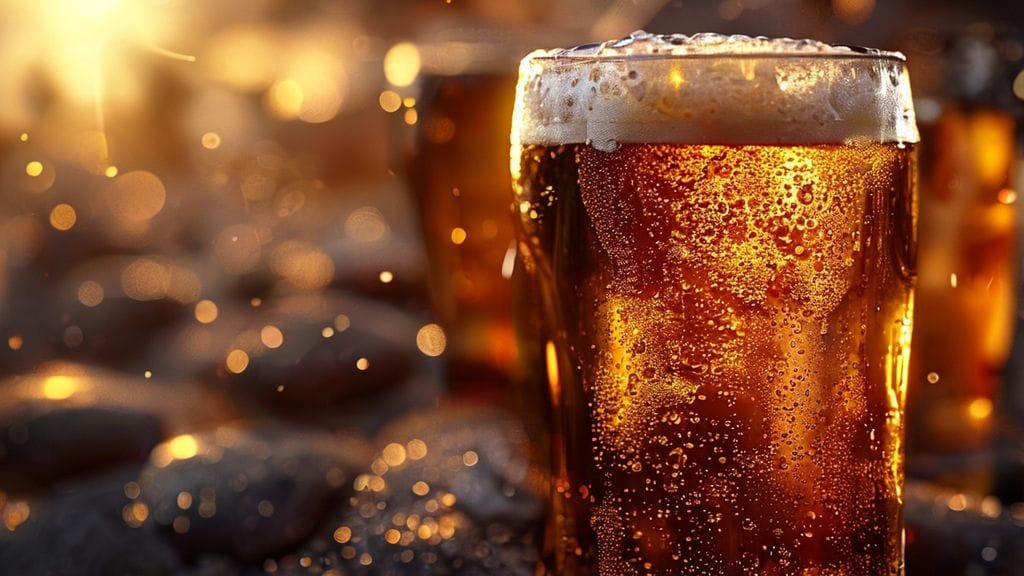
- Appearance: It pours a stunning, deep copper-red, verging on mahogany, with brilliant clarity. A dense, persistent, creamy off-white head crowns the glass, leaving beautiful lacing as it recedes. The color alone speaks of its rich character.
- Aroma: The nose is dominated by intense, complex malt notes. I detect layers of toffee, caramel, and dark bread crust, interwoven with hints of plum and dried fruit. There’s a subtle, almost indescribable smokiness, not acrid like peat, but sweet and warming, reminiscent of toasted marshmallows by a campfire. The noble hops provide a gentle, earthy counterpoint.
- Mouthfeel: This beer has a luxurious, full-bodied mouthfeel. It’s wonderfully smooth and velvety, with a moderate carbonation that lifts the flavors without being prickly. The slight sweetness is balanced by a gentle warmth from the alcohol, and a comforting chewiness that truly fills the palate.
- Flavor: The flavor delivers on the aromatic promise. A wave of rich, complex caramel and toffee notes hits first, followed by toasted bread, dark fruit, and a subtle nutty undertone. The unique “Steinpech” caramelization manifests as a distinct, slightly burnt-sugar complexity that sets it apart from any other Bock. The gentle hop bitterness provides just enough balance to prevent cloying sweetness, allowing the malt character to shine through completely. The finish is long, warming, and satisfyingly malty, with that signature caramelized sweetness lingering. It’s a truly unique experience, one I’m proud to share on BrewMyBeer.online.
What types of rocks are safe and ideal for Steinbier?
I always recommend dense, non-porous igneous rocks like granite, basalt, or various volcanic stones. These rocks are formed under intense heat and pressure, making them resistant to thermal shock. Avoid sedimentary rocks (sandstone, limestone) which can contain water and explode, or metamorphic rocks (slate, marble) which may flake or introduce unwanted minerals or flavors.
How do I safely heat rocks to such high temperatures for brewing?
My preferred method is a dedicated outdoor fire pit with a high-BTU propane burner or a charcoal forge. The key is to achieve a bright orange-white glow, indicating temperatures of 850-950°C (1562-1742°F). Safety is paramount: use heavy-duty heat-resistant gloves, eye protection, and long metal tongs or a custom lifting tool for handling. Always work in a well-ventilated outdoor area, away from flammable materials.
Can I apply the Steinbier technique to other beer styles, or is it exclusively for Bocks?
While historically associated with certain traditional styles like Bock, I’ve experimented with applying the Steinbier technique to other malt-forward beers with great success. Think of a rich Scottish Ale, a robust Imperial Stout, or even a nuanced Altbier. The crucial factor is choosing a style that will benefit from intense caramelization and the unique smoky-sweet notes it imparts, rather than overwhelming delicate hop or yeast profiles. I’ve even considered an experimental version for a strong porter, focusing on the dark caramel notes.
What are the crucial safety precautions I must take when brewing with hot rocks?
Beyond rock selection and heating, safety during the immersion phase is critical. Always have a clear workspace and wear full personal protective equipment: heavy-duty leather welding gloves, a full face shield or safety glasses, and sturdy, closed-toe shoes. Use long-handled, robust tongs to transfer rocks. Position the kettle on a stable, heat-proof surface, and never lean directly over the kettle when introducing a hot rock, as the initial boil can be extremely vigorous and splash. Always have a fire extinguisher and a first-aid kit readily accessible. Remember, the goal is a delicious beer, not a trip to the emergency room, so treat the process with the respect it demands. For more detailed safety guides, be sure to check out BrewMyBeer.online.