
Discover how virtual brewing labs train beginners – from Brewmaster simulator to online certification programs, explore digital education transforming beer learning in 2025.

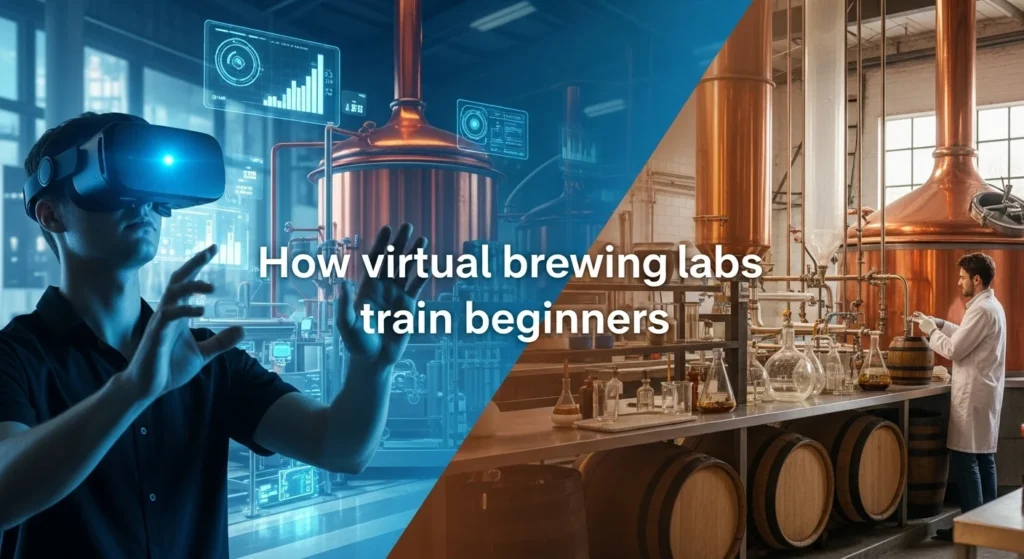
Could software teach brewing better than hands-on experience? Teaching brewing workshops while researching digital education platforms, I’ve explored how virtual brewing labs train beginners through realistic simulators, online courses, and interactive chemistry models creating comprehensive training. These digital applications using home brewing equipment principles demonstrate technology’s educational transformation.
Understanding how virtual brewing labs train beginners matters because interactive simulators enable risk-free experimentation, immediate feedback, and accelerated learning impossible through traditional methods. According to Brewmaster’s Steam listing, discover, learn and master homebrewing art through chemistry-driven brewing techniques perfecting craft in first realistic beer brewing experience.
Through my systematic analysis of virtual training platforms including Brewmaster simulator, Siebel Institute’s online education, and Cornell’s eCornell program, I’ve learned how digital labs accelerate skill development. Some platforms prove remarkably effective, others supplement rather than replace hands-on training, and several demonstrate how virtual environments reduce beginner mistakes.
This guide explores seven aspects of virtual brewing education, from simulation software to certification programs, helping you understand how digital labs train beginners while complementing traditional brewing knowledge.
Brewmaster: Beer Brewing Simulator
The chemistry-driven simulation replicates authentic brewing. According to Fireshine Games’ description, brew perfect beer in relaxing home brewing sim using realistic chemistry simulation brewing hoppy IPAs to creamy stouts.
The educational approach balances realism with accessibility. Players learn mashing temperatures, hop timing, fermentation control, and carbonation techniques through guided recipes before experimenting independently.
The equipment progression mirrors real-world learning. Starting with basic homebrew equipment, players earn beer tokens through competitions unlocking professional-grade gear creating progression motivation while teaching equipment capabilities.
According to YouTube’s official tutorial, Brewmaster offers chemistry-driven brewing techniques teaching naming, bottling, and labeling refining craft through realistic experience.
I’ve tested Brewmaster extensively. The platform excels teaching theoretical concepts – mash pH, hop utilization rates, yeast attenuation – though cannot replicate physical challenges like grain mill adjustments or keg cleaning requiring hands-on practice.
Siebel Institute Online Programs
The World Brewing Academy pioneered online brewing education. According to Siebel’s web-based platform, for over 20 years delivering campus-like experience with same depth as campus-based offerings but purely online environment.
The course content spans entry to advanced levels. According to Lallemand’s Siebel overview, offerings include intensive short programs allowing quick industry entry plus large portfolio online courses providing learning flexibility.
The WBA Master Brewer Program combines campuses. According to Brauwelt’s 2025 announcement, attendees study six weeks at Siebel Chicago then remainder in Munich including two-week European Brewing Study Tour.
The curriculum blends theory and practice. Classroom theory combines with hands-on brewing and lab exercises ensuring participants acquire both knowledge and practical skills needed excelling in professional roles.
The credential value proves substantial. WBA Master Brewer graduates prove well-prepared for head brewer, brewing supervisor, department manager, and brewery owner positions commanding industry respect.
| Platform | Format | Cost | Duration | Certification | Best For | Hands-On Component |
|---|---|---|---|---|---|---|
| Brewmaster Simulator | Game/Software | $25 | Self-paced | None | Hobbyists learning theory | None |
| Siebel Online Courses | Video/Interactive | $500-2,000 | 4-12 weeks | Certificate | Entry to mid-level brewers | Optional campus lab |
| Cornell eCornell | Online Modules | $1,999 | 3-4 months | Cornell Certificate | Career changers | None (theory-focused) |
| Cicerone BeerSavvy | Live Online | $499 | 2-3 days | Certified Beer Server prep | Beer service professionals | None |
| Brewers Association | Video/Webinar | $100-500 | 1-8 hours | CEUs | Working brewers | None |
Cornell’s eCornell Craft Brewing Certificate
The Cornell CALS program focuses ingredient science. According to eCornell’s craft brewing certificate, investigate malts characteristics, explore hops properties, analyze yeasts and microorganisms, evaluate water chemistry creating appropriate profiles.
The course structure emphasizes ingredient interplay. Understanding how malt, hops, yeast, and water interact during brewing enables recipe refinement producing desired characteristics.
The professional development value supports career advancement. Earning 50 PDH (5 CEUs) plus Cornell certificate demonstrates commitment professional development valued by employers and certification programs.
The target audience spans wide spectrum. Homebrewers, hobbyists, brewery startups, equipment vendors, malt suppliers, homebrew retailers, brewery apprentices, and career starters all benefit from comprehensive ingredient education.
According to testimonial quote, “I love making beer. This course really took my understanding of the process to another level” demonstrating practical value beyond theoretical knowledge.
MIT Sloan Beer Game Supply Chain Simulation
The distribution simulation teaches systems thinking. According to MIT Sloan’s beer game, participants play managers in supply chain representing beer production and distribution learning structure and dynamics.
The learning objectives extend beyond brewing. Participants experience interpersonal interactions and emotions arising as unintended consequences understanding erroneous self-reinforcing negative attributions eroding trust in organizations.
The online multiplayer format enables remote learning. Interactive websim works well with groups from four to four hundred supporting fully remote, in-person, and hybrid sessions requiring no advance participant preparation.
According to Skill Dynamics’ virtual version, supply chain simulation teaches demand variability, information delay, and bullwhip effect principles applying across industries beyond brewing.
The business education value proves significant. While not teaching brewing techniques directly, understanding supply chain dynamics proves essential for brewery operations, inventory management, and distribution planning.
How Virtual Brewing Labs Train Beginners Cicerone and Beer Service Training
The BeerSavvy Bootcamp prepares Certified Beer Server exam. According to Cicerone’s live training, program covers beer service fundamentals including proper storage, handling, and presentation techniques.
The certification pathway progresses through levels. Certified Beer Server provides entry-level credential with Certified Cicerone, Advanced Cicerone, and Master Cicerone representing increasing expertise and commitment.
The online format increases accessibility. Virtual training eliminates travel costs and time commitments enabling broader participation from geographically-dispersed beer professionals.
According to Cicerone Certification Program, professional certification for beer servers and beer enthusiasts proves widely recognized demonstrating beer knowledge and service expertise.
The service focus complements brewing knowledge. Understanding proper beer handling, storage temperatures, glassware selection, and draft systems proves essential for brewers ensuring products reach consumers optimally.
Brewers Association and Industry Resources
The BA offers specialized online courses. According to Brewers Association’s course archive, offerings span safety, quality control, brewery operations, and business management topics supporting working brewers.
The NanoCon Online format enables remote participation. According to BYO’s 2025 NanoCon, full-day live online seminars cover brewery operations, business operations and sales, and start-ups with video recordings access.
The continuing education credits support professional development. Many courses provide CEUs or PDH enabling brewers maintaining certifications and demonstrating ongoing skill enhancement.
The supplier Q&A sessions provide practical value. Direct interaction with equipment manufacturers, ingredient suppliers, and service providers enables learning from industry experts addressing specific challenges.
According to BYO’s beer education guide, 2025 sees expanded online offerings including specialized lectures, interactive workshops, and certification prep courses reflecting growing demand flexible learning formats.
Practical Application and Limitations
Virtual labs excel teaching theory and chemistry. Understanding mash pH, hop utilization calculations, yeast metabolism, and water chemistry proves effectively taught through interactive simulations and online coursework.
The physical skills require hands-on practice. Equipment operation, grain milling, keg handling, sanitation protocols, and sensory evaluation cannot be fully replicated digitally requiring traditional training methods.
The hybrid approach proves most effective. According to YouTube’s craft brewer reaction, professional brewers testing Brewmaster appreciate simulation teaching concepts though note physical brewing presents challenges software cannot replicate.
According to IRL vs Digital brewing comparison, Moor Beer Company owner discusses how industrial brewing differs from homebrewing with Brewmaster developers explaining what team decided simulating and why.
The cost-effectiveness favors virtual training. Learning theoretical concepts through $25 simulator or $500 online course proves far cheaper than equipment purchases, ingredient costs, and potential brewing failures during hands-on learning.
Frequently Asked Questions
Can you learn brewing entirely online?
Partially – theory and chemistry yes, physical skills no. According to Siebel Institute, online platform offers campus-like experience though Master Brewer Program includes hands-on brewing and lab sessions for practical skills.
Is Brewmaster simulator realistic?
Chemistry simulation yes, physical challenges no. According to Fireshine Games, realistic chemistry simulation teaches authentic brewing techniques though cannot replicate equipment operation, cleaning, or physical labor aspects.
What’s best virtual brewing education for beginners?
Depends on goals – Brewmaster for hobbyists, Siebel/Cornell for professionals. According to eCornell, craft brewing certificate suits homebrewers, hobbyists, brewery startups, and career starters seeking comprehensive ingredient education.
Do online brewing certifications have value?
Yes for professional development and knowledge demonstration. According to Cicerone, professional certification widely recognized in beer industry though requires passing exams beyond course completion.
How much do online brewing courses cost?
Varies widely – $25 simulator to $2,000+ professional programs. According to Siebel Institute, portfolio ranges entry to advanced level enabling choosing right fit for budget and needs.
Can virtual labs replace traditional brewing education?
No – complement rather than replace hands-on training. According to YouTube comparison, brewers appreciate digital learning teaching concepts though physical brewing presents challenges software cannot replicate.
What software do professional brewers use?
Brewfather for recipe development, various platforms for education. According to Brewfather, tools provide recipe calculators, inventory management, and brewing process tracking supporting commercial and homebrewing operations.
Mastering Digital Brewing Education
Understanding how virtual brewing labs train beginners reveals interactive simulation and online coursework’s capability teaching brewing theory, chemistry, and ingredient science. The digital platforms enable risk-free experimentation, immediate feedback, and accelerated learning impossible through traditional methods alone.
Brewmaster simulator provides accessible entry point teaching mash chemistry, hop timing, fermentation control, and recipe development through gameplay mechanics. The realistic chemistry simulation enables understanding theoretical concepts before investing in physical equipment.
Professional platforms including Siebel Institute’s online programs and Cornell’s eCornell certificate offer comprehensive brewing education spanning entry to advanced levels. The flexible learning formats enable career changers and working brewers enhancing knowledge without campus attendance.
Cicerone certification and beer service training focus proper handling, storage, and presentation complementing brewing technical knowledge. The service expertise proves essential ensuring products reach consumers optimally.
Hybrid approaches combining virtual theory with hands-on practice prove most effective. Digital platforms excel teaching chemistry, ingredient science, and recipe development while physical brewing develops equipment operation, sanitation protocols, and sensory evaluation skills.
As an experienced brewer teaching workshops, I appreciate virtual labs’ role accelerating beginner learning. The platforms enable understanding brewing fundamentals before investing significant money in equipment and ingredients reducing costly early mistakes.
Future developments including improved simulations, virtual reality brewing environments, and AI-driven personalized learning promise enhancing digital education. The technology advances enable more realistic training experiences though cannot fully replace hands-on brewing’s physical and sensory aspects.
Start exploring virtual brewing through free resources and affordable simulators like Brewmaster, evaluate whether professional certification programs align with career goals, and appreciate how digital education complements rather than replaces traditional hands-on brewing training.
About the Author
John Brewster is a passionate homebrewer with over a decade of experience experimenting with different beer styles and advanced techniques. After working at three craft breweries and winning several regional homebrew competitions, John now dedicates his time to developing innovative recipes and teaching brewing methods through both traditional workshops and digital platforms. His specialty lies in brewing education having tested virtual training software, completed multiple online certification programs, and developed hybrid curriculum combining digital theory with hands-on practice.
John maintains detailed comparison notes documenting which virtual platforms effectively teach specific concepts versus requiring physical demonstration. His teaching methodology balances software simulation advantages with recognition that certain brewing skills demand hands-on equipment experience. When not conducting brewing workshops or evaluating educational technology, John creates tutorial content demonstrating how beginners can maximize virtual lab learning while building practical brewing skills. Connect with him at john.brewster@brewmybeer.online for insights on brewing education and effective training methods.