


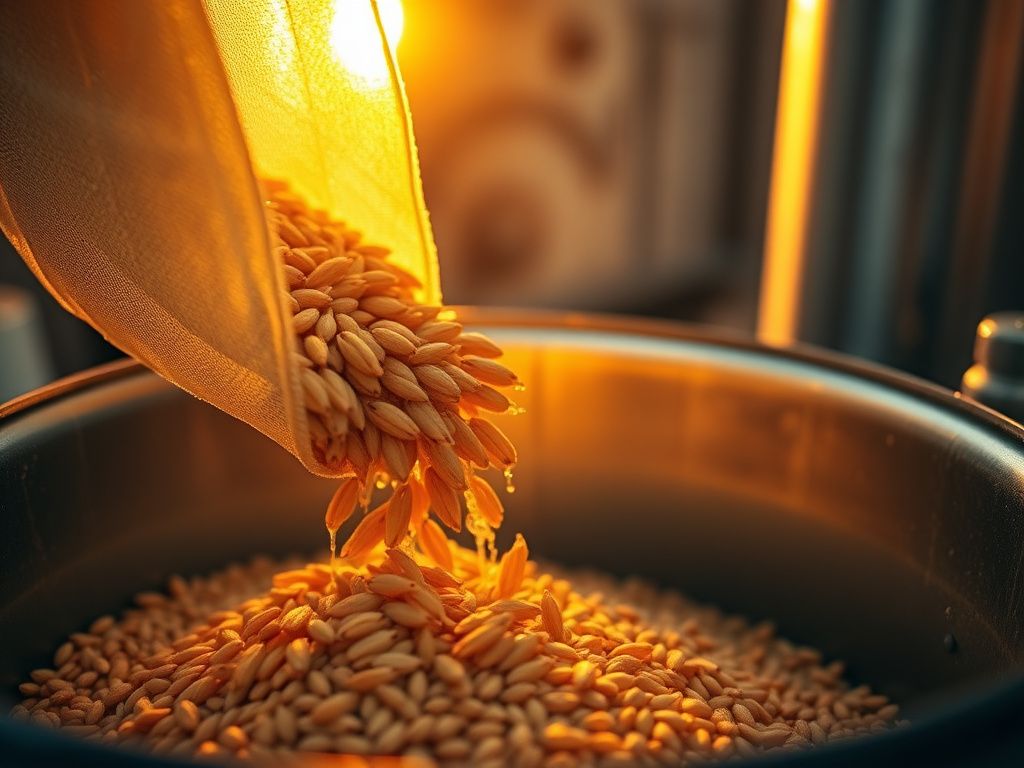
This guide provides a definitive technical overview for initiating all-grain brewing via the Brew-in-a-Bag (BIAB) method. It covers critical equipment, water chemistry, grain processing, precise temperature control for mash efficiency, hop utilization, sanitation protocols, and fermentation dynamics. Optimize your initial brews for repeatable, high-quality results by mastering these foundational BIAB principles.
BIAB Operational Phase |
Critical Parameter |
Typical Range/Value |
Impact on Outcome |
Beginner Consideration |
|---|---|---|---|---|
|
Equipment Assembly |
Kettle Volume |
Minimum 10 Gallons (38L) for 5 Gallon (19L) Batch |
Prevents boil-overs, accommodates full mash volume. |
Oversize kettle provides operational buffer. |
|
Water Treatment |
pH of Mash Water |
5.2 – 5.6 pH @ ambient (5.4 – 5.8 pH @ mash temp) |
Optimal enzyme activity, enhanced hop bitterness, yeast health. |
Targeting 5.4 pH with lactic acid or phosphoric acid is a robust starting point. Consult a water profile calculator. |
|
Grain Milling |
Mill Gap Setting |
0.035 – 0.045 inches (0.89 – 1.14 mm) |
Finer crush increases mash efficiency; too fine risks stuck sparge (less critical in BIAB) and increased tannin extraction. |
A finer crush than traditional 3-vessel mashing is beneficial for BIAB efficiency due to lack of filter bed, but monitor for excessive flour. |
|
Mashing |
Mash Temperature |
148 – 158°F (64 – 70°C) |
Influences fermentability: lower range for thinner, drier beers (more beta-amylase); higher for fuller-bodied, sweeter beers (more alpha-amylase). |
Maintain consistent temperature. Use insulation (jacket, blankets) to minimize heat loss. Stir periodically. |
|
Mash |
Mash Time |
60 – 90 minutes |
Sufficient time for enzymatic conversion of starches to fermentable sugars. |
Do not shorten mash time unless using specialized enzyme additions. Longer mashes can aid conversion. |
|
Lautering (BIAB) |
Bag Draining Duration |
10 – 20 minutes (passive drain) |
Allows maximum wort extraction; squeezing can increase extraction but also tannin risk if pH is high. |
Beginners should passively drain until flow is a slow drip before a gentle squeeze, or avoid squeezing entirely if pH is a concern. |
|
Boiling |
Boil Vigor |
Rolling boil, ~8-10% evaporation rate per hour |
Evaporates off undesirable volatile compounds (DMS), coagulates proteins (cold break), isomerizes hop acids, concentrates wort. |
Maintain consistent boil; monitor for excessive foaming. Account for boil-off rate in pre-boil volume calculations. |
|
Chilling |
Wort Cooling Time |
15 – 30 minutes to pitching temp (60-70°F/15-21°C) |
Rapid chilling reduces risk of infection, promotes cold break formation (clearer beer), minimizes DMS formation. |
Invest in an immersion chiller. Sanitize chiller prior to use. Minimize hot-side oxygen introduction. |
|
Fermentation Prep |
Yeast Pitch Rate |
0.75 – 1.0 million cells/mL/°P for Ales; 1.5 – 2.0 million cells/mL/°P for Lagers |
Ensures healthy, timely fermentation; prevents off-flavors (diacetyl, acetaldehyde) and stuck ferments. |
Use a yeast calculator to determine appropriate starter size or dry yeast packet quantity. Aerate wort thoroughly. |
|
Fermentation |
Temperature Control |
Varies by yeast strain (e.g., 65-70°F/18-21°C for many ale strains) |
Directly impacts yeast health, off-flavor production, and final flavor profile (esters, fusel alcohols). |
Maintain stable fermentation temperature. Use a temperature-controlled environment (fermentation chamber, water bath). |
Essential BIAB Calculations
Accurate volume and temperature management are paramount for repeatable BIAB results.
1. Strike Water Volume (Gallons):
The total volume of water required for your mash. This accounts for your desired pre-boil volume, grain absorption, and any potential dead space.
V_strike = V_pre_boil + (G_weight * 0.125) + V_dead_space
Where:
V_strike= Total strike water volume (Gallons)V_pre_boil= Desired pre-boil volume (Gallons)G_weight= Total grain weight (Pounds)0.125= Approximate grain absorption rate (Gallons per Pound)V_dead_space= Volume of water not extractable from kettle (Gallons, typically 0.2-0.5 gal for most kettles, can be zero if you scoop every drop)
Example: For a 5.5-gallon pre-boil target, 10 lbs of grain, and 0.2 gallons dead space:
V_strike = 5.5 + (10 * 0.125) + 0.2
V_strike = 5.5 + 1.25 + 0.2
V_strike = 6.95 Gallons
2. Strike Temperature (°F):
The temperature to which your water must be heated *before* adding the grains, to achieve your target mash temperature *after* grain addition.
T_strike = ((0.2 * G_weight) / W_strike) * (T_mash - T_grain) + T_mash
Where:
T_strike= Target strike water temperature (°F)0.2= Specific heat of grain (BTU/lb/°F)G_weight= Total grain weight (Pounds)W_strike= Total strike water weight (Pounds, assuming 8.34 lbs/gal)T_mash= Desired mash temperature (°F)T_grain= Ambient temperature of the grains (°F)
Example: For a 10 lbs grain bill, 6.95 gallons strike water (58 lbs), 152°F target mash, and 70°F grain temperature:
T_strike = ((0.2 * 10) / 58) * (152 - 70) + 152
T_strike = (2 / 58) * (82) + 152
T_strike = 0.0345 * 82 + 152
T_strike = 2.83 + 152
T_strike = 154.83°F
3. Original Gravity (OG) Estimation:
Estimate based on the fermentable sugar extracted. For BIAB, expect 65-75% brewhouse efficiency for beginners.
OG_est = 1 + ((PPG * G_weight * Efficiency) / V_final) / 1000
Where:
OG_est= Estimated Original Gravity (e.g., 1.050)PPG= Points per Pound per Gallon for your grain bill (consult grain data sheets or software)G_weight= Total grain weight (Pounds)Efficiency= Expected Brewhouse Efficiency (e.g., 0.70 for 70%)V_final= Final fermentation volume (Gallons)
The Definitive Master-Guide: All-Grain BIAB for Beginners
Introduction to Brew-in-a-Bag (BIAB)
The Brew-in-a-Bag (BIAB) methodology represents a streamlined, single-vessel approach to all-grain brewing, significantly reducing equipment requirements and procedural complexity compared to traditional 3-vessel systems. This method integrates the mashing and lautering steps within a single boil kettle, utilizing a specialized grain bag to contain the grist during the mash. The primary objective is efficient starch-to-sugar conversion and subsequent wort separation, providing a robust foundation for consistent, high-quality homebrew. This guide details the technical parameters and operational sequences essential for BIAB success, designed for brewers transitioning from extract or seeking an accessible entry into all-grain production. Mastery of these fundamentals is critical for achieving repeatable results and understanding the underlying biochemical processes of brewing.
I. Equipment Procurement and Preparation
The BIAB method emphasizes minimal, multi-functional equipment. Precision in temperature control and sanitation are paramount, regardless of setup simplicity.
A. Primary Kettle: A stainless steel kettle with a capacity of at least 10 gallons (38 liters) is recommended for typical 5-gallon (19L) batch sizes. This accommodates the full strike water volume, the grain bill, and prevents boil-overs. A volumetric scale on the interior is advantageous for accurate volume measurements. Kettles with a ball valve facilitate wort transfer, reducing physical strain and aeration.
B. BIAB Bag: This is the defining component. Select a bag constructed from durable, fine-mesh, food-grade polyester or nylon. Dimensions must be adequate to fully line the kettle, with sufficient excess material to be secured above the water level, preventing grain ingress into the main wort. Ensure the mesh size (typically 200-400 micron) is fine enough to retain grain particles but coarse enough to permit efficient liquid flow. Bags with reinforced seams and lifting loops enhance durability and ease of handling.
C. Heat Source: A high-output propane burner (e.g., 60,000-100,000 BTU) is ideal for rapidly heating strike water and maintaining a vigorous boil. Electric induction or stovetop elements can be used for smaller batches or if adequate power is available. Consistent heat application is vital for maintaining mash temperatures and achieving proper boil dynamics.
D. Temperature Monitoring: A calibrated digital thermometer is indispensable for accurate mash temperature regulation. Instant-read units with probes are preferred. For continuous monitoring during mash, a kettle-mounted thermometer or a clip-on digital probe is beneficial. Temperature accuracy within ±1°F (±0.5°C) is the target.
E. Immersion Chiller: Rapid cooling of wort from boiling to fermentation temperature (<75°F/24°C) is critical to minimize dimethyl sulfide (DMS) formation and reduce the risk of microbial contamination. A copper or stainless steel immersion chiller, sized appropriately for your kettle, is highly efficient. Ensure the chiller is fully sanitized before immersion post-boil.
F. Fermentation Vessel: Food-grade plastic buckets or glass carboys, typically 6.5 gallons (25 liters) for a 5-gallon batch, are standard. Equip with an airlock to manage CO2 egress and prevent oxygen ingress. All components must be meticulously cleaned and sanitized.
G. Supporting Equipment:
- Large Stirring Spoon/Paddle: Stainless steel or high-temperature plastic for thorough dough-in and mash agitation.
- Measuring Devices: Hydrometer and graduated cylinder for specific gravity readings (Original Gravity, Final Gravity). A refractometer offers quick, small-sample measurements but requires temperature correction.
- Sanitizer: Star San (acid-based) or iodophor are effective, no-rinse sanitizers.
- Cleaning Supplies: PBW (Powdered Brewery Wash) or similar alkaline cleaner for organic soil removal.
- Grain Mill (Optional but Recommended): Allows control over crush size, optimizing efficiency. Alternatively, request a double-crush from your grain supplier.
For comprehensive equipment options and detailed specifications, consider exploring resources at BrewMyBeer.online.
II. Water Chemistry Fundamentals for BIAB
Water constitutes over 90% of beer volume and profoundly influences mash pH, enzyme activity, hop perception, and final flavor. For BIAB, managing mash pH is the primary concern for beginners.
A. Mash pH: The optimal pH range for enzymatic activity during mashing is 5.2-5.6 at ambient temperature (which translates to approximately 5.4-5.8 pH at mash temperature). A pH outside this range can lead to inefficient starch conversion, off-flavors, and poor clarity.
- Correction Methods:
- Acidification: Lactic acid (88%) or phosphoric acid (10%) are common food-grade acids used to lower mash pH. Add incrementally, stirring well, and re-measuring with a calibrated pH meter. Start with 1-2 mL per 5 gallons and adjust.
- Alkalinity Reduction: If your water is very hard or alkaline, reverse osmosis (RO) or distilled water can be used as a base, then building a profile with brewing salts.
B. Brewing Salts (Optional for Beginners): While advanced brewers manipulate mineral profiles for specific styles (e.g., gypsum for sulfates in IPAs, calcium chloride for chlorides in malty beers), beginners can often achieve good results by focusing solely on mash pH adjustment. If using RO water, a small addition of calcium chloride (CaCl2) or gypsum (CaSO4) can provide essential calcium for enzyme function and yeast health (e.g., 5-10g per 5 gallons).
C. Chloramine/Chlorine Removal: Chlorine and chloramine in municipal water can react with organic compounds during brewing to form chlorophenols, leading to medicinal or band-aid off-flavors. These can be removed by:
- Campden Tablets (Potassium Metabisulfite): A single 0.5g tablet per 20 gallons (76L) will neutralize chlorine/chloramine rapidly. Add to strike water immediately prior to heating.
- Carbon Filtration: An active carbon filter can also remove these compounds effectively.
III. Grain Selection and Milling
The grain bill dictates the fermentable sugars, color, flavor, and body of the beer. Proper milling exposes the starches for enzymatic conversion.
A. Grain Selection:
- Base Malts: Constitute the majority (60-100%) of the grain bill (e.g., 2-row pale malt, Maris Otter, Pilsner malt). Provide fermentable sugars and backbone.
- Specialty Malts: Contribute color, flavor, and body (e.g., Crystal/Caramel malts, roasted malts, chocolate malts, wheat, oats). Use in smaller percentages.
Consult BJCP Style Guidelines for traditional grain bill compositions specific to desired beer styles.
B. Milling Considerations for BIAB: A finer crush than traditional 3-vessel brewing is generally recommended for BIAB. This is because BIAB lacks a traditional grain bed for filtration and liquid separation, relying on direct contact and the bag’s filtration.
- Benefits of Finer Crush: Increased surface area for enzymes, leading to higher mash efficiency (more sugar extracted from grain).
- Risks: While less prone to stuck sparges, an excessively fine crush can introduce too much flour, potentially leading to a pasty mash, scorching, or increased tannin extraction if mash pH is too high or grain is excessively squeezed.
C. Achieving the Crush:
- Home Mill: Set rollers to 0.030-0.035 inches (0.75-0.90 mm). Adjust based on observed crush (cracked husks, well-fragmented endosperm).
- Brew Shop Mill: Request a “double crush” or specifically mention it’s for BIAB.
IV. Mashing Dynamics: Temperature Control and Conversion
Mashing is the enzymatic process where starches in the grain are converted into fermentable sugars. Precise temperature control is critical for dictating the sugar profile and, consequently, the beer’s fermentability and body.
A. Strike Temperature and Dough-In:
- Pre-calculate Strike Temperature: Utilize the formula provided in the Math Box to determine the exact water temperature needed to achieve your target mash temperature after adding grains. Account for the grain’s ambient temperature.
- Heat Water: Heat the full strike water volume in your kettle to the calculated strike temperature.
- Dough-In: Secure the BIAB bag in the kettle, ensuring it lines the sides without bunching. Slowly add the milled grains, stirring thoroughly to break up any dough balls and ensure all grain is fully hydrated. This prevents dry pockets and ensures even temperature distribution. Aim for no lumps. The mash should be a consistent porridge-like consistency.
B. Mash Rest:
- Temperature Maintenance: Once the target mash temperature is reached (e.g., 148-158°F / 64-70°C), insulate the kettle. Wrap it with reflectix, sleeping bags, or blankets to minimize heat loss.
- Stirring: Periodically stir the mash (every 15-20 minutes) to ensure uniform temperature distribution and prevent localized cold spots that hinder enzyme activity.
- Duration: A typical mash lasts 60 minutes. For higher gravity beers or if efficiency is a concern, extend to 90 minutes.
- Temperature Profile:
- Lower Temp (148-152°F / 64-67°C): Favors beta-amylase activity, producing more highly fermentable sugars (maltose). Results in a drier, thinner-bodied beer.
- Higher Temp (154-158°F / 68-70°C): Favors alpha-amylase activity, producing more unfermentable dextrins. Results in a fuller-bodied, sweeter beer.
C. Iodine Test (Optional): At the end of the mash, take a small sample of wort, cool it, and add a drop of iodine solution. If the iodine turns black or purple, starch conversion is incomplete. If it remains yellowish-brown, conversion is complete. This indicates sufficient enzymatic action. If positive, continue mashing for another 15-30 minutes and re-test.
V. Lautering and Sparging in BIAB
In BIAB, lautering (separating wort from grain) is simplified. Sparging (rinsing residual sugars) can be integrated or omitted.
A. Bag Removal:
- Lifting: Carefully lift the entire grain bag out of the kettle. Use a hoist system (pulley) or a strong friend for heavy grain bills.
- Draining: Suspend the bag above the kettle, allowing the wort to passively drain back into the kettle. This passive drain can take 10-20 minutes.
- Squeezing (Controlled): Gentle squeezing of the bag is permissible and common in BIAB to improve efficiency. However, aggressive squeezing, especially if mash pH is above 5.8, can extract astringent tannins from the grain husks. For beginners, a gentle, sustained squeeze (e.g., using tongs or pressing against the side of the kettle) is recommended over twisting or aggressive wringing. Alternatively, skip squeezing entirely and accept a slight efficiency reduction.
B. Sparging (Optional BIAB Method): For beginners, a single-infusion mash without a separate sparge is simplest and often sufficient. However, a “dunk sparge” or “no-sparge” variation can be employed for efficiency gains.
- No-Sparge: All water for the entire brew day (mash and sparge) is added as strike water upfront. This is the simplest BIAB method, accepting lower efficiency but simplifying process.
- Dunk Sparging: After initial draining, the grain bag can be briefly steeped in a separate volume of hot water (170°F/77°C) to rinse remaining sugars. This water is then added to the main wort in the kettle. This is less common for beginner BIAB but offers a slight efficiency boost.
C. Pre-Boil Gravity and Volume: Before proceeding to the boil, measure the volume and specific gravity of your wort. Compare to your recipe’s target pre-boil gravity to estimate your mash efficiency. This data is critical for refining future brews. An online brewing calculator can aid in these calculations and provide guidance for volume adjustments. For further assistance with efficiency optimization, visit BrewMyBeer.online.
VI. The Boil and Hop Utilization
The boil serves several critical functions: sanitization, hop isomerization, protein coagulation, and wort concentration.
A. Achieving a Rolling Boil: Heat the wort rapidly to achieve a vigorous, rolling boil. This ensures adequate evaporation and facilitates the chemical reactions necessary for flavor and stability. A strong boil helps drive off undesirable volatile compounds, primarily Dimethyl Sulfide (DMS) precursors, which can impart a cooked corn flavor.
B. Hop Additions: Hops are added at various stages of the boil to impart bitterness, flavor, and aroma.
- Bittering Hops (60+ minutes): Added early in the boil to allow sufficient time for alpha acids to isomerize, contributing bitterness.
- Flavor Hops (15-30 minutes): Added mid-boil for a balance of bitterness and hop flavor.
- Aroma Hops (0-10 minutes / Flameout / Whirlpool): Added late in the boil or after heat is turned off (flameout/whirlpool) to maximize retention of volatile hop oils responsible for aroma.
- Hop Stands/Whirlpool: After flameout, chilling the wort partially to 170-180°F (77-82°C) and holding for 15-30 minutes with hop additions can enhance aroma without adding significant bitterness.
C. Other Kettle Additions:
- Irish Moss/Whirlfloc (15 minutes): Fining agents that aid in protein coagulation, contributing to clearer beer.
- Yeast Nutrients (10 minutes): Often a blend of diammonium phosphate (DAP) and other micronutrients, these ensure healthy yeast propagation, especially in all-malt worts.
- Water Chemistry Adjustments: Any final water chemistry adjustments can be made during the boil if required.
D. Post-Boil Volume and Gravity: After the boil, measure your final volume and take a hot-side sample for Original Gravity (OG) measurement with a hydrometer (remember to cool the sample to calibration temperature, typically 60°F/15.6°C, for accuracy). This OG value is critical for calculating alcohol by volume (ABV) and monitoring fermentation progress.
VII. Rapid Chilling and Strict Sanitation
The post-boil phase is the most vulnerable to microbial contamination. Rapid chilling and meticulous sanitation are non-negotiable.
A. Rapid Chilling:
- Purpose: Cool wort from boiling to yeast pitching temperature (typically 60-70°F / 15-21°C for ales) as quickly as possible. This minimizes the “hot-side rest” period where thermophilic bacteria can proliferate, reduces DMS formation, and encourages cold break (protein flocculation), leading to clearer beer.
- Immersion Chiller Use: Sanitize your immersion chiller by placing it in the boiling wort for the last 10-15 minutes of the boil. After flameout, run cold water through the chiller coils. Stirring the wort gently around the chiller can significantly accelerate cooling.
B. Sanitation Protocol: All equipment that will come into contact with the cooled wort (anything “cold side”) must be thoroughly cleaned and sanitized. This includes:
- Fermentation vessel
- Airlock and stopper
- Thermometer (used for pitching temperature)
- Hydrometer and sample jar
- Wort transfer tubing/siphon
- Yeast package/starter flask
C. Wort Transfer: Once the wort has reached pitching temperature, carefully transfer it to the sanitized fermentation vessel. Minimize splashing to avoid excessive oxygenation *at this stage*, as oxygen ingress during cooling is beneficial but excessive oxygen *post-cooling* can lead to staling. Use a sanitized funnel or ball valve for transfer. Leave any heavy trub (hop debris, coagulated proteins) behind in the kettle, as it can contribute off-flavors.
VIII. Fermentation Primer
Fermentation is the biological process where yeast consumes sugars and produces alcohol, CO2, and a myriad of flavor/aroma compounds.
A. Yeast Selection: Choose a yeast strain appropriate for your beer style. Yeast greatly influences flavor profile (e.g., fruity esters, spicy phenols).
- Dry Yeast: Convenient, stable, and typically sufficient cell count. Rehydrate per manufacturer’s instructions for optimal viability.
- Liquid Yeast: Offers a wider variety of strains. Often requires a yeast starter to achieve adequate cell counts, especially for higher gravity beers. Consult a yeast starter calculator to ensure proper pitching rates.
B. Pitching Rate: Adequate yeast cell counts are crucial for healthy fermentation. Underpitching can lead to slow or stuck fermentations, increased ester production, and off-flavors like diacetyl. Overpitching can result in muted flavors or autolysis.
- Ale: 0.75 million cells/mL/°P
- Lager: 1.5-2.0 million cells/mL/°P
C. Wort Aeration: Oxygen is essential for yeast cell growth during the initial lag phase of fermentation. Prior to pitching yeast, vigorously aerate the cooled wort. This can be achieved by shaking the fermenter, using an aeration stone with pure oxygen, or splashing during transfer. Oxygen addition should only occur before yeast pitching; avoid any further oxygen ingress once fermentation begins.
D. Temperature Control: Maintain a stable fermentation temperature within the yeast strain’s recommended range. Temperature fluctuations can stress yeast and produce off-flavors. Use a fermentation chamber, temperature-controlled water bath, or insulated environment to ensure consistency.
E. Fermentation Monitoring:
- Airlock Activity: Initial vigorous bubbling, slowing over time, indicates fermentation progress.
- Specific Gravity Readings: Take gravity readings with a sanitized hydrometer (after initial lag phase, then every few days) until the reading is stable for 2-3 consecutive days. This confirms fermentation completion and indicates Final Gravity (FG).
IX. Post-Fermentation and Packaging
Once fermentation is complete, the beer can be conditioned and packaged.
A. Conditioning:
- Diacetyl Rest (Lagers): For lagers, raising the temperature by 5-10°F (3-5°C) for 2-3 days at the end of fermentation helps yeast reabsorb and metabolize diacetyl (a buttery off-flavor).
- Cold Crashing: Chilling the beer to near freezing (35-40°F / 2-4°C) for several days aids in clarification by dropping yeast and particulate matter out of suspension.
B. Packaging:
- Bottling: Requires priming sugar (dextrose) calculations to achieve desired carbonation levels. Ensure bottles and caps are sanitized. Avoid oxygen exposure during transfer.
- Kegging: Offers controlled carbonation via CO2 pressure and easier dispensing. Requires a kegging system (kegs, CO2 tank, regulator, lines).
X. Troubleshooting and Efficiency Optimization
Consistent results require attention to detail and a methodical approach to identifying and resolving issues.
A. Low Mash Efficiency:
- Check Mill Crush: Ensure grains are finely milled but husks mostly intact.
- Mash Temperature Consistency: Verify stable mash temperature throughout the rest. Fluctuations or low temperatures reduce enzyme activity.
- Stirring: Ensure thorough dough-in and periodic stirring during mash.
- Water-to-Grain Ratio: While BIAB uses thicker mashes, ensure adequate water for full hydration.
- pH: Verify mash pH is within optimal range.
B. Off-Flavors:
- Astringency (Tannins): Often from aggressive squeezing of the grain bag, especially at high mash pH (>5.8), or sparging with excessively hot water (>170°F/77°C).
- DMS (Cooked Corn): Insufficient boil vigor, short boil time, or slow chilling.
- Diacetyl (Buttery): Underpitching, insufficient fermentation temperature control, or inadequate diacetyl rest for lagers.
- Phenolic (Band-Aid/Medicinal): Chlorine/chloramine in brewing water, wild yeast contamination.
- Oxidation (Cardboard/Sherry): Excessive oxygen exposure post-fermentation during transfers or packaging.
C. Stuck Fermentation:
- Temperature: Ensure consistent, appropriate fermentation temperature.
- Yeast Health/Pitch Rate: Use viable yeast, pitch adequate amounts.
- Wort Aeration: Ensure proper oxygenation before pitching.
- Nutrients: Consider adding yeast nutrients for complex or high-gravity worts.
By systematically addressing these variables, brewers can incrementally improve their process and the quality of their beer. Maintaining detailed brew logs is essential for tracking parameters and troubleshooting.
Conclusion
The All-Grain BIAB method provides an accessible and efficient pathway into producing high-quality beer. By adhering to precise technical parameters for water chemistry, grain processing, temperature control during mashing and fermentation, and rigorous sanitation, beginners can achieve consistent and satisfying results. This guide emphasizes the critical control points and underlying scientific principles, empowering the brewer to move beyond mere recipe following to a deeper understanding of the brewing process. Continuous learning, meticulous record-keeping, and an analytical approach to each brew session will foster mastery and innovation in your brewing journey.