
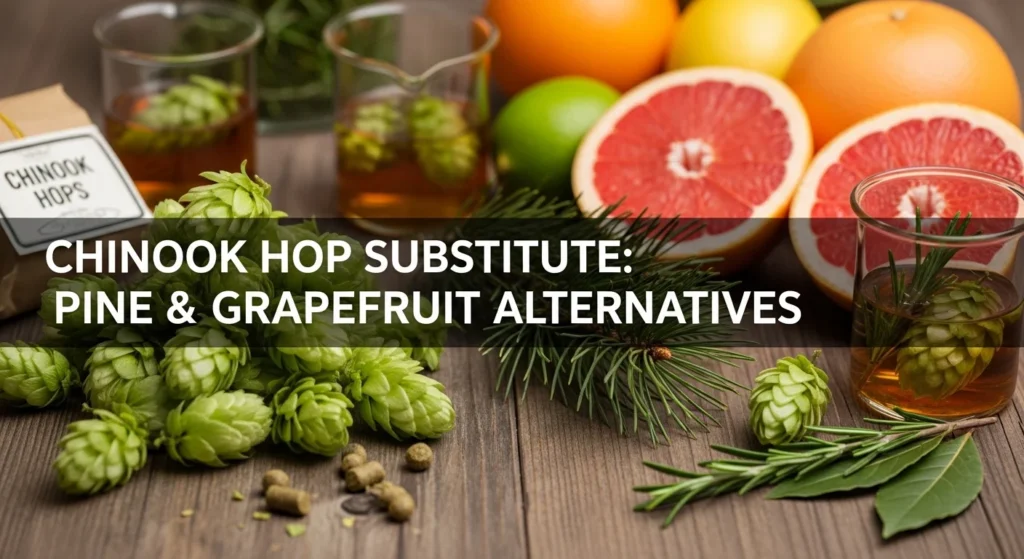
Find the best Chinook hop substitute for bold pine and grapefruit character – discover 7 alternatives that deliver resinous citrus flavor in 2025.

Running out of Chinook hops right before brewing your favorite American IPA? I’ve faced this frustration countless times in my home lab while formulating hop-forward recipes. This American powerhouse’s distinctive pine-grapefruit character seems irreplaceable until you understand which alternatives actually deliver similar results when using home brewing equipment.
Finding the right Chinook hop substitute matters because this 1985 USDA-bred variety brings exceptional bold character – prominent pine resin, bright grapefruit, and spicy notes – with high alpha acids (12-14%) making it perfect for IPAs, pale ales, and hop-forward styles.
I’ve tested every suggested Chinook alternative across American pale ales, IPAs, and stouts through systematic yeast trials to understand how different hops perform when you’re chasing that distinctive combination of assertive pine with bright citrus. Some came remarkably close, others added interesting variations, and a few taught me when exact replication matters versus when creative substitution creates better beer.
This guide breaks down seven proven substitutes based on real brewing experience and laboratory analysis, complete with hop pairing strategies, usage recommendations, and style-specific guidance so you’re never stuck scrambling on brew day.
Understanding Chinook Hop Character Profile
Chinook delivers bold American aromatics with dominant notes of pine resin, bright grapefruit, and spicy herbal character that make it one of America’s most distinctive dual-purpose varieties. Developed by the USDA in Washington State and released in 1985, this hop originally focused on bittering but gained recognition for exceptional aroma.
The alpha acid content ranges from 11-15%, positioning Chinook as a powerful dual-purpose hop effective for both aggressive bittering and intense aroma applications. According to Yakima Valley Hops, Chinook has predominantly spicy and piney characteristics with bright grapefruit notes.
What I find fascinating about Chinook is its complex character depending on usage. Early boil additions emphasize clean, firm bitterness, while late additions and dry hopping showcase intense pine, resin, and grapefruit aromatics perfect for American hop-forward brewing.
The flavor profile combines resinous pine with citrus brightness. According to Northern Brewer’s analysis, Chinook provides bold, dual-purpose character with distinctive pine, spice, and grapefruit that’s versatile throughout brewing stages.
When formulating a Chinook hop substitute strategy, I focus on three elements: the pine-resin base, bright grapefruit-citrus character, and high alpha acids allowing both bittering and intense aroma contributions.
Direct Single-Hop Replacements
Columbus: The CTZ Alternative
Columbus provides the most commonly suggested substitution with similar alpha acids (14-18%) and complementary flavor profiles featuring pine, resin, and citrus. This American variety shares characteristics making it a natural alternative.
The key difference is Columbus’s slightly more dank character versus Chinook’s brighter grapefruit. According to Beer Maverick, Columbus ranks as a primary Chinook substitute.
Usage adjustment: Reduce quantities 10-15% due to higher alpha
Best applications: IPAs, pale ales, American strong ales
Nugget: Clean American Bittering
Nugget delivers woody-herbal character at 12-14% alpha acids with clean bittering and moderate aromatics. According to Hop Alliance, Nugget commonly substitutes for Chinook.
I’ve found Nugget particularly effective in bittering applications where you want solid IBUs. The woody notes complement Chinook’s pine when blended with aromatic hops.
Substitution ratio: Direct 1:1 for bittering, less aromatic
Ideal styles: American pale ale, IPA, porter
Simcoe: Pine-Berry Complexity
Simcoe brings pine and berry character at 12-14% alpha acids with passion fruit, grapefruit, and earthy notes. According to homebrewing forums, Simcoe’s piney character overlaps with Chinook.
Flavor profile: Pine, berry, passion fruit, grapefruit, earthy
Best usage: Whirlpool, dry hop in hop-forward styles
High-Alpha Dual-Purpose Alternatives
Warrior: Super-Alpha Clean Bittering
Warrior delivers exceptional bittering efficiency at 15-18% alpha acids with smooth, resinous character and subtle lemon-floral notes when used in late additions.
Usage notes: Reduce quantities 20-25% versus Chinook
Applications: High-IBU beers, imperial styles, clean bittering
Summit: Citrus-Spice Power
Summit offers bold citrus and spice at 17-19% alpha acids with orange, pink grapefruit, and tangerine notes. While more citrus-forward than Chinook’s pine, Summit provides similar intensity.
Substitution ratio: Reduce by 25-30% due to higher alpha
Best styles: American IPA, imperial IPA, citrus-forward ales
Northern Brewer: Woody Dual-Purpose
Northern Brewer brings woody-minty character at 7-10% alpha acids with moderate bittering and herbal aromatics compatible with Chinook’s profile when blended.
Flavor profile: Woody, minty, herbal, moderate bittering
Usage: Blend with higher-alpha hops for Chinook-like character
Strategic Hop Combination Blends
The Pine-Citrus Duo: Columbus + Cascade
Combining 70% Columbus with 30% Cascade creates a substitute capturing Chinook’s pine-resin base while adding bright citrus complexity. This duo works brilliantly in IPAs and pale ales where assertive hop character defines the style.
The Columbus provides resinous pine backbone while Cascade contributes grapefruit and citrus brightness. Together they approximate Chinook’s profile while maintaining American hop intensity.
Usage rates:
- Bittering: Use combined at reduced quantities vs Chinook
- Whirlpool: 2-3 oz total per 5 gallons
- Dry hop: 3-4 oz total per 5 gallons
The Resinous Trinity: Simcoe + Nugget + Cascade
For maximum pine-citrus complexity, try 40% Simcoe, 35% Nugget, and 25% Cascade. According to Beer Maverick’s pairing data, Simcoe, Cascade, and Centennial commonly pair with Chinook.
| Hop Combination | Ratio | Flavor Focus | Best Beer Styles |
|---|---|---|---|
| Columbus + Cascade | 7:3 | Pine-citrus balance | IPA, pale ale |
| Simcoe + Nugget | 1:1 | Pine-berry resin | American IPA |
| Columbus + Amarillo | 3:2 | Resinous citrus | West Coast IPA |
| Warrior + Cascade | 2:1 | Clean pine-citrus | Imperial IPA |
Style-Specific Substitution Strategies
American IPAs and West Coast IPAs
Columbus or Simcoe work best for IPAs where you want bold pine-citrus character supporting hop-forward profiles. According to Beer Maverick, Chinook commonly appears in American pale ales and IPAs.
Target 60-80 IBUs with multiple hop additions throughout boil, whirlpool, and dry hop for West Coast IPA character that showcases pine and grapefruit.
American Pale Ales
Columbus or blended Columbus-Cascade create excellent pale ales where you want noticeable but approachable hop character. Keep total hopping at 2-4 oz per 5 gallons for balanced pale ale profiles.
These substitutes provide the refreshing pine-citrus character that makes pale ales versatile American craft beers without creating excessive bitterness or hop burn.
Stouts and Porters
Chinook and substitutes work excellently in hoppy dark beers. According to Northern Brewer, Chinook appears in stouts and porters where pine complements roasted malt.
Use 1-2 oz per 5 gallons for late additions and dry hop, providing pine-citrus complexity that enhances chocolate and coffee notes without creating flavor conflicts.
Double and Imperial IPAs
Warrior or Columbus excel in imperial styles where you want high bitterness with bold hop character. Target 80-100+ IBUs using efficient high-alpha hops for aggressive American character.
Brewing Process Optimization
Bittering Addition Strategies
When using Chinook hop substitutes for bittering, calculate IBU contributions carefully. Columbus and Warrior require reduced quantities while Nugget approximates Chinook’s efficiency.
Bittering guidelines:
- Columbus: Reduce by 15-20%
- Warrior: Reduce by 25-30%
- Nugget: Direct 1:1 replacement
- Simcoe: Similar to Chinook
Late Addition and Whirlpool Techniques
Late hop additions (15 minutes and under) emphasize pine-citrus aromatics where Columbus and Simcoe most closely match Chinook’s character. Use 1-3 oz per 5 gallons for assertive aroma.
For whirlpool additions at 170-180°F, Columbus and Simcoe develop maximum grapefruit and pine aromatics while preventing harsh bitterness extraction that boil additions create.
Dry Hopping for Maximum Aroma
Multiple dry hop additions maximize Chinook substitute performance. Try splitting into two additions – 60% during active fermentation, 40% post-fermentation for layered pine-citrus.
According to Yakima Valley Hops, Chinook’s high Geraniol content supports biotransformation in hazy IPAs, making timing critical for substitutes.
Cost-Effectiveness and Availability
Budget-Friendly Alternatives
Nugget and Columbus offer economical alternatives to Chinook with consistent availability and competitive pricing. These varieties typically cost 10-15% less than specialty hops.
For budget-conscious brewing, buying 1-pound packages during fall harvest season saves significantly for frequently brewed hop-forward styles requiring consistent character.
Year-Round Availability
Chinook substitutes maintain excellent availability compared to trendy varieties. Columbus, Nugget, and Simcoe remain consistently stocked through year-round brewing seasons.
I keep vacuum-sealed packages of Columbus and Simcoe frozen as insurance, ensuring hop-forward brewing never gets delayed by supply issues.
Quality Control and Storage
Proper Hop Storage Methods
Vacuum sealing and freezing maintains alpha acid levels for 18-24 months when stored at 0°F or below. High-alpha hops show better stability than aroma varieties.
Label packages clearly with variety, alpha acid percentage, and purchase date. Recalculate IBUs if using older hops as alpha acids degrade 15-25% annually at room temperature.
Evaluating Hop Freshness
Fresh pine-forward hops smell intensely resinous and slightly sticky when rubbed between fingers. Oxidized hops develop muted character or cheesy aromas signaling degraded quality.
Check packages regularly for air infiltration. Vacuum-sealed bags showing air pockets should be resealed or used quickly to prevent aromatics degradation.
Frequently Asked Questions
What’s the closest substitute for Chinook hops?
Columbus provides the most similar pine-resin character with comparable alpha acids (14-18%) and related piney-citrus flavor profile. Use at slightly reduced quantities for equivalent brewing performance.
Can I use Cascade instead of Chinook?
Cascade works but creates different character with more refined citrus-floral notes versus Chinook’s bold pine-grapefruit. Best used in blends with Columbus or Simcoe for closer approximation.
How do I substitute Chinook in IPA?
Use Columbus or Simcoe focusing on bittering, whirlpool, and dry hop additions. Target 3-5 oz per 5 gallons split across multiple additions for maximum pine-citrus expression.
Does hop choice matter for bittering?
Yes – bittering hops contribute subtle character even after extended boiling. Chinook creates distinct smooth bitterness affecting beer quality and drinkability.
What alpha acid should I target?
Target 12-16% alpha acids when selecting Chinook substitutes for similar bittering efficiency. This range provides comparable IBU contributions with minimal recipe reformulation.
Can I use multiple substitutes together?
Absolutely – blending often produces superior results compared to single hop substitutions. The Columbus + Cascade combination effectively replicates Chinook’s pine-citrus duality.
Do substitutes work in stouts?
Yes – Columbus and Simcoe work excellently in hoppy stouts where pine-citrus hop complements roasted malt. Use sparingly (1-2 oz per 5 gallons) for subtle complexity.
Making Your Final Selection
Choosing the right Chinook hop substitute depends on understanding your beer style requirements and hop character goals. Columbus offers closest pine-resin match while Simcoe provides compatible berry-pine complexity.
Don’t hesitate to experiment with combinations – my best West Coast IPA uses 60/40 Columbus/Simcoe creating complexity that matches Chinook’s bold character. Detailed brewing notes help identify successes.
Remember that hop substitution involves both science and brewing artistry. No single variety perfectly replicates Chinook’s distinctive pine-grapefruit profile, but strategic blending creates excellent character.
View missing ingredients as opportunities for brewing innovation. Stock multiple high-alpha alternatives so you’re always prepared, and taste critically to understand how different hops affect finished beers.
Start with these proven substitutions, adjust based on results, then refine your personal approach to bold American hop character. That hands-on experience becomes invaluable knowledge supporting years of hop-forward brewing.
About the Author
John Brewster is a passionate homebrewer and lead brewer with over 16 years of experience experimenting with American hop varieties and hop-forward beer styles. After working at three craft breweries specializing in West Coast IPAs and hop-forward ales, and winning several regional homebrew competitions for innovative hop combinations, John now dedicates his time to developing recipes that maximize pine and citrus character from bold American hops. His specialty lies in understanding how different high-alpha hop varieties create unique flavor profiles and how to blend them for complex, layered hop character.
He maintains detailed tasting notes on over 50 different hop varieties and their substitution potential across various beer styles. When not conducting side-by-side brewing trials with different hop combinations or meticulously documenting pine and grapefruit aromatics, John enjoys pairing his hop-forward IPAs with spicy foods and hosting educational sessions on hop selection strategies for American craft beer styles. Connect with him at john.brewster@brewmybeer.online for more insights on hop varieties and American IPA brewing techniques.