


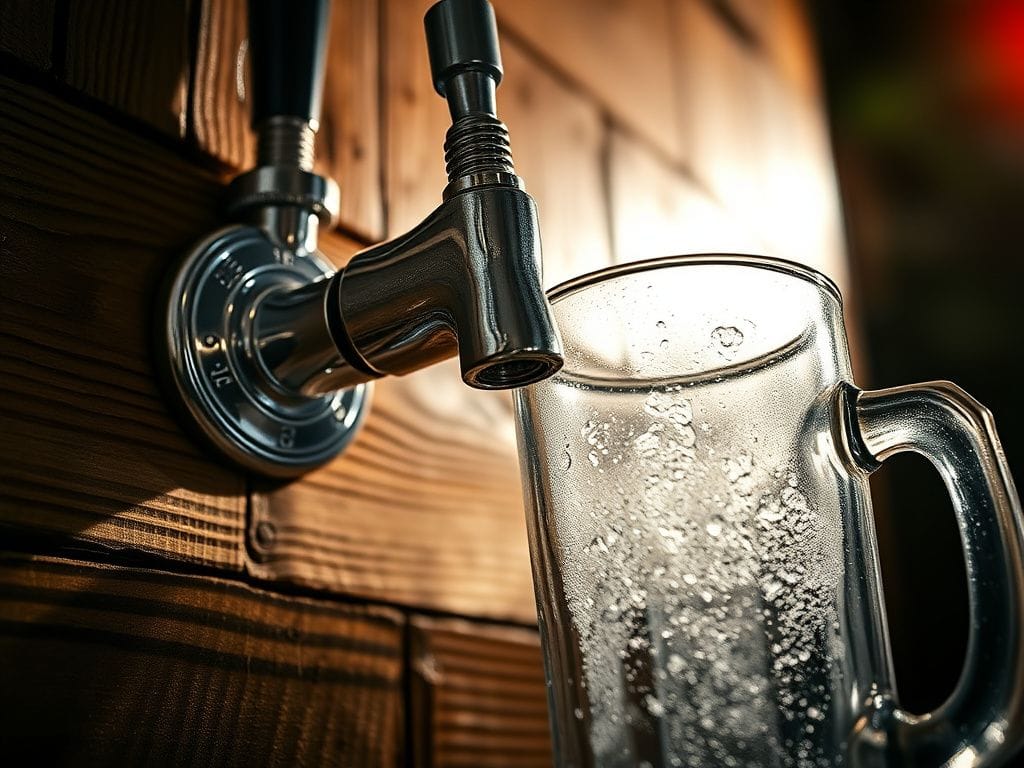
Precision installation of a through-the-wall tap system demands meticulous planning, thermal management, and robust component integration. This guide provides the definitive technical parameters and procedural steps to engineer a professional-grade draft dispense solution, ensuring optimal beer quality and longevity in your man cave. Avoid common pitfalls through adherence to these specifications.
Critical System Components & Parameters
| Component | Specification/Material | Function | Critical Parameter | Installation Note |
|---|---|---|---|---|
| Shank | 304 Stainless Steel (SS) | Connects faucet to beer line through wall penetration. | Length (e.g., 4″ – 12″), Bore (3/16″ ID for flow control), Thread (NPSM). | Insulate thoroughly to prevent thermal bridging and condensation. Ensure adequate wall thickness for specified length. |
| Faucet | 304 SS (preferred), Chrome-plated Brass | Controls beer flow for dispensing. | Forward-sealing design (e.g., Perlick 630SS), Flow control (optional for fine-tuning). | Regular cleaning is paramount; disassemble quarterly for thorough sanitization. |
| Beer Line | Barrier Tubing (e.g., EVOH-lined PVC), NSF 51 Certified | Transports beer from coupler to shank. | 3/16″ ID standard, Specific Length for System Balance (see Math Box). | Cut precisely with a dedicated line cutter. Use Oetiker clamps for secure, leak-proof connections. Maintain cold chain. |
| Gas Line | 5/16″ ID Vinyl Tubing, NSF 51 Certified | Transports CO2 from regulator to coupler. | 5/16″ ID standard, High-pressure rated. | Utilize worm clamps or Oetiker clamps. Route separately from beer lines to prevent cross-contamination or thermal transfer. |
| CO2 Regulator | Dual-gauge (high & low pressure), Brass body | Reduces tank pressure to serving pressure. | Pressure stability (±0.5 PSI), Leak integrity. | Secure to CO2 tank or wall. Perform leak test with solution or pressure drop monitoring post-installation. |
| Coupler | 304 SS (preferred) for Sanke (D-Type), Ball Lock, Pin Lock | Connects gas & beer lines to keg. | Material compatibility (SS), Gasket integrity. | Ensure proper gasket seating. Disassemble and clean regularly, especially poppet valves. |
| Drip Tray | 304 SS (surface mount or recessed) | Catches beer drips & foam. | Drainage capacity, Ease of cleaning. | Position directly beneath faucet. If recessed, ensure proper slope for drainage to an external receptacle or plumbed drain. |
| Insulation | Closed-cell foam (e.g., Armaflex), Expanding foam | Minimizes thermal transfer & condensation. | R-value appropriateness for climate, Moisture barrier. | Crucial around shank, within wall cavity, and along beer lines from cold source. Prevent air infiltration. |
System Engineering Calculations
Accurate pressure management and line resistance calculation are critical for optimal beer dispense. Imprecise values result in excessive foam, sluggish pours, or off-carbonation profiles.
1. CO2 Serving Pressure Determination (PSI)
This calculation ensures the beer remains at the desired carbonation level (Volumes of CO2) at a specific serving temperature. Consult a standard carbonation chart for precise values. For example:
Given:
- Target Carbonation: 2.5 Volumes of CO2 (typical for many lagers and ales, refer to BJCP Style Guidelines for specific styles)
- Serving Temperature: 38°F (3.3°C)
- Elevation: Sea Level (atmospheric pressure factor already considered in chart data)
From a standard carbonation chart (e.g., using a Widmer Brothers Brewing carbonation chart or similar):
At 38°F and 2.5 volumes CO2, the required equilibrium pressure is approximately 12-14 PSI.
Note: This pressure MUST be held constant to maintain carbonation stability. Fluctuations lead to breakout (foaming) or absorption (flatness).
2. Beer Line Length Calculation (Draft System Balance)
The objective is to achieve a net pressure of 0 PSI at the faucet by balancing applied CO2 pressure against the resistance of the beer line and system components. This results in a smooth, controlled pour without excessive foam.
Formula for Required Line Length:
L = (P_gauge - P_faucet - P_elevation) / R_line
Where:
L= Required Beer Line Length (feet)P_gauge= CO2 Pressure at Regulator (PSI) – determined above (e.g., 13 PSI)P_faucet= Faucet Restriction (PSI) – generally assumed to be 1 PSI for standard faucets.P_elevation= Elevation Head Pressure (PSI) – for every foot of vertical rise from keg center to faucet, add 0.5 PSI.R_line= Resistance of Beer Line (PSI/foot) – For 3/16″ ID vinyl or barrier tubing, this is approximately 2.2 – 2.5 PSI/foot. We will use 2.4 PSI/foot for this example.
Example Scenario:
- Keg in refrigeration unit, faucet 3 feet vertically above keg center.
Calculation:
P_elevation = 3 feet * 0.5 PSI/foot = 1.5 PSI
L = (13 PSI - 1 PSI - 1.5 PSI) / 2.4 PSI/foot
L = (10.5 PSI) / 2.4 PSI/foot
L ≈ 4.38 feet
Therefore, a 4.5-foot length of 3/16″ ID beer line would be a suitable starting point for this specific configuration. Minor adjustments may be required during commissioning based on actual pour performance. Consider this a minimum; slightly longer lines (up to ~6 feet for this setup) can offer more forgiveness in pressure regulation without drastically impacting flow rate, but excessively long lines will slow the pour.
Deep Dive: Engineering a Through-The-Wall Draft System
The successful implementation of a through-the-wall draft system transcends mere assembly; it demands a deep understanding of fluid dynamics, thermal physics, and material science. This section details the rigorous planning, component specification, and procedural execution necessary to achieve a commercial-grade dispense solution in a residential application, ensuring beer integrity from keg to glass.
I. Pre-Installation Site Survey & Environmental Assessment
Before any physical modification commences, a comprehensive site survey is mandatory. This involves both the external wall façade and the internal cold storage environment. Failure to conduct a thorough assessment can lead to structural compromise, thermal inefficiency, or non-compliance with local building codes.
A. Wall Construction Analysis: Identify the precise composition of the wall. Common types include:
- Drywall/Plaster and Lathe: Relatively straightforward to penetrate. Identify stud locations using a high-precision stud finder (e.g., Zircon multi-scanner) to avoid cutting into structural members. Plan for precise hole saw operation.
- Brick/Stone/Concrete: Requires specialized masonry drill bits and hole saws (diamond-tipped for concrete, carbide-tipped for brick/stone). Dust mitigation is critical. Structural engineers should be consulted for load-bearing walls.
- Exterior Siding: Vinyl, wood, or fiber cement. Ensure a clean, weather-sealed penetration to prevent moisture ingress. Flashing and appropriate caulk (e.g., silicone or polyurethane sealant) are essential.
B. Structural Integrity: Determine if the proposed penetration path intersects with electrical conduits, plumbing, or load-bearing elements. Utilize a borescope camera if internal visibility is limited. A qualified electrician and plumber should be consulted if any utilities are in the proposed path. Never compromise structural integrity for tap placement; relocate the system if necessary.
C. Internal Cold Storage Environment: This is the heart of your draft system. Whether utilizing a dedicated kegerator, a modified chest freezer, or a custom cold room, precise temperature control (typically 38-42°F / 3.3-5.6°C) is non-negotiable. Assess:
- Space Allocation: Ensure sufficient internal volume for kegs (e.g., full-size, pony, Cornelius), CO2 cylinder(s), regulator(s), and beer line routing without crimping.
- Air Circulation: Stagnant air pockets lead to inconsistent beer line temperatures and increased foaming. Install a small, low-CFM fan (e.g., 12V DC computer fan) to circulate chilled air up the shank and throughout the enclosure.
- Drainage: For chest freezer conversions, a drain hole for condensate or spills is recommended, typically plumbed to an external bucket or floor drain.
- Power Access: Verify proximity to a dedicated 15A or 20A circuit for the refrigeration unit. Avoid extension cords for permanent installations.
D. External Aesthetics & Environmental Factors: Consider the visual impact of the faucet and drip tray on the exterior wall. Account for direct sunlight exposure (which can heat the faucet) and potential for insect ingress (requiring screens or covers when not in use). For systems exposed to external elements, stainless steel components are mandatory for corrosion resistance. Consider a protective cover or enclosure for the faucet during inclement weather or extended periods of non-use.
II. Precision Component Selection & Sourcing
The longevity and performance of your through-the-wall system are directly proportional to the quality of its components. Compromise on material or specification is not an option.
A. Shank Selection:
- Material: Exclusively 304 Stainless Steel (SS). Chrome-plated brass shanks are susceptible to corrosion from beer acids, leading to off-flavors and premature failure.
- Length: Critical for proper wall penetration. Measure wall thickness (including any interior/exterior finishes) and add approximately 1/2″ – 1″ for mounting hardware and clearance. Common lengths range from 4″ to 12″.
- Bore Diameter: Standard 3/16″ ID is typical. For specialized high-flow applications or stout faucets, larger bores may be considered, but these require advanced line length calculations.
- Thermal Mass: A solid SS shank contributes to thermal stability at the faucet.
B. Faucet Selection:
- Material: Again, 304 SS is the professional standard for all beer-contact surfaces.
- Design: Prioritize forward-sealing faucets (e.g., Perlick 630SS, Intertap). These designs prevent beer from drying inside the faucet body, minimizing bacterial growth and sticking. Rear-sealing faucets (e.g., standard picnic tap) allow beer to sit stagnant, leading to rapid contamination.
- Flow Control: Optional, but highly recommended for dispensing various beer styles or for fine-tuning pour rates. These faucets incorporate an adjustable restriction mechanism to modulate flow without altering system pressure.
C. Beer Line Specification:
- Material: Barrier tubing is superior to standard PVC. EVOH (Ethylene Vinyl Alcohol) lined tubing or PEX offers excellent oxygen barrier properties, prevents CO2 egress, and resists flavor absorption/leaching.
- Diameter: 3/16″ ID is the industry standard for achieving adequate resistance for balanced draft systems. Larger IDs (e.g., 1/4″, 5/16″) offer less resistance, requiring significantly longer line lengths.
- Certification: Ensure NSF 51 certification for all beer contact materials, guaranteeing suitability for food and beverage applications.
- Connectors: Utilize stainless steel flare nuts with neoprene washers at the shank connection. For coupler connections, high-quality, re-usable barbed fittings or compression fittings (with Oetiker clamps) are preferred over reusable worm clamps, which can damage tubing.
D. Gas Line Specification:
- Material: 5/16″ ID vinyl tubing, rated for high pressure (typically 100 PSI working pressure). While less critical than beer line, NSF 51 certification is still recommended.
- Connectors: Use secure clamps (Oetiker or worm clamps) at regulator and coupler connections.
E. CO2 System:
- Regulator: A dual-gauge primary regulator (one gauge for tank pressure, one for serving pressure) is essential. For multi-tap systems, secondary regulators allow independent pressure control for each keg. Brass body is standard, SS for corrosive environments.
- CO2 Cylinder: Aluminum cylinders are lighter. Sizing (5lb, 10lb, 20lb) depends on consumption rate. Ensure hydro-testing date is current.
- Safety: Implement a check valve between the regulator and gas line to prevent beer from flowing back into the regulator, which can cause severe damage.
F. Couplers:
- Type: D-Type Sanke for commercial kegs, Ball Lock or Pin Lock for homebrew Cornelius kegs.
- Material: 304 SS beer-contact components.
G. Drip Tray:
- Material: 304 SS for corrosion resistance and ease of cleaning.
- Mounting: Surface mount or recessed. Recessed trays offer a cleaner aesthetic and can be plumbed directly to a drain.
- Drainage: If plumbing to a drain, ensure proper trap and vent to prevent sewer gas ingress. A simple external collection bucket is often sufficient for residential use.
H. Thermal Insulation & Management:
- Shank Insulation: Absolutely critical. Utilize closed-cell foam tubing (e.g., Armaflex) wrapped tightly around the shank from the cold side into the wall cavity. Expanding foam can fill voids, but ensure it is low-expansion to avoid damaging wall structures.
- Wall Cavity: Ensure the entire wall penetration is sealed and insulated to prevent heat transfer and condensation within the wall.
- Beer Line Chilling: If beer lines run outside the refrigerated unit for more than a few inches, a separate chilling solution is required (e.g., a glycol chiller recirculating cold fluid through a jacket around the beer lines, or a dedicated draft fan circulating cold air from the kegerator). This is paramount for maintaining consistent beer temperature from keg to faucet, preventing the “first-pour foam” syndrome.
III. Installation Procedure: A Phased Approach
Execution must be systematic and precise. Deviations can result in leaks, structural issues, or system malfunction.
A. Layout & Marking:
- Internal Marking: From inside the cold storage unit, identify the exact horizontal and vertical center point for the shank. Ensure it clears internal components and allows for ergonomic faucet access outside.
- Pilot Hole: Drill a small (e.g., 1/4″) pilot hole from the inside, ensuring it exits cleanly on the exterior at the desired location. Use a level.
- Exterior Verification: Confirm the exterior pilot hole location aligns with aesthetic and functional requirements.
B. Wall Penetration:
- Hole Saw Selection: Choose a hole saw appropriate for the shank diameter (e.g., 7/8″ or 1″). For masonry, use a diamond-tipped or carbide-tipped hole saw.
- Drilling: From the exterior, use the pilot hole as a guide. Drill slowly and steadily, applying even pressure. For masonry, utilize a hammer drill function. For drywall, cut cleanly to avoid tearing.
- Clean-up: Remove all debris from the wall cavity. Inspect for any unforeseen obstructions.
C. Shank & Faucet Assembly:
- Gaskets: Place a rubber or neoprene gasket on the exterior side of the wall. Insert the shank through the wall, ensuring the internal threaded end is inside the cold storage unit.
- Wall Plate (Optional): If using an aesthetic wall plate on the exterior, install it now with appropriate sealant.
- Securing Shank: From the interior, slide the large washer over the shank threads, followed by the shank nut. Hand-tighten initially, then use a basin wrench or crescent wrench to firmly secure the shank. Do not overtighten, which can damage the wall or gaskets, but ensure no movement.
- Faucet Attachment: On the exterior, thread the faucet onto the shank. Ensure a faucet washer (usually nylon) is present between the faucet and the shank collar for a leak-proof seal. Hand-tighten, then use a faucet wrench to achieve a snug, upright position.
D. Beer Line & Gas Line Integration:
- Beer Line Cutting: Refer to the “System Engineering Calculations” for precise length. Cut the 3/16″ ID beer line cleanly and squarely using a dedicated tubing cutter.
- Shank Connection: Slide a flare nut and neoprene washer onto one end of the beer line. Secure it to the interior threaded end of the shank. Hand-tighten, then use a wrench (e.g., 7/16″ or 1/2″) to ensure a snug, leak-free connection. Do not overtighten.
- Coupler Connection: Attach the other end of the beer line to the appropriate barbed fitting on the keg coupler. Secure with an Oetiker clamp for a permanent, reliable seal.
- Gas Line Connection: Attach the 5/16″ ID gas line to the ‘Gas In’ barb on the CO2 regulator. Secure with an Oetiker clamp. Connect the other end to the ‘Gas Out’ barb on the keg coupler, again with an Oetiker clamp.
E. Thermal Insulation Protocol:
- Shank & Wall Cavity: Pack the wall cavity around the shank with closed-cell foam insulation. Apply foam pipe insulation over the entire exposed shank length within the cold storage unit. If using expanding foam, use minimal expansion formulas and allow proper cure time.
- Beer Line Path: Route beer lines strategically to minimize contact with warm surfaces. Insulate any exposed beer line run from the keg to the shank within the cold storage unit, ideally with additional foam sleeves, to preserve critical liquid temperature. Consider a fan to circulate cold air towards the shank within the cold box.
- Exterior Sealing: Apply a high-quality, exterior-grade sealant (e.g., marine-grade silicone or polyurethane) around the exterior wall plate or faucet base where it meets the wall, creating a weather-tight seal against moisture and air infiltration.
F. CO2 Cylinder & Regulator Setup:
- Cylinder Placement: Secure the CO2 cylinder upright within the cold storage unit or externally in a well-ventilated area (if external, ensure lines are insulated).
- Regulator Attachment: Ensure the CO2 tank valve is closed. Thread the CO2 regulator onto the tank valve. Use a wrench to snug the connection (usually 13/16″), but do not overtighten.
- Leak Detection: Apply a leak detection solution (e.g., Star San solution, soapy water, or commercial leak spray) to all gas connections: tank valve, regulator inlet, regulator gauges, and all gas line connections. Open the tank valve slowly. Look for bubbles, indicating a leak. Tighten connections as necessary. This step is non-negotiable for safety and efficient CO2 usage.
G. Drip Tray Installation:
- Mounting: Position the drip tray directly beneath the faucet. For surface mounts, secure with appropriate wall anchors. For recessed trays, ensure proper framing and support within the wall.
- Drainage: If a plumbed drain is utilized, connect it now, ensuring a slight downward slope for effective liquid removal. Verify no leaks in the drain line.
IV. Commissioning, Calibration, and Maintenance Protocols
Initial system activation and ongoing preventative maintenance are paramount for consistent dispense quality and longevity. This ensures your precision draft system components function optimally.
A. System Sanitization:
- Initial Cleaning: Before introducing beer, flush the entire beer path (coupler, beer line, shank, faucet) with a brewers’ caustic cleaner (e.g., PBW – Powdered Brewery Wash) mixed according to manufacturer instructions. Circulate for 15-30 minutes.
- Rinsing: Rinse thoroughly with potable water until all traces of cleaner are removed.
- Sanitization: Circulate a non-rinse sanitizer (e.g., Star San or iodophor) through the system for the recommended contact time. Ensure all beer-contact surfaces are coated.
- Final Rinse: For Star San, no final rinse is needed; simply drain. For iodophor, a quick flush with sterile water may be desired.
B. Carbonation & Pressure Setting:
- Keg Connection: Connect the sanitized beer line and gas line to the keg coupler. Attach the coupler to the keg.
- Initial Pressure: With the CO2 tank valve open, adjust the low-pressure regulator gauge to the calculated serving pressure (e.g., 13 PSI) for your target carbonation and temperature. Allow several hours (or up to 24 hours) for the beer to equilibrate to this pressure and temperature, especially if the keg was not previously carbonated to target.
- Monitoring: Periodically check the serving pressure and the temperature within the cold storage unit. Stable temperature and pressure are critical for proper carbonation and dispense.
C. Pour Test & Adjustment:
- First Pour: Dispense a pint. Observe the flow rate and foam level.
- Troubleshooting Foam:
- Excessive Foam: Often indicates too much pressure, too warm beer, or an unbalanced system. Check temperature first. If temperature is stable, ensure your line length is adequate (may need to increase slightly). Re-check CO2 pressure.
- Sluggish Pour/Flat Beer: Indicates too little pressure, a clogged line/faucet, or a crimped line. Check CO2 pressure. Inspect lines for kinks. Disassemble and clean the faucet if flow is restricted.
- Fine-Tuning: Minor adjustments (typically 0.5-1 PSI) to the CO2 regulator pressure may be required to achieve the perfect pour. Allow time for changes to manifest.
D. Ongoing Maintenance Schedule:
- Daily (or before each use): Flush faucet with a quick burst of water to clear any residue.
- Weekly (or between kegs): Clean the faucet thoroughly with a faucet brush and sanitizing solution.
- Bi-weekly/Monthly: Perform a full line cleaning using a dedicated beer line cleaner (e.g., BLC – Beer Line Cleaner) and a pump or cleaning keg. This is paramount for preventing biofilm buildup and off-flavors. Refer to draft system maintenance guidelines from professional organizations.
- Quarterly/Annually: Disassemble and inspect all beer-contact components (coupler, shank, faucet). Replace worn gaskets, O-rings, and check valves. Lubricate faucet levers if necessary with food-grade silicone grease. Re-verify all gas connections for leaks.
V. Safety & Regulatory Compliance
Adherence to safety protocols is non-negotiable for any pressurized system and wall modification.
A. CO2 Handling:
- Always secure CO2 cylinders upright with a chain or strap to prevent tipping, which can damage the valve or regulator.
- Ensure adequate ventilation in the area where CO2 is stored. CO2 is an asphyxiant and heavier than air.
- Never tamper with safety relief valves on regulators or CO2 tanks.
B. Electrical Safety:
- Ensure all refrigeration units are properly grounded.
- Avoid overloading electrical circuits.
- For any custom electrical work (e.g., adding outlets, installing fans), consult a licensed electrician.
C. Structural Integrity:
- Do not drill into load-bearing studs without professional engineering consultation.
- Ensure wall penetrations are properly sealed to prevent moisture damage and pest ingress.
By rigorously following these guidelines, you can engineer and install a through-the-wall tap system that not only enhances your man cave but also delivers consistent, high-quality beer for years. The precision required in this endeavor is directly transferable to all aspects of brewing. Learn more at optimize your home brewing setup.