Discover beer tasting vs wine tasting differences – from carbonation to bitterness, learn 8 key distinctions in 2025.
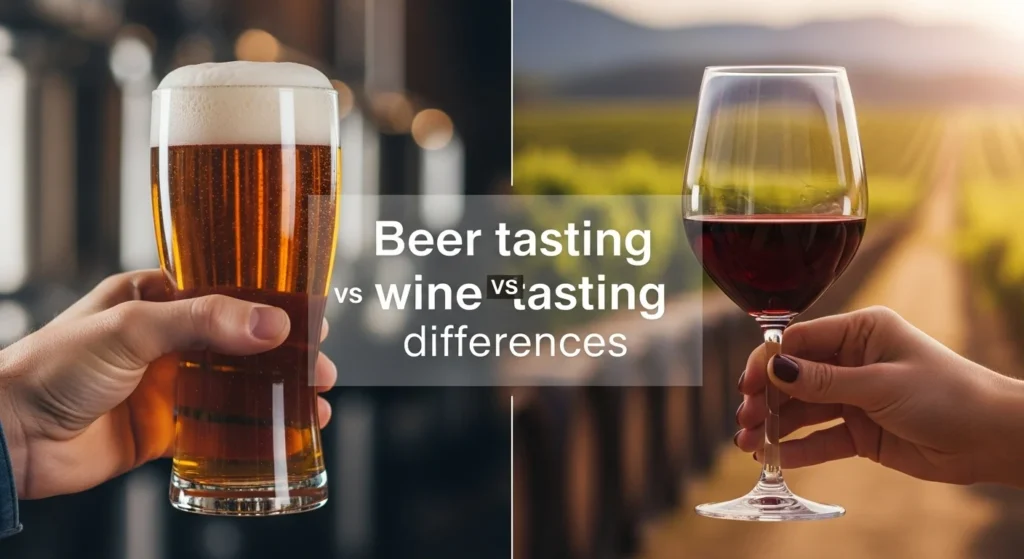
Ever swirled a beer glass and wondered if you’re supposed to spit like wine tasters do? As a certified nutritionist and fermentation expert who’s conducted hundreds of tastings, I’ve discovered that understanding beer tasting vs wine tasting differences transforms how you appreciate both beverages. These aren’t just different drinks – they require fundamentally different evaluation approaches when using home brewing equipment.
The beer tasting vs wine tasting differences extend far beyond obvious distinctions. While both involve analyzing appearance, aroma, and flavor, beer’s carbonation, bitterness from hops, and malt-driven complexity create unique tasting challenges requiring specialized techniques and vocabulary.
Through my grandmother’s traditional fermentation methods and modern nutritional science training, I’ve learned how these beverages demand different sensory approaches. Some techniques transfer beautifully between them, others need complete adjustment, and several reveal surprising similarities hiding beneath surface differences.
This guide explores eight critical distinctions between beer and wine tasting, from swallowing versus spitting to temperature requirements, helping you confidently evaluate both fermented beverages.
Swallowing vs Spitting: The Fundamental Difference
The most dramatic difference between beer and wine tasting is that beer tasters swallow while wine tasters typically spit. According to WSET’s practical tasting guide, a key point of difference in beer tasting compared to wine tasting is that it is typical to swallow the beer.
This isn’t about etiquette – it’s about evaluation. According to WSET, carbonation plays a crucial role in the overall flavor experience and how we perceive the beer, and to fully appreciate this one must swallow it.
Carbonation changes everything. The bubbles carry aroma compounds to your olfactory receptors differently than still wine. Swallowing allows you to experience how carbonation lifts flavors, creates mouthfeel, and affects finish.
Professional wine tasters spit to avoid intoxication during evaluations assessing dozens of wines. Beer tasters can swallow because beer’s lower alcohol content (typically 4-8% vs wine’s 12-15%) makes tasting sessions more manageable.
This fundamental difference affects entire tasting methodology. Wine evaluation focuses on pre-swallow assessment analyzing tannins and acidity on the palate, while beer evaluation emphasizes post-swallow finish examining lingering bitterness and carbonation effects.
Acidity Profiles: pH Levels and Perception
Beer and wine differ dramatically in acidity levels. According to Napa Valley Wine Academy, wine is more acidic with pH between 3.0-3.6, while beer’s pH is usually between 4.0-4.5.
The acid types differ too. According to Napa Valley Wine Academy, wine is dominated by tartaric acid (tastes unmistakably like wine), while sour beers will be dominated by lactic acid (tastes like sauerkraut).
Sour beer styles bridge this gap. According to Napa Valley Wine Academy, some styles are every bit as acidic and refreshing as wine – think Flanders beers, Lambics, and Berliner Weisse, with pHs ranging from 3.2-3.5.
This affects tasting approach. Wine tasters assess acidity as structural element balancing sweetness and tannins. Beer tasters evaluate acidity as style characteristic – expected in sours, undesirable in lagers.
| Characteristic | Wine Tasting | Beer Tasting |
|---|---|---|
| Typical pH | 3.0-3.6 | 4.0-4.5 |
| Primary Acid | Tartaric acid | Lactic/acetic acid (sours) |
| Acidity Role | Structural balance | Style-specific trait |
| Temperature | 45-65°F | 38-55°F |
| Swallow/Spit | Spit typical | Swallow typical |
| Carbonation | Minimal (still wines) | Essential character element |
Bitterness vs Tannins: Structural Components
Beer’s bitterness from hops parallels wine’s tannins as structural elements. According to Napa Valley Wine Academy, tannin provides astringent feeling in wine (grippy, gritty, pixelated), while beer’s equivalent is bitterness and astringent texture from hops.
The chemistry differs fundamentally. According to Napa Valley Wine Academy, bitterness comes from boiling hops with isomerization of alpha acids, while grape tannins come from skins or barrels.
Both create drying palate effects. I’ve found through extensive sensory analysis that highly hopped IPAs create similar astringency to tannic Cabernet Sauvignon, though through completely different chemical mechanisms.
Beer tasters evaluate bitterness using International Bitterness Units (IBUs) measuring hop acid concentration. Wine tasters assess tannin quality (smooth, grippy, astringent) and quantity (light, medium, high) using subjective scales.
The functional similarity means wine tasters can transfer structural evaluation skills to beer. Both require assessing how these components balance sweetness, how they interact with other flavors, and how they affect finish.
Color Assessment: Malt vs Grape Pigments
Beer and wine derive colors from completely different sources. According to Napa Valley Wine Academy, wine color runs along two spectrums relying on pigment in grape skins and oxygen exposure.
Beer color tells completely different story. According to Napa Valley Wine Academy, beer color is dictated by malt – the easiest way to remember is thinking about the color spectrum of toast.
The progression mirrors cooking grain. Beer ranges from straw (lightly kilned malt) through gold, amber, red, brown to black (heavily roasted malt). Wine progresses from straw/lemon (white wines) through gold and amber to ruby, garnet, tawny (red wines).
According to Napa Valley Wine Academy, beer color is akin to white wine color (straw, gold, brown) and red wine (ruby).
I assess beer color differently than wine. In beer, color directly indicates malt selection – darker beers used roasted malts creating chocolate, coffee, or caramel flavors. In wine, color indicates grape variety, age, and oxygen exposure but doesn’t predict specific flavors as reliably.
Beer Tasting vs Wine Tasting Foam Analysis: Beer’s Unique Feature
Beer foam (head) represents entirely unique evaluation category absent in most wine tasting. According to Napa Valley Wine Academy, beer is famous for foam sitting atop it – when assessing foam, look at color (white, tan, brown), size, and stability.
Wine typically lacks foam except sparkling wines. According to Napa Valley Wine Academy, wine foam lacks protein content of beer, so stability of large exploding bubbles is fleeting.
Foam quality indicates beer condition. Dense, persistent foam with small bubbles suggests proper carbonation, fresh beer, and adequate protein content. Poor foam indicates stale beer, improper storage, or dirty glassware.
I evaluate foam color, texture, and retention systematically. White foam indicates lighter beers, tan suggests amber styles, brown appears in stouts. Rocky foam (uneven, large bubbles) indicates poor carbonation, while creamy foam (small, dense bubbles) suggests quality brewing.
Clarity Expectations: Haze Trends
Both beer and wine naturally produce haze. According to Napa Valley Wine Academy, both are naturally hazy full of proteins and polyphenols, so some form of filtration takes place.
The haze trends diverge dramatically. According to Napa Valley Wine Academy, there is trend for unfiltered beer and wine – a haze craze – think En Rama Sherry and Hazy IPAs.
Cultural expectations differ by style. Traditional European lagers demand crystal clarity, while New England IPAs embrace intentional turbidity. Most wines expect clarity, though unfiltered “natural” wines gain popularity.
According to Napa Valley Wine Academy, producers argue removing haze can reduce complexity and intensity of beverages.
In my fermentation analysis, I’ve found haze from proteins, yeast, and hop particles can enhance mouthfeel and flavor delivery. Clarity became aesthetic preference rather than quality indicator as brewing science advanced.
Aroma Complexity: Ingredients vs Terroir
Beer and wine develop aromas through fundamentally different mechanisms. According to WSET’s comparison guide, beer has more flexible ingredients and carbonation, while both share some aromas.
Wine aroma derives primarily from grape variety and terroir. According to WSET, wine tasters detect fruit, floral, spice, earthy, and oak-derived aromas revealing wine style and origin.
Beer aroma comes from multiple ingredient sources. According to WSET, beer tasters sniff for hop character (floral, fruity, herbaceous), malt character (caramel, bread, chocolate), fermentation character (spices, barnyard), and other characteristics.
This creates fundamentally different evaluation frameworks. Wine tasting identifies grape variety and regional characteristics through aroma. Beer tasting deconstructs ingredient contributions – what came from hops versus malt versus yeast.
I approach beer aroma analysis systematically, separating hop aromatics (citrus, pine, floral) from malt aromatics (caramel, toast, chocolate) from yeast character (fruity esters, spicy phenols). Wine demands integrated assessment where components blend.
Professional Certification: Sommeliers vs Cicerones
Beer and wine developed parallel but distinct professional pathways. According to Wikipedia’s beer sommelier entry, a beer sommelier (cicerone in the US) is a trained professional specializing in beer service and knowledge, similar to traditional wine sommelier.
The terminology differs by region. According to WSET’s career guide, a beer sommelier is trained expert specializing in beer styles, brewing methods, and food pairings – the role is sometimes called Cicerone, particularly in the United States.
Certification requirements overlap significantly. According to Wikipedia, knowledge required for certification includes understanding of styles, brewing, ingredients, history, glassware, service, draught systems, tasting, and food pairings.
According to NPR’s coverage, the Cicerone program works to bring the same knowledge level sommeliers have about wine to the world of malt and hops.
I’ve observed both certifications require similar dedication. Master Sommelier and Master Cicerone represent pinnacle achievements in their respective fields, with similar pass rates (around 10%) and intensive study requirements.
Frequently Asked Questions
Do beer tasters spit like wine tasters?
No – beer tasters typically swallow. According to WSET, swallowing beer allows proper evaluation of carbonation effects, which play crucial role in overall flavor experience.
Is beer more acidic than wine?
No – wine is more acidic. According to Napa Valley Wine Academy, wine has pH between 3.0-3.6, while beer is usually 4.0-4.5, though sour beers can match wine acidity.
What is a beer sommelier called?
According to Wikipedia, a beer sommelier is known as a cicerone in the United States – a trained professional specializing in beer service and knowledge.
Can wine tasting skills transfer to beer?
Yes – according to WSET, wine tasters can transfer skills, building on existing knowledge while learning beer-specific evaluation techniques.
Why does beer have foam but wine doesn’t?
According to Napa Valley Wine Academy, beer foam comes from protein content absent in most wines – even sparkling wine foam lacks stability due to missing proteins.
Is beer tasting as complex as wine tasting?
Yes – beer tasting involves complex ingredient analysis. According to WSET, beer tasters evaluate hop character, malt character, fermentation character, and carbonation – different complexity than wine but equally sophisticated.
What temperature should beer be tasted at?
Beer serving temperature varies by style, typically 38-55°F. Lighter beers serve colder (38-45°F), while stronger ales serve warmer (50-55°F) to reveal complexity. Wine typically serves 45-65°F.
Understanding Both Fermentation Traditions
Mastering beer tasting vs wine tasting differences enriches appreciation for both fermented beverages. Beer’s carbonation, hop bitterness, and malt complexity require swallowing, foam evaluation, and ingredient-specific analysis absent in wine tasting.
Yet remarkable similarities exist. Both assess appearance systematically, evaluate aroma intensity and character, analyze structural balance, and consider finish length. Professional certifications (Master Sommelier, Master Cicerone) demand similar dedication and expertise.
The fundamental difference lies in evaluation philosophy. Wine tasting identifies grape variety and terroir through integrated sensory assessment. Beer tasting deconstructs ingredient contributions – understanding what hops, malt, and yeast each provide to final character.
As a fermentation expert who’s conducted hundreds of tastings, I appreciate how these different approaches reveal unique aspects of human creativity with fermented beverages. Wine showcases terroir and grape variety through minimal intervention. Beer demonstrates ingredient mastery and brewing innovation through controlled fermentation.
Start developing both skill sets through systematic tasting practice, understanding how carbonation affects flavor delivery, and appreciating how different fermentation traditions create distinct sensory experiences.
About the Author
Lisa Fermenta is a certified nutritionist and fermentation expert who explores the health benefits of probiotic beverages. Her journey began in her grandmother’s kitchen, where she learned traditional fermentation methods from Eastern European brewing and winemaking families. Lisa holds advanced certifications in both wine and beer evaluation, including WSET Level 3 in Wine and Cicerone Certified Beer Server credentials. She specializes in comparative sensory analysis of fermented beverages, understanding how different fermentation methods create unique flavor profiles and nutritional properties.
Through her nutrition background, Lisa examines how tasting techniques affect flavor perception and how fermentation creates beneficial compounds. When not conducting professional tastings or teaching fermentation workshops, Lisa enjoys experimenting with traditional kvass recipes and hosting cross-cultural fermentation dinners. Connect with her at [email protected] for insights on fermentation science and beverage evaluation.