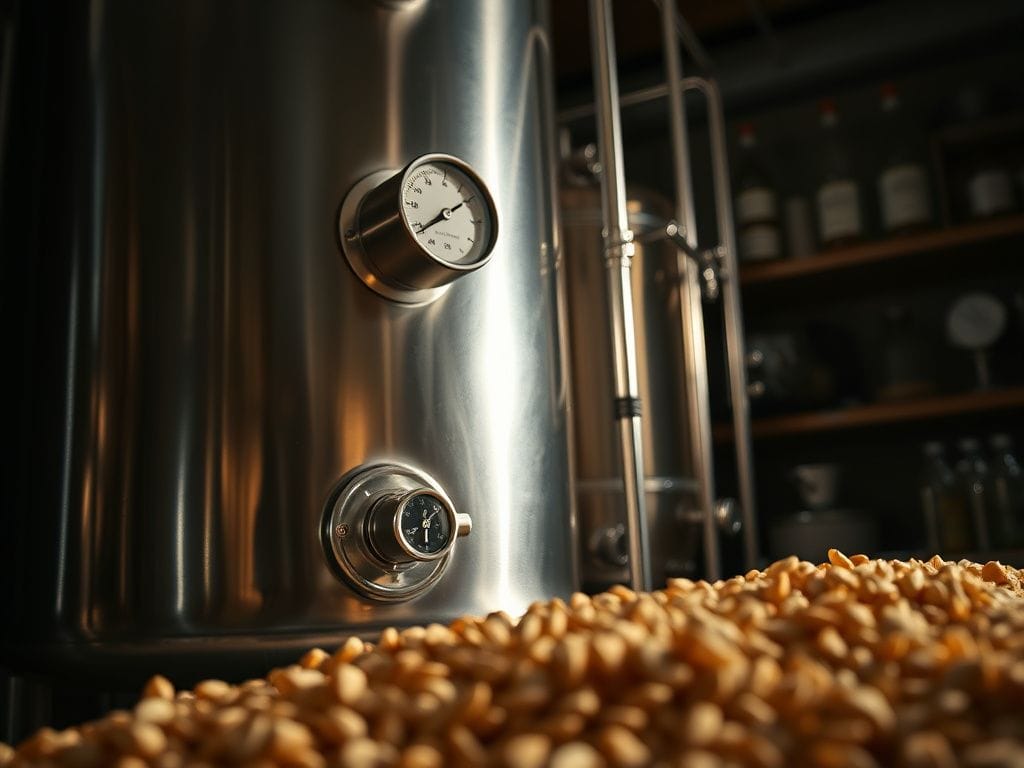
Embarking on the homebrewing journey with rapid scaling in mind demands precise equipment selection. Beginners seeking to quickly expand production and refine their craft must prioritize modular, robust kits that facilitate larger batch sizes and advanced techniques from day one. This definitive guide rigorously analyzes starter systems optimized for efficiency, quality, and seamless upgrades, ensuring your brewing foundation supports sustained high-volume output. Select wisely, brew prolifically.
Master Brewer’s Starter Kit Analysis: Scalability Matrix
| Kit Architecture/Name | Primary Fermentation Capacity & Material | Key Component Material & Grade | Scalability Features & Advantages | Initial Upgrade Path & Focus |
|---|---|---|---|---|
| Grainfather G30/Brewzilla 35L (All-in-One Electric) | 30-35L (7-9 gal) max, typically 23L/5gal final volume; 304 SS conical fermenter often bundled or as direct upgrade. | 304 Stainless Steel (SS) vessel and components; high-grade plastics for pumps/fittings. | Integrated mashing/boiling, precise PID temp control. Highly automated. Reduces footprint. Excellent for consistent 5-7 gallon batches. Allows for seamless transition to advanced techniques (e.g., spunding, pressure fermenting with accessory ferementer). | Glycol chiller for fermenter, external conical fermenters (e.g., SS BrewTech, Speidel), counter-pressure filling, dedicated filtration, larger pump for transfer. |
| SS BrewTech Brew Bucket + Basic Kettle (Modular SS System) | 7-14 gallons (26-53L); 304 SS conical or cylindrical fermenter. | 304 Stainless Steel for kettle, fermenter, ball valves. Silicone tubing. | Open-ended system allowing component upgrades. Stainless fermenters offer superior sanitation, temperature control via chilling coils/jackets, and durability. Kettle can be scaled up to 15-20 gallons easily. Adaptable to BIAB, HERMS, or RIMS. | Larger SS kettle (e.g., 15-20 gal), dedicated wort chiller (plate/counterflow), glycol chiller for SS fermenter, oxygenation kit, CO2 manifold for force carbonation/transfers. |
| Speidel Plastic Fermenter (30-60L) + Large Kettle (BIAB Focus) | 30L, 60L, 120L (8-32 gal); High-Density Polyethylene (HDPE) fermenter. | HDPE for fermenter, 304 SS kettle (10-20 gal), high-temp nylon BIAB bag. | Cost-effective entry into larger batches. Speidel fermenters are robust, easy to clean, and seal well. HDPE is oxygen barrier-friendly. Large kettle allows for 10-15 gallon BIAB batches. Excellent for proving recipes at volume without massive initial outlay. | Dedicated fermentation chamber (fridge/freezer with controller), larger SS kettle (e.g., 20-30 gal), pump for transfers/recirculation, plate chiller, pH meter, liquid yeast propagation setup. |
| Blichmann BoilerMaker Kettle + Fermenator (High-End Modular) | 7-15 gallons (26-57L); 304 SS conical fermenter with temperature control options. | Heavy-gauge 304 Stainless Steel throughout. High-quality brass/SS fittings. | Premium build quality and durability, designed for decades of use. Fully modular, allowing for precise system expansion. Boilermaker kettles are robust for larger batches, Fermenators offer professional-grade fermentation control (e.g., cooling coils). Integrates seamlessly with advanced accessories. | Full 3-vessel system (HLT, Mash Tun, Boil Kettle), pumps, plate/counterflow chiller, Blichmann RIMS/HERMS kit, oxygenation system, closed-transfer capabilities, automated CO2 pressure regulation. |
| Northern Brewer Deluxe All-Grain Starter Kit (BIAB/Entry All-Grain) | 6.5 gallons (25L) primary fermenter (plastic carboy or bucket); expandable to 7-10 gal. | Food-grade plastic for fermenter, 304 SS kettle (typically 10-15 gal). | Provides essential equipment for 5-gallon all-grain BIAB batches. Teaches fundamental techniques. Kettle size is often sufficient for initial 5-gallon batches with future potential for 10-gallon extract or smaller 5-gallon all-grain no-sparge. Cost-effective entry. | Larger SS conical fermenter (7-15 gal), immersion chiller, temperature controller with chest freezer/fridge, dedicated brewing pump, pH meter, water treatment chemicals, grain mill. |
Scalability Efficiency Metrics: Financial & Operational Analysis
For beginners aiming to scale rapidly, evaluating a kit extends beyond initial cost; it encompasses output volume per unit time, ingredient efficiency, and long-term infrastructure savings. Consider these calculations for true scalability:
1. Output Volume Ratio (Gallons/Hour of Brew Day):
This metric quantifies the return on your time investment. Assuming a 5-gallon target batch size for a basic kit vs. a 10-gallon target for a scalable kit, and a conservative estimate of brew day duration:
- Basic 5-Gallon Extract Kit: 4 hours total brew day for 5 gallons = 1.25 gallons/hour.
- Scalable 10-Gallon All-Grain Kit (e.g., All-in-One Electric or BIAB): 5-6 hours total brew day for 10 gallons (due to increased volume, mash time, etc.) = 1.67 – 2.00 gallons/hour.
Analysis: A scalable 10-gallon system, even with a slightly longer brew day, yields 33-60% more finished product per hour of labor, immediately improving your output velocity.
2. Yeast Management Savings (Per 10-Gallon Batch):
Efficient yeast management is critical for larger batches and cost control. While a 5-gallon batch might use one dry yeast packet (~$5), a 10-gallon batch typically requires two (~$10) or a significant liquid yeast starter.
- Cost per 10-Gallon Batch (New Dry Yeast): $10.00
- Cost per 10-Gallon Batch (Liquid Yeast Starter): $8 (vial) + $2 (DME for starter) = $10.00
Scalable Advantage: With robust, sanitary fermenters (e.g., stainless steel conical), yeast can be harvested and repitched for subsequent batches. This practice, critical for rapid scaling, effectively reduces yeast cost for all subsequent batches to near $0.00. Over 10 consecutive 10-gallon batches, this represents a potential $90-$100 saving on yeast alone.
3. Bulk Ingredient Cost Reduction (Malt):
Scaling rapidly enables purchasing ingredients in bulk, significantly reducing per-unit cost. Consider a common base malt, 2-Row:
- Small Quantity (5-10 lbs, for 5-gallon batches): ~$1.50 – $2.00/lb.
- Bulk Quantity (50-55 lbs sack, for 10-gallon batches/multiple 5-gallon batches): ~$0.90 – $1.20/lb.
Calculation Example for 10 lbs of 2-Row (approx. for a 10-gallon batch):
- Purchased in 5lb increments (two bags): 10 lbs * $1.75/lb = $17.50
- Purchased from a 50lb sack: 10 lbs * $1.00/lb = $10.00
Analysis: A $7.50 saving per 10 lbs of base malt by leveraging bulk purchasing. For a brewer scaling fast, these savings compound rapidly across multiple batches and various ingredient types (hops, specialty grains).
These calculations underscore that while initial investment for scalable kits may be higher, the return on investment through increased output, reduced operational costs, and enhanced quality control rapidly offsets the difference, propelling the beginner towards efficient, high-volume brewing.
The Definitive Master-Guide: Best Homebrewing Starter Kits for Beginners Who Want to Scale Fast
Embarking on the homebrewing journey is a commitment, a convergence of science, art, and patience. For the discerning beginner whose vision extends beyond a solitary 5-gallon batch, rapidly scaling production is not merely an aspiration but a strategic imperative. This guide is crafted for those who understand that an initial investment in the right infrastructure dictates the velocity and quality of their brewing evolution. It is about future-proofing your passion, ensuring that your starter kit isn’t a bottleneck, but a launchpad for consistent, high-volume, and technically sophisticated brewing operations. Welcome to BrewMyBeer.online, where we build brewers, not just beer.
The Scalable Mindset: Beyond the Basic Kit
Many beginners opt for entry-level kits, typically comprising two 6.5-gallon fermenting buckets, an airlock, a hydrometer, and a bottle capper. While adequate for a nascent interest, such kits are inherently limiting. Rapid scaling necessitates a shift in perspective. You’re not merely brewing; you’re establishing a micro-production facility. This means prioritizing robust, durable, and modular equipment that supports increased batch sizes, advanced process control, and efficient workflow. The goal is to minimize redundant purchases and maximize long-term value, ensuring that as your skills expand, your equipment capabilities match your ambition. This initial strategic choice profoundly impacts your trajectory, dictating the precision of your fermentations and the consistency of your product.
Core Components for Scalability: Engineering Your Brewing Foundation
Primary Fermentation Vessels: The Heart of Production
The fermenter is arguably the most critical component for a scaling brewer. While plastic buckets are cheap, their limitations for temperature control, oxygen permeability, and long-term sanitation are significant. For rapid scaling, consider:
- Stainless Steel Conical Fermenters (e.g., SS BrewTech Brew Bucket/Chronical, Blichmann Fermenator): These are the gold standard.
- Material: 304 Stainless Steel (SS) offers unparalleled durability, ease of sanitation (no scratching, non-porous), and excellent thermal conductivity for precise temperature control.
- Conical Design: Allows for yeast harvesting from the bottom dump valve without exposing the beer to oxygen, crucial for managing multiple generations of yeast and maintaining consistency across large batches. Also facilitates trub removal.
- Capacity: Start with at least 7-gallon capacity for standard 5-gallon batches, allowing ample headspace for vigorous fermentation. For those targeting 10-gallon batches immediately, 14-gallon or larger vessels are imperative.
- Temperature Control: Many SS conicals integrate chilling coils or jacketed designs, connecting directly to glycol chillers or immersion chillers. This precise temperature control is non-negotiable for producing consistent, quality beer at scale.
- Pressure Fermentation: Many SS fermenters are rated for pressure, enabling closed transfers (minimizing oxygen exposure) and spunding (naturally carbonating beer under pressure).
- High-Grade Plastic Fermenters (e.g., Speidel Fermenters, FermZilla Pressure Fermenters):
- Material: Food-grade HDPE (Speidel) or PET (FermZilla) offer improved oxygen barriers and durability over basic buckets.
- Capacity: Available in 30L (8 gal) up to 120L (32 gal), providing substantial volume options.
- Features: Speidels are robust, easy to clean, and feature wide lids for access. FermZillas offer conical designs, pressure rating, and the ability to dump yeast and perform closed transfers at a fraction of the cost of SS.
- Consideration: While superior to buckets, plastic will eventually scratch and harbor bacteria, necessitating eventual replacement. However, they offer an excellent cost-to-performance ratio for entry-level scaling.
Brewing Kettles: The Boil Volume Imperative
For any all-grain brewing, especially when scaling, the kettle size is paramount. An undersized kettle leads to boil-overs, reduced batch size, or the inability to perform full-volume mashes/boils, compromising efficiency and quality.
- Capacity: For a true 5-gallon finished batch, a 10-gallon (38L) kettle is the minimum for all-grain, allowing for boil-off and sufficient head-space. For 10-gallon finished batches, a 15-20 gallon (57-76L) kettle is essential.
- Material: 304 SS is the only choice. It’s durable, easy to clean, and inert.
- Features: Look for kettles with a tri-clamp or welded ball valve for easy wort transfer, and ideally, an integrated thermometer for accurate temperature monitoring. A false bottom or bazooka screen is critical for all-grain setups to prevent grain particulate from entering the fermenter and clogging transfer lines. Induction-ready kettles offer flexibility with heat sources.
Heat Source: Powering Your Production
Efficient and powerful heat is crucial for reaching and maintaining strike temperatures, boiling quickly, and getting a good rolling boil for hop utilization and hot break formation.
- Propane Burners: High BTU (e.g., 60,000-100,000 BTU) burners are workhorses for outdoor brewing, quickly heating large volumes. Ensure stability for larger kettles.
- Electric Brewing Systems:
- Immersion Elements: Drop-in elements (e.g., 5500W 240V) provide precise, clean heating for indoor brewing. Require dedicated electrical circuits.
- All-in-One Systems (e.g., Grainfather G30, Brewzilla): These systems integrate the kettle, heating element, pump, and often a control panel into a compact unit. Excellent for single-vessel mashing (BIAB or recirculating mash), precise temperature control, and compact setup. They streamline the brew day, making scaling up production more manageable for beginners. However, their maximum batch size is typically limited to 5-7 gallons.
Mashing Systems: Extracting Gold
Moving from extract to all-grain is a significant step in scaling quality and control. The method chosen impacts efficiency, equipment complexity, and future expandability.
- Brew-In-A-Bag (BIAB):
- Description: The simplest all-grain method, using a large, fine-mesh bag to hold the grist directly in the boil kettle. After mashing, the bag is lifted and drained.
- Scalability: Excellent for beginners wanting to scale to all-grain rapidly with minimal additional equipment. A large enough kettle and a sturdy lift system (pulley, hoist) are key for 10-gallon or larger BIAB.
- Efficiency: Typically 70-80%, can be optimized with proper crush and mash techniques.
- Recirculating Infusion Mash Systems (RIMS/HERMS):
- Description: More advanced, involving a separate mash tun and a pump to continuously recirculate wort through a heating element (RIMS) or a heat exchange coil in a hot liquor tank (HERMS) to maintain precise mash temperatures.
- Scalability: Highly scalable, offering superior temperature control and consistent conversion. Requires a dedicated mash tun, pump, and control system. Many all-in-one electric systems (Grainfather, Brewzilla) are essentially RIMS-style systems.
- Efficiency: Often yields higher extract efficiency (75-85%+) due to constant temperature and wort clarity.
Wort Chilling: Speed and Sanitation
Rapidly chilling wort post-boil is paramount for preventing off-flavors (DMS), minimizing bacterial infection, and achieving a good cold break. As batch sizes increase, so does the chilling demand.
- Immersion Chillers (SS or Copper): Submerged directly into the hot wort. Cost-effective for 5-gallon batches, but less efficient for 10+ gallons unless oversized.
- Plate or Counterflow Chillers: Highly efficient, rapidly chilling large volumes by passing wort and cold water through separate, counter-directional paths. Essential for scaling up due to their speed and efficiency. Require careful cleaning to prevent infection.
Oxygenation/Aeration: Fueling Your Yeast
Yeast health is critical for successful fermentation, especially with larger batches. Proper oxygenation of the wort prior to pitching is non-negotiable.
- Aeration: Vigorously shaking the fermenter or stirring with a sanitized spoon introduces some oxygen, but often insufficient for large or high-gravity batches.
- Oxygenation Kit: A dedicated oxygen tank, regulator, and aeration stone provides precise, sterile oxygen directly to the wort, ensuring optimal yeast health and rapid fermentation initiation. Absolutely critical for 10-gallon batches and beyond.
Cleaning & Sanitation: The Unsung Hero of Scale
As equipment grows, so does the challenge of cleaning and sanitation. Invest in high-quality cleaning agents (PBW or similar) and sanitizers (Star San, Iodophor). Consider a dedicated pump for Clean-In-Place (CIP) cleaning of larger fermenters or plate chillers. A dedicated utility sink or wash tub with an appropriately sized sprayer can dramatically improve efficiency.
Crucial Factors Beyond Core Gear: Optimizing Your Workflow for Scale
Temperature Control: Precision is Paramount
Consistent fermentation temperatures are the bedrock of quality beer. For rapid scaling, active temperature control is not an option; it’s a requirement.
- Fermentation Chambers: Modified refrigerators or freezers coupled with an external temperature controller (e.g., Inkbird, Johnson Controls) allow precise control over fermentation, lagering, and cold crashing temperatures for 1-2 fermenters.
- Glycol Chillers: For multiple SS fermenters or very large volumes, a glycol chiller circulates chilled glycol through fermenter cooling coils or jackets, offering commercial-grade temperature stability and control. This is the ultimate upgrade for serious scaling.
Yeast Management: The Living Engine
Scaling fast means managing yeast efficiently. Harvesting and re-pitching yeast from healthy fermentations can save significant money and provide consistent fermentation characteristics. However, this requires excellent sanitation and understanding of yeast health.
- Yeast Starters: Essential for liquid yeast to ensure a sufficient cell count for pitching into larger batches or high-gravity beers. A stir plate and appropriate flask are necessary.
- Yeast Harvesting & Washing: With conical fermenters, yeast can be harvested directly from the cone. Understanding how to properly wash and store yeast significantly reduces ingredient costs and ensures optimal fermentation performance for future brews.
- Pitching Rates: Utilize brewing software (e.g., BeerSmith) to calculate precise pitching rates for various batch sizes and gravities, ensuring healthy fermentations and avoiding off-flavors.
Water Chemistry: The Invisible Ingredient
Water constitutes 90%+ of your beer. As you scale, controlling water chemistry becomes essential for consistent results and optimizing mash efficiency and flavor profiles. This goes beyond just removing chlorine.
- pH Meter: An accurate pH meter (digital) is critical for monitoring mash pH, sparge water pH, and finished beer pH.
- Brewing Salts & Acids: Calcium chloride, gypsum, Epsom salts, lactic acid, phosphoric acid – these allow you to adjust your water profile to suit specific beer styles and optimize mash conditions.
- Water Report: Obtain a local water report or send a sample for analysis to understand your baseline water profile.
Recipe Scaling: The Mathematical Art
Simply doubling ingredients for a double batch size rarely yields an identical beer. Hop utilization, water-to-grist ratios, and boil-off rates change. Utilize brewing software from day one to accurately scale recipes, adjust hop additions for desired IBUs, and manage water volumes. This minimizes waste and ensures consistency as you grow.
Process Automation & Monitoring: Consistency and Control
For rapid scaling, consistency is king. This requires precise control and diligent monitoring.
- PID Controllers: Programmable controllers for heating elements, maintaining strike temps, mash temps, and boil vigor.
- Digital Thermometers & Hydrometers/Refractometers: Accurate measurements at every stage. A refractometer is particularly useful for quickly checking gravity during the mash and before/after fermentation (with temperature correction).
- Flow Meters & Pumps: For precise liquid transfers and sparging, ensuring consistent volumes.
Recommended Architectures for Beginners Who Want to Scale Fast
1. The All-in-One Electric System (e.g., Grainfather G30, Brewzilla 35L)
Pros: Excellent for beginners. Integrated heating, pump, and control. Compact footprint. Highly automated temperature control for mashing. Produces consistent 5-7 gallon batches with relative ease. A great pathway to all-grain without complex plumbing. Many units now support Wi-Fi integration for remote monitoring.
Cons: Batch size is inherently limited by the unit’s volume. While you can often expand with an auxiliary fermenter, the brewing process itself is capped. A single point of failure (e.g., pump or heating element) can halt production. Initial cost is higher than basic kits.
Scalability Path: Start with the base unit for 5-7 gallon all-grain batches. Immediately upgrade fermentation with a dedicated stainless steel conical fermenter (7-14 gal) and a glycol chiller. This allows for precise fermentation control while the all-in-one handles the hot side. Later, consider adding a second all-in-one unit for double batching, or moving to a full 3-vessel system, using the all-in-one as a dedicated Hot Liquor Tank (HLT) or ancillary kettle. Visit BrewMyBeer.online for detailed product reviews.
2. Modular Stainless Steel System (SS BrewTech Brew Kettle + SS Brew Bucket/Chronical)
Pros: Unparalleled durability, sanitation, and flexibility. Allows for component-by-component upgrades. Stainless steel fermenters offer superior temperature control, yeast harvesting, and closed transfers. Ideal for 5-10 gallon batches with options for much larger volumes. This setup builds an industrial-grade foundation from the start.
Cons: Higher initial cost. Requires separate heating source (propane burner or electric element). More pieces to assemble/manage during brew day.
Scalability Path: Begin with a 10-15 gallon SS kettle and a 7-gallon SS Brew Bucket. Use a high-quality propane burner. Initially, perform BIAB, then upgrade to a dedicated pump and plate chiller. Add a fermentation chamber with a temperature controller, or a full glycol chiller for the SS fermenter. As you grow, add a second SS fermenter, then expand to a dedicated mash tun (transforming your kettle into a boil kettle, or vice versa) to build a 2- or 3-vessel system. This is the most flexible and future-proof architecture.
3. Hybrid BIAB + Speidel Plastic Fermenter (Cost-Effective Volume)
Pros: Excellent cost-to-volume ratio. Speidel fermenters (30L, 60L) offer robust, high-volume, and relatively oxygen-impermeable fermentation vessels at an affordable price point. Coupled with a large SS kettle (15-20 gal) for BIAB, this allows for immediate 10-15 gallon all-grain batches without the full investment of SS fermenters. Great for proving recipes at scale.
Cons: Plastic fermenters have a finite lifespan and offer less precise temperature control than jacketed SS. Yeast harvesting is less efficient than with a conical. Requires a sturdy lifting mechanism for the BIAB bag at larger volumes.
Scalability Path: Start with a large SS kettle (15-20 gal), a high-BTU propane burner, a robust BIAB bag, and a 60L Speidel fermenter. Immediately add an immersion chiller and a fermentation chamber (e.g., chest freezer) with a temperature controller for the Speidel. Upgrade to a brewing pump for transfers. Eventually, replace the Speidel with SS conical fermenters as budget allows, migrating to the Modular SS System path. This offers a stepping stone to large-batch all-grain without breaking the bank immediately.
Workflow Optimization for Speed and Efficiency
Scaling fast isn’t just about equipment; it’s about optimizing your process. Each minute saved on brew day translates to more time for brewing more beer.
- Pre-Heating Water: Have your strike water or sparge water heating while you mill grain or set up other equipment.
- Mise en Place: Prepare all ingredients (measure hops, mill grain, sanitize yeast starter) before brew day.
- Dedicated Cleaning Station: A well-organized cleaning station with appropriate brushes, chemicals, and sprayers reduces downtime post-brew.
- Efficient Chilling: Utilize a plate or counterflow chiller for rapid wort cooling. Consider pre-chilling your chilling water with a glycol bath or dedicated chiller for even faster results.
- Yeast Pitching: Have your yeast starter ready and at the correct temperature for immediate pitching.
- Closed Transfers: Minimize oxygen exposure and reduce cleaning time by performing closed transfers from fermenter to keg, using CO2 pressure.
Quality Control at Scale: Maintaining Excellence
As you scale, maintaining quality becomes more challenging but also more critical. Consistent quality builds reputation.
- Detailed Record Keeping: Log every parameter: pH, gravity (OG, FG), fermentation temperatures, yeast pitch rate, water chemistry, hop additions, run-off volumes. This data is invaluable for replication and troubleshooting.
- Sensory Evaluation: Develop your palate. Taste and evaluate every batch critically. Understand what good beer tastes like and identify off-flavors.
- Calibration: Regularly calibrate your pH meters, thermometers, and hydrometers to ensure accurate readings.
- Sanitation Protocols: Strict, repeatable sanitation procedures are the absolute foundation. Any lapse will manifest as off-flavors or infection.
Long-Term Vision: From Homebrewer to Prosumer
For a beginner who wants to scale fast, the vision isn’t merely to brew more beer, but to brew more *better* beer. This means investing in knowledge as much as equipment. Read technical brewing books, join online forums, and learn from experienced brewers. Understand the microbiology of fermentation, the biochemistry of mashing, and the physics of heat transfer. Your initial kit choice sets the stage, but your dedication to continuous learning and meticulous execution will determine your success. The journey from a basic bucket to a multi-fermenter, temperature-controlled, closed-transfer brewing operation is within reach with the right foundation and commitment. Explore more advanced techniques and equipment at BrewMyBeer.online.