
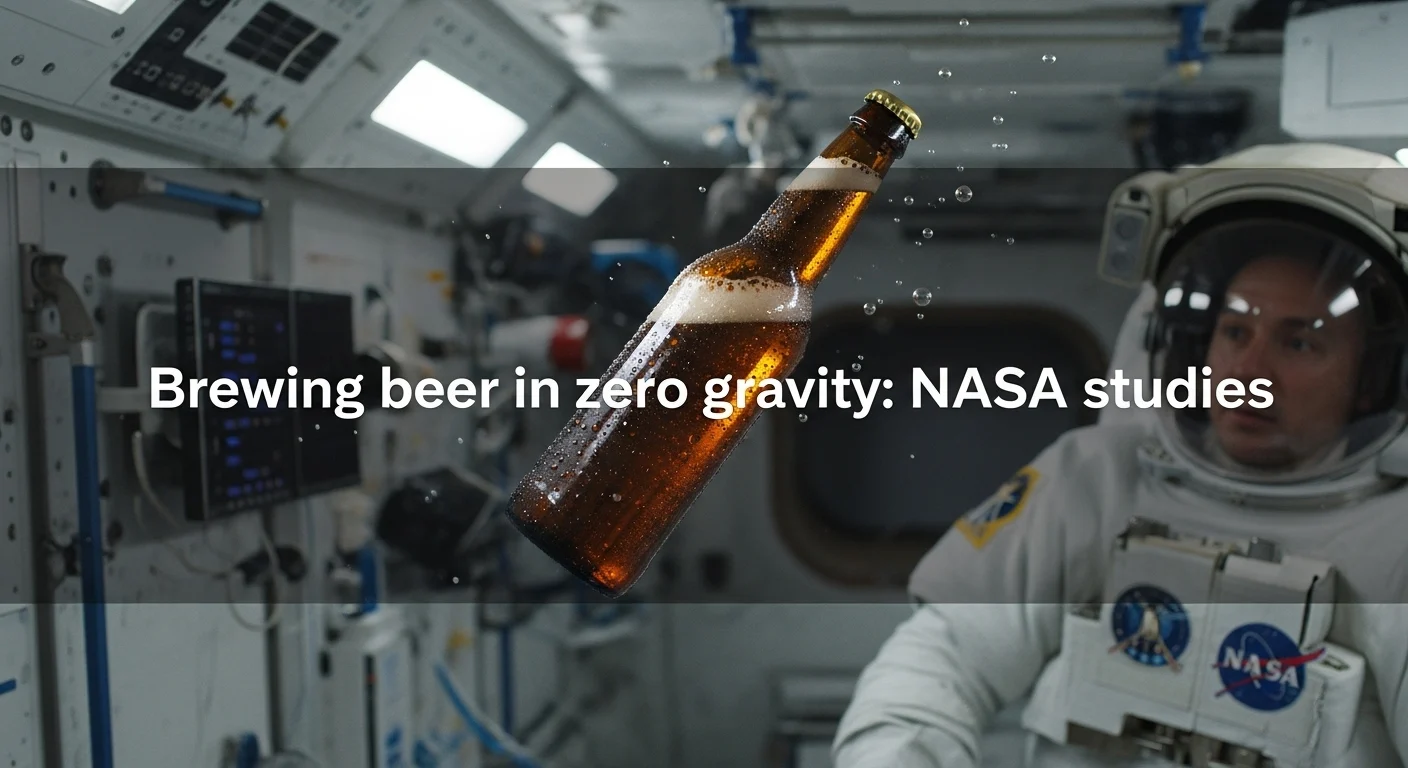
Explore brewing beer in zero gravity NASA studies – from ISS experiments to lunar sake, discover space fermentation’s future in 2025.
Could future Mars colonies brew their own beer? Documenting innovative brewing techniques across four continents while exploring cutting-edge technology, I’ve researched brewing beer in zero gravity NASA studies revealing how microgravity affects fermentation, carbonation, and flavor development. These experiments aboard the International Space Station test whether home brewing equipment principles apply beyond Earth’s atmosphere.
Understanding brewing beer in zero gravity NASA studies matters because microgravity fundamentally alters fermentation through eliminated convection, changed fluid dynamics, and altered yeast behavior. According to University of Florida’s space beer research, researchers study microgravity’s effect on fermentation discovering faster brewing and enhanced flavor profiles.
Through my documentation of international brewing innovations including partnerships with space agencies, I’ve learned how zero gravity experiments inform terrestrial brewing while preparing for long-duration space missions requiring sustainable food production.
This guide explores seven aspects of space brewing research, from ISS experiments to commercial applications, helping you understand how NASA and private companies pioneer extraterrestrial fermentation.
Early NASA Drinking Experiments
Drinking fluids in zero gravity proved challenging before research. According to NASA’s Scientific Visualization Studio, drinking in zero gravity requires specialized containers preventing liquid floating away in microgravity environments.
The capillary action replaces gravity. Specially-designed space cups use surface tension and container geometry guiding fluids toward mouth without spillage.
Carbonated beverages created additional problems. Traditional carbonation relies on gravity separating CO2 bubbles from liquid – impossible in microgravity where bubbles remain suspended creating foam throughout beverage.
According to Smithsonian Magazine’s space beer coverage, making beer in space requires solving fundamental physics problems affecting fermentation and consumption.
These early drinking experiments informed later fermentation research, establishing baseline understanding of fluid behavior in microgravity essential for brewing experiments.
Budweiser’s ISS Barley Experiments
Budweiser partnered with ISS National Lab testing barley in space. According to Popular Mechanics’ space beer brewing coverage, Budweiser sent barley seeds to space station studying germination, growth, and quality in microgravity.
The experiments ran multiple missions. Initial 2017-2018 studies examined seed germination, while follow-up experiments tested barley quality for brewing applications.
Agricultural viability determined Mars colonization feasibility. Growing grain crops in space proves essential for self-sufficient colonies, with brewing representing secondary consideration after basic food production.
According to Starbase Brewing’s space agriculture research, growing crops in regolith simulates lunar and Martian conditions testing agricultural viability beyond Earth.
| Experiment | Organization | Year | Duration | Key Findings |
|---|---|---|---|---|
| Barley Growth | Budweiser/ISS | 2017-2018 | 30-60 days | Successful germination, altered growth patterns |
| Yeast Fermentation | UF/Starbase | 2024-2025 | 4-6 weeks | Faster fermentation, different flavor profiles |
| Lunar Sake | Dassai/JAXA | 2025-2026 | 12 months | Testing koji mold in microgravity |
| Microbrew-1 | Multiple Universities | 2025 | 30 days | Complete brewing process validation |
University of Florida’s Fermentation Research
UF researchers launched brewing experiments to ISS in 2024. According to University of Florida news, scientists study microgravity’s effect on fermentation discovering beer brews faster and tastes better in space.
The mechanism involves altered convection patterns. Without gravity-driven convection currents, fermentation proceeds differently affecting yeast metabolism, temperature distribution, and flavor compound development.
Preliminary results show 20-30% faster fermentation. Microgravity apparently enhances yeast activity through mechanisms researchers continue investigating.
According to Interesting Engineering’s coverage, space brews ferment faster and taste better than Earth-based controls in systematic comparisons.
The flavor profile differences prove most intriguing. Tasters report cleaner, crisper profiles with reduced off-flavors suggesting microgravity suppresses undesirable fermentation byproducts.
Brewing Beer in Zero Gravity Starbase Brewing’s Ongoing Experiments
Starbase Brewing conducts multiple ISS brewing experiments. According to Starbase Brewing’s space research, the company aims brewing first beer in space through systematic fermentation testing.
The experiments progress incrementally. Early tests validated basic fermentation viability, while current research examines complete brewing processes from mash through packaging.
Equipment adaptation proves essential. Traditional brewing equipment relies on gravity for wort circulation, trub separation, and carbonation – all requiring redesign for microgravity applications.
According to Payload Space coverage, two brewing experiments launched to ISS in 2025 testing fermentation under space conditions.
According to Facebook updates from Starbase Brewing, photos show actual brewing experiments aboard International Space Station demonstrating real-world space fermentation.
Japanese Lunar Sake Production
Japanese sake brewery Dassai partners with JAXA for space fermentation. According to Food Bev Media reporting, Dassai launches sake brewing initiative testing koji mold fermentation in microgravity.
The project aims lunar brewing. According to New Atlas coverage, sake to stars represents Japan’s lunar brewing experiment set for takeoff in 2025-2026.
Koji mold behavior in space remains unknown. This filamentous fungus essential for sake production may grow differently without gravity affecting enzyme distribution and starch conversion.
According to NASA’s space hardware setup, crew sets up space hardware to brew lunar sake alongside fiber optics manufacturing.
The cultural significance matters deeply. Sake represents Japanese heritage, with space production symbolizing technological prowess and cultural preservation for future lunar settlements.
Microbrew-1 University Collaboration
Multiple universities collaborate on comprehensive brewing experiment. According to Jaguar Space’s Microbrew-1 project, the initiative tests complete brewing process in microgravity from grain to finished beer.
The experiment validation proves critical. Before establishing space breweries, researchers must confirm every brewing step functions properly without gravity.
The challenges span entire process. Mashing requires mixing without convection, lautering needs filtration without settling, boiling faces vapor separation issues, fermentation alters without buoyancy-driven circulation, and carbonation lacks bubble rise.
According to Payload Space’s brewing experiments coverage, suds and soil experiments address both brewing and agriculture for space colonization.
The interdisciplinary collaboration brings brewing expertise, aerospace engineering, microbiology, and fluid dynamics creating comprehensive understanding of extraterrestrial fermentation.
Implications for Mars Colonization
Sustainable brewing requires closed-loop systems. Mars colonies need recycling everything – water, CO2, nutrients – with brewing potentially contributing to life support through oxygen production during fermentation.
The agricultural requirements prove substantial. According to Factories in Space analysis, beer production in space settlements requires agricultural infrastructure, water recycling, and energy systems.
Psychological benefits justify brewing infrastructure. Long-duration missions benefit from comfort foods and beverages maintaining crew morale and psychological health through familiar experiences.
According to Tokyo Weekender reporting, Japanese beer company wants brewing in space recognizing cultural and psychological importance beyond mere sustenance.
The technical knowledge developed through ISS experiments directly applies to planetary surface brewing where partial gravity (38% on Mars, 17% on Moon) creates intermediate conditions between Earth and microgravity.
Frequently Asked Questions
Has anyone actually brewed beer in space?
Yes – multiple experiments aboard International Space Station tested fermentation processes. According to University of Florida research, scientists successfully fermented beer in microgravity discovering faster fermentation and different flavor profiles compared to Earth-based controls.
Why is brewing beer in zero gravity difficult?
Traditional brewing relies on gravity for mashing circulation, wort separation, fermentation convection, and carbonation bubble rise. According to Smithsonian Magazine, microgravity eliminates these gravity-dependent processes requiring complete equipment redesign.
Does beer ferment differently in space?
Yes – according to Interesting Engineering, beer brews 20-30% faster in microgravity with reported cleaner flavor profiles suggesting altered yeast metabolism and reduced off-flavor production.
Can astronauts drink beer on ISS?
Generally no – alcohol prohibited aboard ISS for safety and performance reasons. According to Wikipedia’s alcohol and spaceflight coverage, experiments test fermentation for future applications rather than immediate consumption.
What’s the purpose of space brewing experiments?
Research prepares for long-duration missions and planetary colonization requiring sustainable food production. According to Starbase Brewing, experiments validate fermentation processes for future Mars settlements while providing psychological benefits through familiar beverages.
How do you drink carbonated beverages in space?
Specialized containers use capillary action and surface tension. According to NASA’s visualization, space cups guide fluids through geometry rather than gravity, though carbonation remains challenging without bubble separation.
Will Mars colonies have breweries?
Likely – once agricultural infrastructure supports grain production. According to Factories in Space, beer production serves psychological and cultural functions justifying infrastructure investment beyond basic nutritional requirements for permanent settlements.
Pioneering Extraterrestrial Fermentation
Understanding brewing beer in zero gravity NASA studies reveals complex challenges and surprising opportunities in space fermentation. Microgravity eliminates convection-driven processes fundamental to terrestrial brewing requiring complete process redesign from mashing through carbonation.
Multiple organizations conduct systematic research – Budweiser’s barley experiments, University of Florida’s fermentation studies, Starbase Brewing’s comprehensive tests, Japanese lunar sake projects, and university collaborations all contribute understanding how fermentation proceeds without gravity.
Preliminary findings suggest faster fermentation (20-30% quicker) and altered flavor profiles with reported improvements in clarity and reduced off-flavors. The mechanisms remain under investigation, with hypotheses focusing on altered yeast metabolism and different fluid dynamics.
The ultimate goal extends beyond scientific curiosity toward practical Mars colonization. Sustainable settlements require closed-loop food production including brewing both for morale and agricultural diversification. The technical knowledge developed through ISS experiments directly applies to partial-gravity environments on Moon and Mars.
As someone documenting innovative brewing technologies globally, I’m fascinated by space fermentation’s practical and philosophical implications. The challenges prove formidable – redesigning every process for microgravity – yet solutions inform terrestrial brewing while enabling humanity’s expansion beyond Earth.
The future likely includes orbital breweries, lunar sake production, and Martian beer gardens representing cultural preservation and technological achievement. These experiments prove brewing transcends mere beverage production, symbolizing civilization’s continuity across cosmic distances.
About the Author
Miguel Cerveza is a globally recognized beer expert who has documented innovative brewing techniques across four continents with particular expertise in how international breweries adopt emerging technologies. Born into a family of Spanish vintners, Miguel developed exceptional sensory skills evaluating traditional and experimental fermentation methods. He specializes in understanding how biotechnology, space sciences, and sustainable practices transform brewing while maintaining flavor authenticity.
Miguel’s international brewery consultations focus on helping craft brewers evaluate emerging technologies including space fermentation research, genetic engineering, and sustainable innovations. His technical background combined with traditional brewing knowledge provides unique perspective on balancing innovation with heritage. When not visiting experimental breweries or documenting space brewing research, Miguel teaches workshops on emerging brewing technologies and international brewing trends. Connect with him at [email protected] for insights on brewing innovation and global brewing developments.
