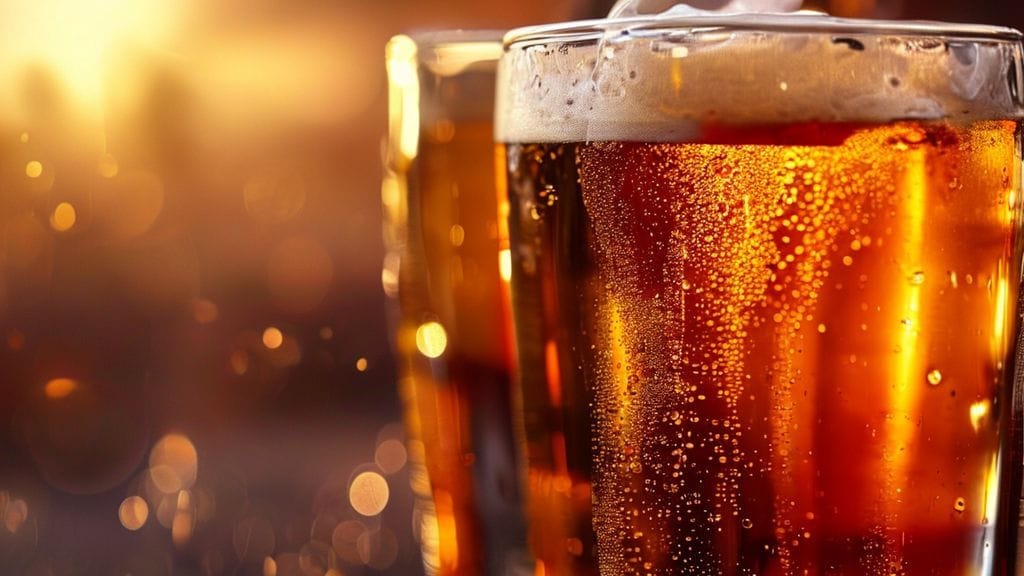
While both Helles and Pilsner are iconic German pale lagers, their fundamental distinction lies in their balance. Helles prioritizes a smooth, malt-forward profile with subtle sweetness and minimal hop presence, aiming for a rounded elegance. Pilsner, conversely, champions a crisp, dry, and assertive noble hop bitterness and aroma, delivering a refreshing and direct hop-driven experience.
| Metric | Helles | Pilsner (German) |
|---|---|---|
| Original Gravity (OG) | 1.044 – 1.050 | 1.044 – 1.050 |
| Final Gravity (FG) | 1.006 – 1.012 | 1.006 – 1.011 |
| Alcohol By Volume (ABV) | 4.7% – 5.4% | 4.4% – 5.2% |
| International Bitterness Units (IBU) | 16 – 22 | 22 – 40 |
| Standard Reference Method (SRM) | 2 – 5 | 2 – 4 |
| Fermentation Temp (Primary) | 9°C – 12°C (48°F – 54°F) | 8°C – 11°C (46°F – 52°F) |
| Lagering Temp | 0°C – 2°C (32°F – 36°F) | 0°C – 2°C (32°F – 36°F) |
| Key Malt Profile | Pilsner malt with optional small Vienna/Carapils addition for body. | 100% Pilsner malt. |
| Key Hop Profile | Low noble hop bittering, minimal aroma/flavor additions. | Significant noble hop bittering, multiple late aroma/flavor additions. |
The Brewer’s Hook: Decoding the Lagers
When I first ventured into brewing traditional German lagers two decades ago, I confess, I conflated Helles and Pilsner in my mind. “They’re both pale, clean, and refreshing lagers, right?” I’d muse, confidently oblivious to the nuances that separate these two titans. My initial attempts to brew a “generic” pale lager often yielded something decent, but it always lacked that authentic character—the rounded elegance of a Helles or the razor-sharp snap of a true Pilsner. It wasn’t until I meticulously brewed them side-by-side, controlling every variable from water chemistry to lagering time, that the profound differences truly revealed themselves. It was an awakening, a moment when I realized that brewing isn’t just about following a recipe, but understanding the soul of the beer. Trust me, the devil, or in this case, the distinction, is in the details.
The Math: Formulating Flavor Profiles
Crafting a Helles or a Pilsner isn’t just about throwing ingredients into a kettle; it’s a careful orchestration guided by precise calculations. The subtle differences in malt composition and hop utilization directly translate into the beer’s final character. Let’s break down the math behind these two classics.
Grain Bill Percentages: The Foundation
While both styles rely heavily on Pilsner malt, the small variations are critical for defining their core identity. My experience has shown these ranges to be effective:
| Malt Type | Helles (%) | Pilsner (German) (%) |
|---|---|---|
| Pilsner Malt | 90% – 98% | 98% – 100% |
| Vienna Malt (Optional for Helles) | 2% – 5% | 0% |
| Carapils/Dextrin Malt (Optional for Helles) | 2% – 5% | 0% |
For a Helles, a small percentage of Vienna malt (2-5%) subtly enhances malt complexity and adds a touch of golden hue without imparting significant color. Carapils (2-5%) can bolster mouthfeel and head retention. For a Pilsner, however, purity is key: 100% Pilsner malt is the traditional choice, allowing the hops to truly shine.
Alcohol By Volume (ABV) Calculation
The standard formula I use, which accounts for the specific gravity differences from fermentation, is:
ABV % = (Original Gravity – Final Gravity) * 131.25
Let’s take an example:
- **Helles Example:** OG = 1.048, FG = 1.010.
- ABV = (1.048 – 1.010) * 131.25 = 0.038 * 131.25 = **4.97%**
- **Pilsner Example:** OG = 1.048, FG = 1.008.
- ABV = (1.048 – 1.008) * 131.25 = 0.040 * 131.25 = **5.25%**
Notice the slightly lower FG for the Pilsner, contributing to its drier finish and often slightly higher ABV, even with the same OG. This reflects the push for higher attenuation in Pilsner brewing.
Bitterness Ratio (BU:GU)
This ratio (IBU / (OG – 1) * 1000) is a quick way to compare the perceived bitterness relative to the beer’s original gravity. It helps quantify the balance:
- **Helles:** Typically in the 0.40 – 0.50 range. For an IBU of 20 and OG of 1.048, BU:GU = 20 / 48 = **0.42**.
- **Pilsner:** Usually higher, in the 0.60 – 0.80 range. For an IBU of 35 and OG of 1.048, BU:GU = 35 / 48 = **0.73**.
This numerical difference starkly highlights the hop-forward nature of Pilsner compared to the malt-centric Helles.
Step-by-Step Execution: Crafting the Lager
While sharing a similar lineage, the brewing processes for Helles and Pilsner diverge subtly in critical areas, particularly in mashing, hopping, and fermentation. These seemingly minor differences compound to create distinct beers. My approach ensures I capture the authentic character of each.
1. Water Chemistry: The Unsung Hero
Both styles benefit from soft water, characteristic of their German origins. I typically start with reverse osmosis (RO) water and build my profile:
- Calcium (Ca): 50-70 ppm
- Magnesium (Mg): 5-10 ppm
- Sodium (Na): <10 ppm
- Chloride (Cl): 40-60 ppm
- Sulfate (SO4): 50-80 ppm (Helles leans lower, Pilsner can go slightly higher for a drier snap).
- Alkalinity (as CaCO3): <50 ppm. This low alkalinity is crucial for proper mash pH.
Target mash pH for both is **5.2-5.4** at mash temperature. I use lactic acid to adjust if necessary.
2. Milling and Mashing: Extracting the Essence
I aim for a fine crush to maximize efficiency, especially with Pilsner malt. Decoction mashing is traditional and I often employ it, especially for a Pilsner, to enhance malt complexity and body, but a well-executed step mash can also suffice.
Helles Mash Schedule (Infusion or Step):
- **Protein Rest:** Infuse to **50°C (122°F)**, hold for **15 minutes**. While some skip this for well-modified malts, I find it aids head retention and smooth protein breakdown.
- **Saccharification Rest 1 (Beta-amylase):** Raise to **63°C (145°F)**, hold for **45 minutes**. This promotes higher dextrin production for body and residual sweetness.
- **Saccharification Rest 2 (Alpha-amylase):** Raise to **72°C (162°F)**, hold for **20 minutes**. Ensures complete starch conversion.
- **Mash Out:** Raise to **78°C (172°F)**.
Pilsner Mash Schedule (Decoction or Step):
For Pilsner, I lean towards decoction to really bring out that distinctive malt character. If performing a single decoction:
- **Protein Rest:** Infuse to **50°C (122°F)**, hold for **15 minutes**.
- **Saccharification Rest 1:** Remove 1/3 thick mash, bring to boil for 10-15 mins, return to main mash to raise temperature to **62°C (144°F)**, hold for **30 minutes**.
- **Saccharification Rest 2:** Remove another 1/3 thick mash, boil for 10-15 mins, return to main mash to raise temperature to **72°C (162°F)**, hold for **20 minutes**. This vigorous boiling during decoction extracts melanoidins and creates a richer malt profile.
- **Mash Out:** Raise to **78°C (172°F)**.
If opting for an infusion step mash for Pilsner, I’d target **60-62°C (140-144°F)** for 45 minutes to ensure high fermentability, followed by a **70°C (158°F)** rest for 15 minutes.
3. Sparging and Boiling: Hops Define the Line
I sparge slowly, ensuring clear wort. A **90-minute boil** is standard for both to achieve good hot break and dimethyl sulfide (DMS) precursor reduction.
Helles Hop Schedule (60-minute boil):
- **60 minutes:** 18 IBU of Hallertau Mittelfrüh (e.g., 25g @ 4.0% AA for 20L). This provides clean bittering.
- **10 minutes:** 3 IBU of Hallertau Mittelfrüh (e.g., 10g @ 4.0% AA for 20L). For a whisper of aroma.
Total IBU: **21**. Bitterness is low, allowing malt to dominate.
Pilsner Hop Schedule (60-minute boil):
- **60 minutes:** 25 IBU of Hallertau Mittelfrüh or Tettnang (e.g., 40g @ 4.0% AA for 20L). Establishes a firm bitter backbone.
- **30 minutes:** 8 IBU of Saaz or Spalt (e.g., 15g @ 4.0% AA for 20L). Builds complexity.
- **10 minutes:** 5 IBU of Saaz (e.g., 10g @ 4.0% AA for 20L). For a pronounced aroma.
- **Whirlpool (5 minutes):** 10g Saaz. For extra aromatic punch.
Total IBU: **~38**. The hop character is assertive and multifaceted.
4. Fermentation: The Cold and Clean Path
Yeast choice is paramount. I exclusively use a German Lager strain like Wyeast 2124 (Bohemian Lager) or White Labs WLP830 (German Lager Yeast), or a dry equivalent like Fermentis Saflager W-34/70. Proper pitching rates (1.5-2 million cells/mL/°P) are non-negotiable for clean lagers.
- **Pitching Temp:** For both, I crash to **8°C (46°F)** before pitching.
- **Primary Fermentation:**
- **Helles:** Start at **10°C (50°F)** for 3 days, then allow to free rise to **12°C (54°F)** for the remainder. This slight rise helps finish strong. Maintain until target FG is reached, typically 7-10 days.
- **Pilsner:** Hold firmly at **9°C (48°F)** for the entire primary fermentation. This promotes a very clean, crisp profile. Fermentation usually finishes in 8-12 days.
- **Diacetyl Rest:** Once gravity is within 2-3 points of terminal gravity, I raise the temperature for both to **18°C (64°F)** for **2-3 days**. This allows the yeast to clean up diacetyl and other undesirable compounds.
5. Lagering: The Maturation Process
This is where the magic happens for lagers. After the diacetyl rest, I crash the temperature down.
- **Cold Crash:** Drop to **0°C (32°F)** over 24-48 hours.
- **Lagering Duration:**
- **Helles:** Minimum **4 weeks** at **0-1°C (32-34°F)**. This mellows the malt and smooths the beer.
- **Pilsner:** Minimum **6-8 weeks** at **0-1°C (32-34°F)**. The extended lagering sharpens the hop character and ensures brilliant clarity and a super crisp finish.
- Carbonation: Target 2.4-2.6 volumes of CO2 for Helles, and 2.6-2.8 volumes for Pilsner, enhancing its refreshing bite.
By meticulously controlling these parameters, I consistently achieve lagers that truly embody their respective styles. Remember, patience is the ultimate ingredient for BrewMyBeer.online.
Troubleshooting: What Can Go Wrong
Brewing lagers, especially these two, is a test of precision and patience. My years of experience have taught me that even small deviations can significantly impact the final product. Here are some common pitfalls I’ve encountered and how to address them:
1. Diacetyl (Buttery/Butterscotch Flavor)
- **Cause:** Insufficient diacetyl rest, or stress on the yeast during fermentation.
- **Fix:** Ensure your diacetyl rest (raising temperature to ~18°C / 64°F) is long enough, typically 2-3 days, or until a forced diacetyl test confirms its absence. Always pitch enough healthy yeast and maintain consistent fermentation temperatures.
2. Green/Young Beer Flavors (Sulfur, Acetaldehyde – Green Apple)
- **Cause:** Insufficient lagering time. Yeast needs time to clean up byproducts.
- **Fix:** Simple: more time. Lagering at near-freezing temperatures is crucial for conditioning and flavor maturation. Don’t rush it. Helles needs at least 4 weeks, Pilsner often 6-8 weeks.
3. Lack of Clarity (Haze)
- **Cause:** Poor protein rest, insufficient cold crashing, chill haze, or unfiltered beer.
- **Fix:** Ensure proper protein rest (if used), crash aggressively to 0°C (32°F) for extended periods (especially during lagering), and consider fining agents like gelatin or BioFine Clear. Some haziness can be yeast, but chill haze often indicates protein/polyphenol complexes.
4. Off-Target Bitterness/Balance
- **Cause:** Inaccurate hop measurements, incorrect hop alpha acid percentages, or a misjudgment of water chemistry.
- **Fix:** Calibrate your scale, always use fresh hops with known alpha acids, and verify your water profile. For future batches, adjust hop additions (timing and quantity) based on sensory evaluation. For Helles, too much bitterness drowns the malt; for Pilsner, too little makes it flabby.
5. Thin Body or Lack of Head Retention
- **Cause:** Overly aggressive protein rest, too low of a saccharification rest temperature (leading to high fermentability), or inadequate dextrin malt (Carapils) in Helles.
- **Fix:** Adjust mash temperatures (e.g., slightly higher sacch rest for Helles), consider a small addition of Carapils/dextrin malt (2-5%) for Helles, or ensure a proper decoction for Pilsner to boost body and foam stability.
Sensory Analysis: A Tale of Two Lagers
My favorite part of brewing is the sensory evaluation. It’s where all the technical work culminates in a tangible experience. Understanding the subtle sensory cues allows me to discern a perfectly executed Helles from an exemplary Pilsner. Here’s how I perceive them:
Helles
- Appearance: I look for a brilliant, clear, pale gold color, sometimes leaning towards a slightly deeper straw. It should have a sturdy, creamy, white head with excellent retention. The carbonation streams should be fine and persistent.
- Aroma: The nose is dominated by a clean, sweet, bready malt character, reminiscent of fresh dough, sometimes with a subtle honey-like quality. There’s a faint, elegant whisper of noble hops – floral or slightly spicy, but never assertive. It’s an inviting, subtle aroma.
- Mouthfeel: This is where Helles shines with its smooth elegance. It’s medium-light in body, with a soft creaminess from the malt. The carbonation is moderate, contributing to a gentle crispness without being prickly. It finishes incredibly clean, without any lingering stickiness or bitterness.
- Flavor: The taste mirrors the aroma: a delightful celebration of high-quality Pilsner malt. Sweet, grainy, and bready notes are upfront, balanced by a very low, clean hop bitterness that simply keeps the sweetness in check, never overshadowing it. There might be a slight noble hop flavor, but it’s understated. The finish is soft, smooth, and refreshing, encouraging another sip.
Pilsner (German)
- Appearance: I expect a sparkling, brilliant pale straw to light gold color, often slightly paler than a Helles. The head should be voluminous, dense, and white, with superb retention. Effervescence is typically higher, creating a livelier appearance.
- Aroma: Here, the hops take center stage. I get a pronounced, elegant bouquet of noble hops – spicy, floral, herbal, or grassy notes from varieties like Saaz, Hallertau, or Spalt. Underneath this hop symphony, there’s a delicate, crackery or biscuity malt aroma from the Pilsner malt, and sometimes a faint, clean sulfur note from the lager yeast, which is perfectly acceptable and even desirable in German Pilsner.
- Mouthfeel: Pilsner delivers a crisper, drier mouthfeel than Helles. It’s light to medium-light bodied, with higher carbonation that accentuates its refreshing bite. The finish is remarkably dry and exceptionally clean, often with a lingering, pleasant hop bitterness.
- Flavor: The palate is a harmonious interplay of assertive hop bitterness and flavor, supported by a clean, cracker-like malt background. The noble hop character (spicy, floral, herbal) is prominent from start to finish. The bitterness is firm but never harsh or lingering unpleasantly. It’s exceptionally dry and refreshing, with a distinct snap in the finish that leaves the palate clean and ready for the next sip.
FAQs
Can I use the same yeast for both Helles and Pilsner?
Yes, absolutely. I consistently use a single, reliable German lager yeast strain (like W-34/70 or WLP830) for both Helles and Pilsner. The differences in the final beers come not from distinct yeast strains, but from variations in fermentation temperatures, malt bill, and hop schedule. Proper pitching rates and a meticulous diacetyl rest are far more critical than switching yeast.
What about water profiles? Do they need to be drastically different?
While historically, specific regional water profiles contributed to the development of these styles, in modern homebrewing, both Helles and German Pilsner benefit from very soft water. I start with RO water for both and build a minimalist profile with low mineral content. For Pilsner, I might allow for slightly higher sulfate (up to 80 ppm) to accentuate hop crispness, whereas Helles I keep sulfates lower (50-60 ppm) for a softer malt presentation. The key is low alkalinity and minimal mineral interference.
Is decoction mashing necessary to brew authentic Helles or Pilsner?
No, it’s not strictly necessary, especially for Helles. While decoction mashing is a traditional technique that enhances malt depth and complexity, particularly in Pilsners, a well-executed step mash can achieve excellent results for both styles. I often use a step mash for Helles, focusing on specific temperature rests to build body and fermentability. For Pilsner, a single decoction can significantly elevate the malt character, but I’ve brewed fantastic Pilsners with precise multi-step infusion mashes too. Don’t let decoction be a barrier to entry; focus on temperature control and good technique. You can learn more about advanced mashing techniques on BrewMyBeer.online.
Which style is easier for a beginner lager brewer to tackle?
I would generally recommend starting with Helles. Its slightly more forgiving hop schedule means you have less bittering and aroma to balance, allowing you to focus on achieving a clean fermentation and proper lagering. While both require precision and patience, the subtle malt complexity of a Helles is often a bit more achievable for a newcomer than the assertive, hop-forward crispness and perfect clarity demanded by a true Pilsner. Once you master the Helles, you’ll have the foundational skills for a superb Pilsner.