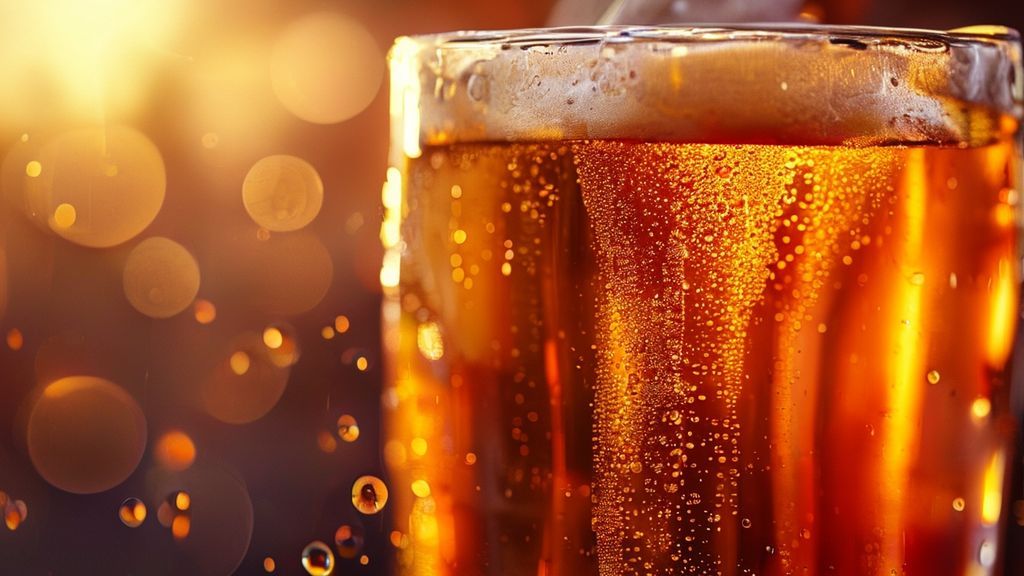
Brewing a classic American IPA means mastering the interplay of aggressive hop bitterness, vibrant aroma, and a clean, fermentable malt backbone. I’ve honed this recipe over years, achieving a beer that boasts citrus, pine, and tropical notes, supported by a crisp, dry finish. It’s a rewarding challenge that yields an exceptionally flavorful and balanced hop-forward ale.
| Metric | Target Value |
|---|---|
| Original Gravity (OG) | 1.060 – 1.070 |
| Final Gravity (FG) | 1.010 – 1.015 |
| Alcohol by Volume (ABV) | 6.0% – 7.5% |
| International Bitterness Units (IBU) | 50 – 70 |
| Standard Reference Method (SRM) | 6 – 10 |
| Mash Temperature | 65.0 – 66.0°C (149-151°F) |
| Fermentation Temperature | 18 – 21°C (64-70°F) |
| Water Profile (SO4:Cl Ratio) | 2:1 to 3:1 |
The Brewer’s Hook: Chasing the Hop Dragon
My journey with the American IPA began like many, I suspect – with an unquenchable thirst for aggressive hop character. Early on, I wrestled with recipes that promised punch but delivered only harsh bitterness, or aromatic explosions that faded within days. I still remember one particularly frustrating batch where I dry-hopped with an absurd amount of hops, only to have the beer taste like wet grass. It taught me a fundamental truth: brewing an exceptional American IPA isn’t just about throwing in hops; it’s about precision, timing, and understanding the interplay between malt, water, and yeast to elevate those hops. Through countless trials and meticulous data logging, I’ve refined my approach to achieve that vibrant, aromatic, yet balanced experience I always craved. This guide distills my two decades of experience into actionable steps so you don’t have to make my early mistakes.
The Math Behind the Magic: Crafting Your IPA Profile
Understanding the fundamental calculations is crucial for repeatable results and for precisely targeting your desired beer profile. I don’t rely on guesswork; I rely on the numbers. Here’s how I break it down.
Grain Bill Calculation Guide (Targeting 23 Liters / 6 US Gallons)
My standard American IPA grist is designed for fermentability and a clean backdrop that lets the hops shine. I typically aim for a starting gravity of 1.065.
| Ingredient | Quantity (kg) | Percentage (%) | Purpose |
|---|---|---|---|
| 2-Row Pale Malt | 5.0 kg | 90.9% | Fermentable sugars, base malt character |
| Crystal Malt (40L) | 0.3 kg | 5.5% | Color, body, residual sweetness, malt complexity |
| Carapils/Dextrin Malt | 0.2 kg | 3.6% | Head retention, body, foam stability |
| Total Malt | 5.5 kg | 100% |
Hop Utilization and IBU Calculation (Simplified)
While precise IBU calculation involves complex formulas considering boil gravity, hop age, and utilization rates, for practical homebrewing, I work with a general understanding. My goal is typically **50-70 IBU**. Here’s a typical schedule for a 60 IBU target using hops around 13% Alpha Acid (AA):
| Hop Type | Alpha Acid (%) | Amount (g) | Boil Time (min) | Contribution (approx. IBU) | Purpose |
|---|---|---|---|---|---|
| Magnum | 13.0% | 20 | 60 | ~35 IBU | Clean bitterness |
| Centennial | 10.0% | 30 | 15 | ~15 IBU | Flavor & some aroma |
| Citra | 13.0% | 30 | 0 (Whirlpool) | ~5-10 IBU | Max aroma & flavor |
| Mosaic | 12.0% | 30 | 0 (Whirlpool) | ~5-10 IBU | Max aroma & flavor |
For more detailed IBU calculations, I recommend using a brewing software, but this approach gets you close enough for consistent homebrew results. Remember, dry hops contribute negligible bitterness.
Water Chemistry Targets
Water chemistry is often overlooked but profoundly impacts hop perception. For American IPAs, I aim for a sulfate-to-chloride ratio (SO4:Cl) of at least 2:1, often pushing to 3:1. This accentuates hop bitterness and dryness. Here are my typical targets for a finished wort:
| Ion | Target Range (ppm) | Impact |
|---|---|---|
| Calcium (Ca²⁺) | 100 – 150 | Mash pH stability, yeast health, clarity |
| Magnesium (Mg²⁺) | 10 – 20 | Yeast nutrient, mash enzyme function |
| Sodium (Na⁺) | 0 – 50 | Enhances sweetness, mouthfeel (keep low) |
| Sulfate (SO₄²⁻) | 200 – 300 | Enhances hop bitterness, dry finish |
| Chloride (Cl⁻) | 50 – 100 | Enhances malt sweetness, mouthfeel |
I typically start with RO water and build my profile using gypsum (calcium sulfate) and calcium chloride to hit these targets, adjusting mash pH with lactic acid if needed to hit a mash pH of **5.2 – 5.4**.
Step-by-Step Execution: My Method for a Stellar American IPA
This is my refined process, designed for maximum hop expression and a clean, fermentable beer.
1. Malt Preparation & Milling
- Weigh out all your malts according to the grain bill.
- Mill your grains to ensure a consistent crush. I aim for a crush that leaves most husks intact but pulverizes the endosperm. This helps with lautering efficiency and avoids astringency.
2. Water Treatment & Mash-In
- Start with your chosen volume of brewing water (e.g., 28-30 liters for a 23L batch, accounting for absorption and boil-off). If using RO water, add your mineral salts to achieve your target water profile (e.g., 8g Gypsum, 2g Calcium Chloride for a 23L batch of RO water).
- Heat your strike water to approximately **71-72°C (160-162°F)**. This accounts for heat loss when adding the grains.
- Mash in, slowly adding the milled grains to the hot water while stirring vigorously to prevent dough balls.
- Confirm your mash temperature. I aim for a mash rest at **65.5°C (150°F)**. If it’s too high, add a small amount of cold water; too low, add some hot water, stirring continuously.
- Measure and adjust mash pH. My target is **5.2 – 5.4** at mash temperature. I use lactic acid sparingly if needed.
- Hold the mash at **65.5°C (150°F)** for **60 minutes**. This temperature promotes a good balance of fermentable sugars for a crisp finish and unfermentable dextrins for body.
- Mash Out: Raise the mash temperature to **76°C (168°F)** for **10 minutes**. This stops enzyme activity and makes the wort less viscous for better lautering.
3. Lautering & Sparge
- Recirculate the wort until it runs clear, typically for **10-15 minutes**. This establishes the grain bed as a filter.
- Slowly drain the wort into your boil kettle. Maintain a slow, steady flow to avoid compacting the grain bed.
- Begin sparging (rinsing the grain bed) with water heated to **77°C (170°F)**. I prefer a fly sparge, continuously adding water as wort drains, but a batch sparge works too.
- Collect enough wort to hit your pre-boil gravity target and desired boil volume (e.g., 27-28 liters for 23L post-boil). Stop if your runnings drop below 1.010 to prevent tannin extraction.
4. The Boil & Hop Additions
- Bring the wort to a vigorous boil. Once boiling, add your bittering hops (e.g., **20g Magnum** for **60 minutes**).
- Set a timer for your total boil duration, typically **60 minutes**.
- As the boil progresses, add your flavor hops. I often add a dose at **15 minutes** (e.g., **30g Centennial**) and another at **5 minutes** (e.g., **30g Simcoe**).
- With **10 minutes** remaining, add a kettle fining agent like Irish Moss or Whirlfloc to aid in clarity.
- At flameout (0 minutes), perform a whirlpool addition. Turn off the heat and stir the wort vigorously for **5-10 minutes** to create a whirlpool. Add your large aroma hop charge (e.g., **30g Citra + 30g Mosaic**). Let these steep for **20 minutes** as the wort cools. This extracts maximum volatile hop oils.
5. Cooling & Fermentation
- Rapidly cool the wort to pitching temperature, ideally using a wort chiller. Aim for **18°C (64°F)**. Rapid cooling minimizes DMS formation and hop oxidation.
- Sanitize your fermenter, airlock, and anything that will touch the cooled wort.
- Transfer the cooled wort to the fermenter, ensuring good aeration (splashing, oxygenating stone) to prepare for yeast health.
- Pitch your yeast. I always use a healthy starter or a sufficient quantity of liquid yeast (e.g., White Labs WLP001 California Ale Yeast or Wyeast 1056 American Ale) or two packets of a reliable dry yeast (e.g., Fermentis US-05). Ensure the yeast is at a similar temperature to the wort.
- Ferment at **18°C (64°F)** for the first **3-5 days**, allowing it to rise naturally to **20°C (68°F)** for the remainder of primary fermentation. This promotes a clean fermentation profile.
- Monitor specific gravity daily after the initial vigorous fermentation subsides. Fermentation is complete when gravity readings are stable for **3 consecutive days**, typically around **1.012 – 1.015**.
6. Dry Hopping & Conditioning
- Once primary fermentation is complete and gravity is stable, I perform my first dry hop. I add **5g/L** (approx. 115g for 23L) of my chosen aroma hops (e.g., a blend of Citra, Mosaic, Centennial) directly to the fermenter. I keep the temperature at **18-20°C** for this stage.
- After **3-4 days** of the first dry hop, I often crash cool the fermenter to **10-12°C (50-54°F)**.
- For maximum aroma, I sometimes add a second dry hop charge of **3g/L** (approx. 70g for 23L) for another **2-3 days** while the beer is still cool but before final packaging. This is a technique I’ve found really boosts fresh hop character without introducing vegetal notes.
- After the final dry hop, cold crash the beer to **0-2°C (32-36°F)** for **48-72 hours** to drop out yeast and hop particulate, aiding in clarity.
7. Packaging
Whether bottling or kegging, meticulous sanitation is paramount. My preference is kegging for less oxidation and easier force carbonation.
- Sanitize all packaging equipment thoroughly.
- Transfer the conditioned beer gently to avoid disturbing the sediment and minimizing oxygen pickup.
- For kegging, force carbonate to **2.4-2.6 volumes of CO2** at **2-4°C (35-39°F)**. This can take several days.
- For bottling, prime with dextrose (corn sugar). Calculate your priming sugar for **2.4 volumes of CO2**. For 23 liters, this is typically **130-140 grams** of dextrose. Condition bottles at **18-20°C (64-68°F)** for **2-3 weeks**.
For more detailed guides on packaging, check out the resources at BrewMyBeer.online.
What Can Go Wrong? Troubleshooting Common IPA Issues
Even after 20 years, I’ve seen my share of unexpected challenges. Here are some common pitfalls and how I address them.
- Insufficient Hop Aroma/Flavor: This is frequently due to old hops, insufficient late boil/whirlpool additions, or not enough dry hopping. Ensure your hops are fresh and stored cold. Don’t be shy with flameout and dry hop additions. I’ve found that extending whirlpool contact time to 20 minutes makes a noticeable difference.
- Harsh, Lingering Bitterness: Often caused by excessive bittering hops, poor water chemistry (too high SO4:Cl ratio, or high mash pH leading to increased tannin extraction), or a lack of balancing malt sweetness/body. Re-evaluate your bittering hop additions and adjust water profile.
- Vegetal or Grassy Flavors: Primarily from over-dry hopping (too much contact time, too high temperature, or too fine hop particulate). Reduce dry hop contact time, especially the second dry hop. I keep mine to a maximum of **3-4 days**.
- Diacetyl (Buttery/Butterscotch): This is a sign of incomplete fermentation or insufficient diacetyl rest. Ensure your yeast is healthy and pitch enough. After significant fermentation, I let my fermenter free rise to **20-21°C** for a couple of days to clean up any diacetyl before cold crashing.
- Haze (Non-Yeast): Could be chill haze (proteins precipitating out when cold), hop haze (from dry hopping), or starch haze (poor mash conversion). Using kettle finings, cold crashing, and ensuring proper mash conversion and a thorough sparge helps.
- Oxidation (Cardboard/Sherry Flavors): The enemy of IPAs. Minimize oxygen exposure at every stage post-fermentation – during transfers, dry hopping, and packaging. I purge my kegs with CO2 multiple times before filling.
Sensory Analysis: What an American IPA Should Be
After all that meticulous work, it’s time for the reward. Here’s what I look for in a well-crafted American IPA.
Appearance
A classic American IPA should be a vibrant golden to deep amber hue, often with brilliant clarity, though modern interpretations can have a slight hop haze. A robust, persistent white head of small, tightly packed bubbles is essential, leaving a delicate lacing on the glass as it recedes.
Aroma
The aroma should be a powerful declaration of hops. I expect intense notes of citrus (grapefruit, orange, lemon zest), pine, resin, and sometimes tropical fruit (passionfruit, mango, pineapple) or stone fruit (apricot, peach). These hop characters should dominate, but a subtle clean, bready malt background can often be detected, providing a foundation. No off-aromas like diacetyl or DMS should be present.
Mouthfeel
Medium body, often leaning towards crisp and refreshing. Carbonation should be moderate to moderately-high, contributing to the beer’s effervescence and helping to carry the hop aromatics. The finish should be remarkably dry, enhancing the perception of bitterness without being cloying. There’s a certain “grip” or texture from the hops, but it shouldn’t be astringent.
Flavor
The flavor directly mirrors the aroma, with a strong, assertive hop bitterness hitting first and lingering through the finish. Citrus, pine, and tropical fruit flavors are prominent and well-defined. The malt character is clean, supporting the hops without competing; minimal caramel or bready notes are acceptable but should never overshadow. The high attenuation ensures a crisp, non-sweet finish, allowing the hop bitterness to truly shine. There should be a good balance between the initial hop burst and the enduring bitter finish.
Frequently Asked Questions About American IPAs
How do I prevent my American IPA from becoming too malty or sweet?
To prevent excessive maltiness, I focus on two key areas. First, keep your crystal malt additions to **5-7%** of the grist, and use lighter color crystal malts (e.g., 40L). Second, ensure a highly attenuative fermentation. I mash on the lower end of the saccharification range, around **65.5°C (150°F)**, for **60 minutes** to promote the production of fermentable sugars. Using a clean, highly attenuating American ale yeast (like US-05 or WLP001) and ensuring proper fermentation temperatures (starting at **18°C**, allowing a free rise to **20°C**) will help dry out the beer and prevent residual sweetness.
What is the secret to getting a huge hop aroma without vegetal notes?
This is where my experience really comes into play. The secret lies in a multi-stage approach and precise temperature control. I use large whirlpool additions at flameout, letting them steep for **20 minutes** as the wort cools before chilling completely. For dry hopping, I do it in two stages: the first, a larger charge of **5g/L** after primary fermentation is complete, at fermentation temperature (**18-20°C**) for **3-4 days**. Then, I crash cool the beer and consider a second, smaller charge of **3g/L** for only **2-3 days** at a cooler temperature (**10-12°C**). The cooler temperature minimizes vegetal extraction while still pulling out fresh aromatics. Always use fresh hops, stored cold and oxygen-free. You can find more of my advanced hop techniques on BrewMyBeer.online.
Is it okay for my American IPA to be hazy?
Traditionally, American IPAs were known for their brilliant clarity. However, with the rise of New England IPAs (NEIPAs), consumer perception of haze has shifted. For a classic American IPA, I personally strive for clarity. Hop haze (from heavy dry hopping) can be acceptable, but excessive turbidity or starch haze points to an issue. To achieve clarity, I ensure good mash conversion, use kettle finings (Whirlfloc), cold crash aggressively to **0-2°C (32-36°F)** for several days post-fermentation, and minimize oxygen exposure during transfers. If you prefer a hazy IPA, you’re looking at a different style, which often involves different malts and dry hopping techniques.