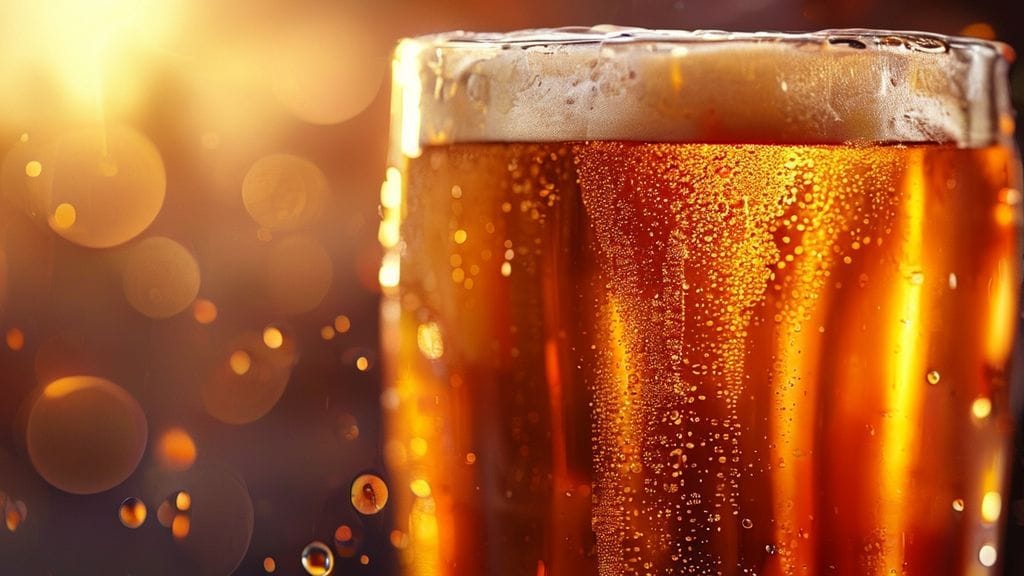
Brewing a truly exceptional International Pale Lager demands meticulous control, a deep understanding of fermentation kinetics, and precise raw material selection. My approach emphasizes a clean, crisp profile achieved through a high proportion of quality Pilsner malt, judicious use of adjuncts for body reduction, and strict temperature management during both fermentation and extended lagering. Target Specific Gravities hover around 1.048 OG, finishing dry at 1.008 FG, yielding a sessionable yet characterful brew.
| Metric | Value | Notes |
|---|---|---|
| Original Gravity (OG) | 1.048 SG | Pre-fermentation density. |
| Final Gravity (FG) | 1.008 SG | Post-fermentation density, indicating high attenuation. |
| Alcohol by Volume (ABV) | 5.2% | Calculated from OG and FG. |
| International Bitterness Units (IBU) | 18 IBU | Clean, firm bitterness. |
| Standard Reference Method (SRM) | 3 SRM | Very pale, straw-like color. |
| Mash Temperature | 64°C (147°F) | Single infusion for high fermentability. |
| Fermentation Temperature | 10°C (50°F) | Cool fermentation for a clean profile. |
| Lagering Period | 4-6 Weeks | Cold conditioning for clarity and flavor maturation. |
| Carbonation | 2.6 Volumes CO2 | Bright, effervescent mouthfeel. |
The Pursuit of Crisp: My Journey with International Pale Lagers
There’s a prevailing misconception that brewing a “simple” lager is somehow easier than an IPA or a stout. My two decades in this craft have taught me the exact opposite. When I first started experimenting with lagers, I made the classic mistake of underestimating the criticality of precision. I’d mash a little warm, pitch my yeast a little shy, and let my fermentation temperatures creep up by a degree or two. The result? Beers that were “okay” but lacked that undeniable crispness, that brilliant clarity, that clean snap that defines a truly world-class International Pale Lager. I ended up with esters, diacetyl, and a haziness that refused to settle.
It was a harsh, but necessary, lesson in the art of brewing subtlety. This style leaves no room for error; every variable, from water chemistry to cold conditioning duration, plays a starring role. My journey to mastering this style has been about embracing the challenge of precision, understanding the ‘why’ behind every step, and meticulously recording my data. It’s about creating a beer that is transparent not just in its appearance, but in its flavor profile, allowing the quality of its components to shine through without distraction. Join me as I lay out the exact blueprint I’ve refined over countless batches to consistently hit that elusive mark of lager perfection.
The Numerical Blueprint: Decoding Your Lager’s DNA
To brew an International Pale Lager that truly shines, we must start with a rigorous mathematical foundation. This isn’t guesswork; it’s a calculated orchestration of ingredients and processes. I’ve developed a precise methodology to ensure consistent results, focusing on the interplay between fermentability, bitterness, and alcohol content.
Grain Bill Composition (for a 20L / 5.3 Gallon Batch)
My typical grain bill emphasizes fermentability and a light body, crucial for this style. Adjuncts are key for achieving a drier finish without sacrificing flavor.
| Grain/Adjunct | Mass (kg) | Mass (lb) | Percentage (%) | Notes |
|---|---|---|---|---|
| Pilsner Malt | 3.80 kg | 8.38 lb | 82.6% | High quality, low color base malt. |
| Flaked Rice | 0.80 kg | 1.76 lb | 17.4% | Adds fermentable sugars, lightens body/color. |
| Total Grain Bill | 4.60 kg | 10.14 lb | 100% |
Hop Schedule and Bitterness Calculation
For a clean bitterness, I stick to a single bittering addition of a noble hop or high alpha acid hop, ensuring the IBU is within style guidelines. The formula for IBU is complex, relying on hop alpha acid, utilization, wort gravity, and boil time. For simplicity, I target a specific amount of alpha acid contribution based on laboratory-tested hop pellets. For this batch, using a hop like Magnum (14% AA) or Hallertau Mittelfrüh (4% AA) for bittering is appropriate.
- Bittering Addition: 20g (0.7 oz) Hallertau Mittelfrüh (4% AA) for 60 minutes.
- Calculated IBU: Approximately 18 IBU (using a standard brewing software with a 20L batch, OG 1.048).
Alcohol by Volume (ABV) Calculation
The standard formula I rely on for accurate ABV post-fermentation is:
ABV = (OG – FG) * 131.25
Using our target gravities:
- OG: 1.048
- FG: 1.008
- ABV = (1.048 – 1.008) * 131.25
- ABV = 0.040 * 131.25
- ABV = 5.25%
Water Profile Targets
Water chemistry is often overlooked but is absolutely paramount for a clean lager. I aim for a very soft water profile, emulating that of Pilsen, to allow the malt and subtle hop character to shine without mineral harshness. My target ions for 20 liters:
| Ion | Target (ppm) | Addition (g) from RO Water |
|---|---|---|
| Calcium (Ca²⁺) | 50 ppm | 2.0g CaCl₂ or Gypsum |
| Magnesium (Mg²⁺) | 5 ppm | 0.4g MgSO₄ (Epsom Salt) |
| Sodium (Na⁺) | 10 ppm | 0.5g NaCl (Table Salt) |
| Chloride (Cl⁻) | 75 ppm | (Included in CaCl₂/NaCl additions) |
| Sulfate (SO₄²⁻) | 60 ppm | (Included in MgSO₄/Gypsum additions) |
| Bicarbonate (HCO₃⁻) | 0-50 ppm | Minimize for light lagers, adjust mash pH. |
| Mash pH Target | 5.2 – 5.4 | Adjust with lactic acid if needed. |
My base water is usually reverse osmosis (RO) water, allowing me to build the profile from scratch with precision. This control is critical for achieving the clean flavor profile this style demands. If you’re using tap water, get a detailed water report and adjust accordingly.
Execution: Brewing My International Pale Lager, Step-by-Step
Precision and hygiene are paramount. I follow this strict regimen to ensure consistent quality.
- Water Treatment and Heating (90 minutes):
- Start with 15 liters (4 gallons) of RO water for the mash. Add water salts according to your calculations to achieve the target profile (e.g., 2.0g CaCl₂, 0.4g MgSO₄, 0.5g NaCl for 20L batch).
- Heat water to **70°C (158°F)** to hit a strike temperature that results in the desired mash temperature after grain addition.
- Mashing (60 minutes):
- Add the milled Pilsner malt and flaked rice to the strike water. Stir thoroughly to eliminate dough balls.
- Monitor the temperature closely. The target mash temperature is **64°C (147°F)**. This single infusion rest at the lower end of the saccharification range promotes a highly fermentable wort, crucial for the dry finish of an International Pale Lager.
- Maintain temperature for **60 minutes**.
- Perform an iodine test to confirm starch conversion. If the sample turns blue/black, continue mashing.
- Check mash pH. It should be between **5.2 and 5.4**. Adjust with food-grade lactic acid if necessary (typically 0.5-1.5 mL).
- Mash Out (10 minutes):
- Raise mash temperature to **76°C (168°F)** by adding hot water or direct heating. This stops enzymatic activity and reduces wort viscosity for better lautering. Hold for **10 minutes**.
- Lautering and Sparging (60-90 minutes):
- Recirculate the wort until it runs clear, typically **10-15 minutes**.
- Begin collecting wort into your boil kettle. Slowly add sparge water at **77°C (170°F)** to maintain the grain bed’s temperature and extract sugars efficiently. I aim for approximately 15 liters (4 gallons) of sparge water.
- Collect a total of **25 liters (6.6 gallons)** of pre-boil wort. My target pre-boil gravity is typically around 1.042 SG, assuming an 80% mash efficiency.
- Boiling (60 minutes):
- Bring the wort to a vigorous boil.
- At **60 minutes (from start of boil)**, add the bittering hops (e.g., 20g Hallertau Mittelfrüh).
- At **10 minutes (remaining in boil)**, add 1/2 tsp Irish Moss or a whirlfloc tablet to aid in wort clarity.
- At **5 minutes (remaining in boil)**, add a hop addition for minimal aroma, if desired (e.g., 10g Hallertau Mittelfrüh). This is optional for a truly neutral profile.
- At **Flameout**, cut the heat.
- Chilling and Aeration (30 minutes):
- Rapidly chill the wort to **10°C (50°F)** using an immersion or plate chiller. Speed is crucial to minimize DMS formation and prevent bacterial contamination.
- Once chilled, transfer to a sanitized fermenter. Aerate the wort thoroughly (e.g., 60 seconds with pure oxygen or 5 minutes with an aeration stone and air pump). This is vital for healthy yeast propagation in high-gravity lagers.
- Yeast Pitching and Fermentation (10-14 days):
- Pitch a healthy yeast starter of a clean lager strain (e.g., Wyeast 2007 Pilsen Lager or White Labs WLP830 German Lager). I typically use a 2-liter starter for a 20-liter batch, pitching at 2 million cells/mL/°P.
- Maintain fermentation temperature precisely at **10°C (50°F)** for the primary fermentation.
- After **7-10 days**, when gravity is within 2-3 points of final gravity (e.g., 1.010-1.011), perform a diacetyl rest. Raise the temperature slowly to **16°C (61°F)** and hold for **2-3 days**. This allows the yeast to reabsorb diacetyl and other undesirable compounds.
- After the diacetyl rest, drop the temperature back to **10°C (50°F)** and confirm final gravity (should be 1.008 SG).
- Lagering (4-6 Weeks):
- Rack the beer to a clean, sanitized secondary fermenter or leave in primary if you have temperature control.
- Gradually reduce temperature to **1-2°C (34-36°F)** over several days.
- Lager for a minimum of **4 weeks**, ideally **6 weeks**. This extended cold conditioning is non-negotiable for clarity and flavor maturation. I’ve found that patience here is rewarded immensely. My experience shows that rushing this phase is the quickest way to end up with a sub-par product. For more insights on this critical stage, visit BrewMyBeer.online.
- Finishing and Carbonation (7-14 days):
- Optional: Add finings like gelatin (1/2 tsp dissolved in 120ml warm water, cooled, then added to the beer) during the last week of lagering for enhanced clarity.
- Crash cool to **0°C (32°F)** for 2-3 days.
- Transfer to a sanitized keg or bottles. Force carbonate to **2.6 volumes of CO2** at 2°C (36°F). This typically requires holding at 12-14 PSI for 5-7 days in a keg. If bottle conditioning, use 120-130g of priming sugar for a 20L batch.
Troubleshooting: What Can Go Wrong and How I Fix It
Even with meticulous planning, brewing can throw curveballs. Here are common issues I’ve encountered with International Pale Lagers and my proven solutions.
- Diacetyl (Butterscotch/Butter Popcorn Flavor):
- Cause: Insufficient diacetyl rest, often due to rushing fermentation or pitching unhealthy yeast. Yeast produces diacetyl as a byproduct, which it later reabsorbs.
- My Fix: Extend the diacetyl rest. If detected post-fermentation, gently raise the temperature to **18°C (64°F)** for 2-3 days, ensuring the yeast is still viable. A robust diacetyl rest at **16°C (61°F)** for at least 48 hours is non-negotiable in my process.
- Haze (Lack of Clarity):
- Cause: Yeast in suspension, chill haze, or protein haze. Often due to insufficient lagering, improper chilling, or lack of finings.
- My Fix: Extend lagering to **6-8 weeks**. Ensure rapid chilling post-boil. Use kettle finings (Irish Moss/Whirlfloc) in the boil and add gelatin finings during the last week of lagering. Always crash cool to near freezing **(0-1°C / 32-34°F)** before packaging. Filtration is an option for commercial clarity, but I rarely find it necessary for homebrews if lagering is executed perfectly.
- Sulfur/DMS (Cooked Corn/Cabbage Off-flavor):
- Cause: DMS (Dimethyl Sulfide) is a common lager off-flavor, often stemming from insufficient boil vigor, slow cooling, or using certain malts (though less common with modern Pilsner malts). Some yeast strains naturally produce a light sulfur note which dissipates during lagering.
- My Fix: Ensure a vigorous, open boil for the entire 60 minutes. Chill the wort as rapidly as possible to fermentation temperature. Adequate lagering will also help reduce yeast-derived sulfur notes. If I notice a persistent cooked corn character, I reassess my boil vigor and chilling speed.
- Green Beer/Harshness:
- Cause: Rushing the lagering phase, not allowing the beer to fully mature and smooth out.
- My Fix: Patience. This is the hardest “fix.” The beer needs time for yeast to clean up byproducts and for flavors to meld. If I taste harshness, I extend lagering for another 2-4 weeks, even if it means waiting longer for my reward. A diacetyl rest also contributes significantly to flavor smoothness.
Sensory Analysis: What a Perfect International Pale Lager Tastes Like
After all that meticulous work, the payoff is a beer that is truly a benchmark of brewing prowess. Here’s what I expect from my International Pale Lager:
- Appearance: It should be brilliantly clear, a shimmering pale straw to light gold color (typically **3 SRM**). When poured into a proper glass, it forms a dense, persistent white head with fine, clingy bubbles. Light should pass through it unhindered, a testament to proper chilling and lagering.
- Aroma: The nose should be clean and subtle. I look for a very low, delicate aroma of grainy-sweet Pilsner malt. Hop aroma is almost non-existent or presents as a very faint, noble spice or floral note, often described as ‘clean hop’. There should be absolutely no fruity esters, phenolic spiciness, or diacetyl. A faint, transient sulfur note is acceptable initially, particularly with some lager yeasts, but should dissipate completely with proper lagering.
- Mouthfeel: This beer should be crisp, effervescent, and incredibly refreshing. The body is light to medium-light, never watery, but certainly not heavy or cloying. Carbonation is medium-high, providing a delightful prickle on the tongue. It finishes dry, often with a slight carbonic bite, which enhances its refreshing quality.
- Flavor: The flavor mirrors the aroma – clean and balanced. There’s a delicate interplay of subtle grainy malt sweetness from the Pilsner malt, quickly followed by a clean, moderate hop bitterness that provides balance without being aggressive. This bitterness should not linger harshly. Fermentation characteristics are neutral, allowing the malt and hop to be the sole stars. It finishes exceptionally clean and dry, inviting another sip. There should be no off-flavors, no astringency, and no cloying sweetness.
Why Are Adjuncts (Like Rice or Corn) Used in International Pale Lagers?
My choice to use adjuncts like flaked rice isn’t about cutting corners; it’s a calculated decision for stylistic integrity. Adjuncts increase the fermentability of the wort, leading to a drier finish, which is crucial for the crisp, refreshing character of this style. They also lighten the body, prevent excessive malt sweetness, and contribute to the very pale color. Without them, the beer can become too malty and heavy, deviating from the expected profile. It’s about precision, not compromise.
How Critical Is Temperature Control for Lagers Compared to Ales?
Temperature control for lagers is not just critical; it’s absolutely non-negotiable. Ale yeast tolerates a wider temperature range (typically 18-22°C / 64-72°F) and produces desirable esters at warmer temperatures. Lager yeast, however, thrives at much cooler temperatures (9-13°C / 48-55°F). Even a few degrees too high can lead to off-flavors like excessive diacetyl (buttery), fusel alcohols (harsh, solventy), or fruity esters, which are completely undesirable in a clean lager. My experience has shown that consistent temperature control, especially during primary fermentation and the diacetyl rest, is the single most important factor in achieving a truly clean lager profile. Invest in precise temperature control, or don’t bother brewing a lager.
Can I Skip the Lagering Phase to Save Time?
Absolutely not, if you want to brew a true International Pale Lager. Skipping or shortening the lagering phase is a common mistake I see new brewers make. Lagering (cold conditioning at near-freezing temperatures for weeks) is vital for several reasons: it promotes brilliant clarity by allowing yeast and proteins to drop out, it smooths out any remaining harsh flavors, and it allows the yeast to reabsorb and clean up fermentation byproducts that contribute to “green beer” flavors. Without proper lagering, your beer will likely be hazy, less refined, and lack the characteristic crisp, clean finish. Patience is a virtue in lager brewing. For more in-depth discussion on lagering techniques, check out the resources at BrewMyBeer.online.
What’s the Best Yeast for Brewing an International Pale Lager?
For this style, I exclusively rely on clean, attenuative lager yeast strains. My personal favorites are:
- Wyeast 2007 Pilsen Lager: This strain produces a very clean, crisp beer with minimal sulfur and excellent attenuation. It drops bright beautifully.
- White Labs WLP830 German Lager Yeast: Another fantastic choice known for its ability to produce highly authentic German lagers. It ferments cleanly and accentuates the subtle malt character without any fuss.
- Fermentis SafLager W-34/70: For dry yeast users, this is my go-to. It’s a reliable, clean-fermenting strain that performs exceptionally well across various lager styles. It’s robust and provides consistent results, making it an excellent choice for brewers prioritizing ease of use without compromising quality.
The key is pitching a healthy, adequately sized starter (or multiple packets of dry yeast) and ensuring proper oxygenation, as lager yeasts require a strong start at cooler temperatures.