
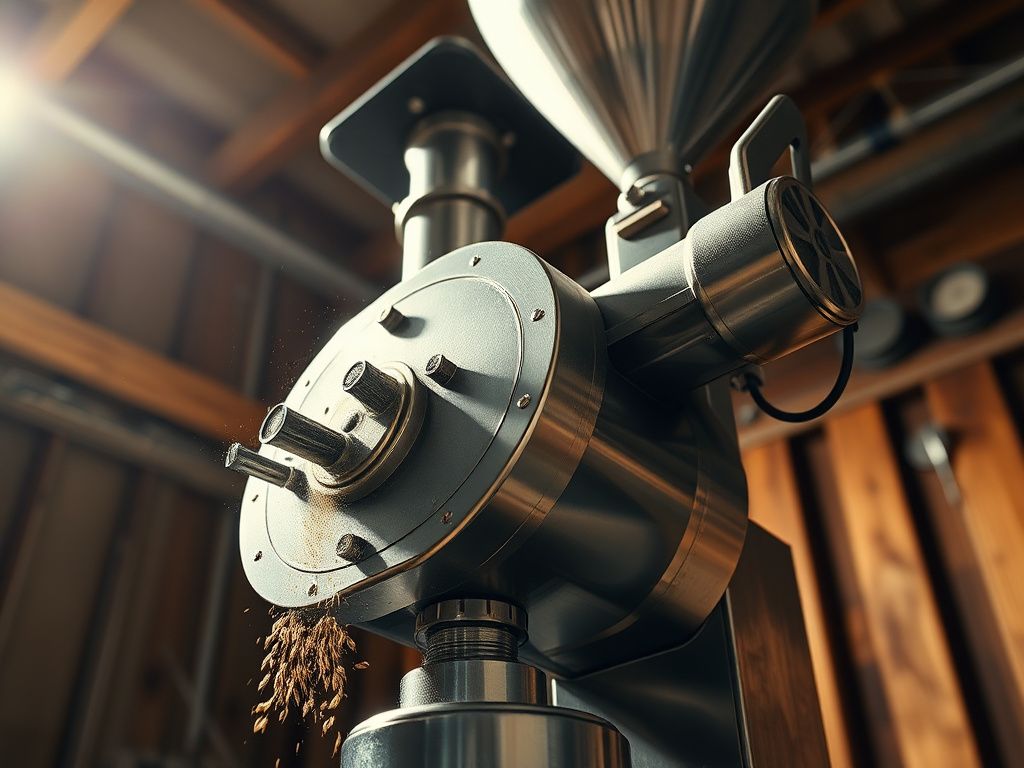
Achieve unparalleled consistency and safety in your brewing operations with a custom-built motorized grain mill station. This guide provides the technical specifications and construction methodology for integrating precise motor control and comprehensive dust collection, optimizing extract efficiency while maintaining a pristine brewing environment. Elevate your grain processing to a professional standard.
Motorized Grain Mill Station Component Specification
| Component | Specification | Function | Material/Type | Notes/Considerations |
|---|---|---|---|---|
| Grain Mill | 2-roller or 3-roller, adjustable gap (0.025″ – 0.070″) | Crushes whole malted barley kernels to specific grist profile. | Hardened steel rollers, aluminum body | Roller diameter & length influence throughput. Ensure precise, repeatable gap adjustment. |
| Drive Motor | 0.5 HP – 1.0 HP, 1725 RPM (or geared equivalent for 100-200 RPM at mill shaft) | Provides rotational power to the grain mill rollers. | TEFC (Totally Enclosed Fan Cooled) AC motor, geared motor, or DC motor with controller. | Select based on mill type and desired throughput. TEFC for dust-prone environments. VFD recommended for variable speed control. |
| Hopper | 10-25 kg capacity (e.g., 20L volume) | Feeds whole grain consistently into the mill rollers. | Food-grade HDPE, stainless steel, or plywood with food-safe liner. | Design with steep sides (60°+ angle) to prevent bridging. Include safety grating. |
| Dust Collector Unit | Minimum 300 CFM (Cubic Feet per Minute) @ 2-3″ SP (Static Pressure), 0.5-1.0 Micron filtration. | Captures and filters airborne malt dust generated during milling. | Dedicated dust collector with cartridge filter, cyclonic separator pre-filter recommended. | Proper sizing is critical. HEPA-level filtration optional for ultimate air quality. Ensure robust collection bag/bin. |
| Enclosure/Frame | Rigid, stable, sound-dampening structure | Houses all components, mitigates vibration, reduces noise, contains dust. | Plywood (18-25mm), steel square tubing, or aluminum extrusion. | Design for easy access for maintenance, cleaning, and grain collection. Integrate vibration dampening. |
| Ducting & Plenum | 4″ – 6″ diameter smooth-wall pipe, custom-fabricated plenum | Transports dust-laden air from mill zone to collector. | PVC, sheet metal. | Minimize bends, ensure airtight seals. Plenum design critical for effective capture at the mill discharge. |
| Electrical Controls | Motor ON/OFF switch, Emergency Stop (E-Stop), VFD (Variable Frequency Drive) | Manages motor operation, provides safety cut-off, enables speed adjustment. | NEMA-rated enclosure, industrial-grade switches, VFD. | Proper grounding and circuit protection (breaker, fuse) are mandatory. VFD allows precise RPM tuning. |
Motor & Dust Collection System Sizing Calculations
1. Motor Torque & RPM Calculation for Milling:
To achieve an optimal crush at a rate of 1-2 kg/min (2.2-4.4 lbs/min) for a typical 2-roller mill, the mill’s drive roller often operates between 100-200 RPM. A direct drive with a 1725 RPM motor would require a significant gear reduction. Belt-and-pulley systems are common.
Assume a desired mill roller speed (N_mill) = 150 RPM.
If using a 1725 RPM AC motor, calculate pulley ratio (R):
R = N_motor / N_mill = 1725 RPM / 150 RPM = 11.5
If the motor pulley (D_motor) is 2 inches, the mill pulley (D_mill) should be:
D_mill = R * D_motor = 11.5 * 2 inches = 23 inches
A 0.5 HP (373 W) motor is typically sufficient for hobby to small commercial scale, providing ample torque for malt. Power (P) = Torque (T) × Angular Velocity (ω).
T (Nm) = P (Watts) / (ω (rad/s))
ω (rad/s) = N_mill (RPM) × (2π / 60)
For N_mill = 150 RPM:
ω = 150 × (2π / 60) ≈ 15.7 rad/s
Assuming 80% efficiency for the mill and drive system, the required motor power would be slightly higher. A 0.5 HP motor provides approx. 23.7 Nm of torque at 150 RPM (theoretical, actual depends on motor characteristics and losses).
2. Dust Collection Airflow (CFM) Calculation:
Effective dust capture at the source requires a minimum capture velocity at the pickup point, typically 200-500 feet per minute (FPM) for light dusts like malt. The volume of air required is Flow Rate (Q) = Area (A) × Velocity (V).
Consider a capture hood/plenum opening around the mill discharge area. Let’s assume a rectangular opening of 6 inches x 12 inches (0.5 ft x 1.0 ft).
Area (A) = 0.5 ft × 1.0 ft = 0.5 sq ft
Desired capture velocity (V) = 400 FPM.
Q (CFM) = A (sq ft) × V (FPM) = 0.5 sq ft × 400 FPM = 200 CFM
This is the theoretical minimum. Due to losses in ducting, filter loading, and static pressure requirements, a dust collector unit with a higher rated capacity (e.g., 300-500 CFM) is recommended to ensure sufficient flow at the collection point. For a 4-inch duct, typical transport velocity should be 3500-4500 FPM to prevent settling, requiring 300-400 CFM for that duct size alone. Select a collector rated for these specifications at the system’s calculated static pressure loss.
The Definitive Master-Guide: Building a Motorized Grain Mill Station with Dust Collection
Introduction: Precision Milling as a Foundation for Quality Brewing
The foundation of exceptional beer lies not only in meticulously selected ingredients but also in the precision of their preparation. For all-grain brewers, this begins with the grain crush. An optimized crush profile maximizes extract efficiency, ensuring consistent wort gravity and fermentable sugar ratios, directly impacting the final beer’s alcohol content, body, and flavor profile. Manual milling, while functional, introduces variability in crush consistency, restricts throughput, and generates significant airborne particulate. The construction of a motorized grain mill station with integrated dust collection addresses these critical limitations, transforming a manual chore into a precise, efficient, and clean operation. This technical deep dive will guide you through the design, component selection, construction, and calibration processes, enabling you to build a professional-grade milling system that enhances your brewing prowess.
I. Component Selection and Justification
The success of your motorized grain mill station hinges on the judicious selection of its core components. Each element plays a synergistic role in the system’s overall performance, safety, and longevity.
A. The Grain Mill: Heart of the System
The choice of grain mill is paramount. Two-roller mills are standard for homebrewers and smaller commercial operations, offering a good balance of cost and performance. Three-roller mills, typically more expensive, provide superior crush consistency by performing a pre-crush on the first set of rollers before the final sizing on the second set. Consider:
Roller Material: Hardened tool steel is preferred for durability and resistance to wear, especially when processing large volumes or occasionally harder grains like corn.
Roller Diameter and Length: Larger diameter rollers provide a greater crushing surface area, improving efficiency and reducing slippage. Longer rollers accommodate wider grain streams, increasing throughput.
Adjustability: A precise, repeatable gap adjustment mechanism (e.g., eccentric adjusters, set screws with feeler gauges) is non-negotiable for dialing in the optimal crush profile. The target gap typically ranges from 0.035″ to 0.045″, depending on malt type and desired extract efficiency.
B. The Drive Motor: Powering the Crush
A geared AC motor is often the simplest and most robust solution for direct drive, providing appropriate RPMs (100-200 RPM) and high torque. Alternatively, a standard 1725 RPM AC motor can be coupled with a belt-and-pulley system for speed reduction. Key considerations:
Horsepower (HP): For a typical 2-roller mill processing 1-2 kg/min, a 0.5 HP to 0.75 HP motor is usually sufficient. Over-specifying HP can lead to higher power consumption and unnecessary cost without significant performance gains for this application.
RPM: The mill rollers should turn slowly to minimize flour production and preserve husk integrity. A VFD (Variable Frequency Drive) is highly recommended for precise speed control, allowing you to fine-tune the milling process for different malt types and environmental conditions.
Motor Type: A TEFC (Totally Enclosed Fan Cooled) motor is essential in a dusty environment. The enclosure protects internal components from grain dust, which is combustible under specific conditions (though less of a concern with malt dust than finer industrial dusts, prevention is key).
Mounting: Secure, vibration-dampened mounting is crucial to prevent mechanical stress and noise.
C. The Hopper: Consistent Grain Feed
The hopper facilitates the consistent and controlled feeding of grain into the mill. Its design directly influences milling efficiency and safety.
Material: Food-grade HDPE, stainless steel, or even well-sealed plywood with a food-safe liner (e.g., epoxy paint) are suitable. Avoid materials that can leach chemicals or harbor bacteria.
Volume: Size the hopper to accommodate your typical batch size, minimizing refills during a milling session. A 20-30L capacity is good for 5-10 gallon homebrew batches.
Angle: Steep sides (at least 60-degree angle from horizontal) are critical to prevent grain “bridging” or clogging. A smooth internal surface aids flow.
Safety Grate: Always include a safety grate or screen at the hopper opening to prevent accidental contact with moving rollers and to filter out foreign objects that could damage the mill.
D. Dust Collection System: Health, Safety, and Cleanliness
Milling generates significant fine malt dust, which can be an irritant, a potential allergen, and, in high concentrations, a minor explosion hazard. A robust dust collection system is non-negotiable for a professional setup.
Collector Type: A dedicated single-stage dust collector with a high-efficiency cartridge filter (0.5-1.0 micron) is ideal. Integrating a cyclonic separator as a pre-filter significantly extends the life of the main filter by removing larger particulates.
Airflow (CFM): Sizing is critical. Refer to the math box for basic calculations. A minimum of 300-500 CFM is generally recommended for effective capture at the mill discharge point.
Ducting: Use smooth-walled, rigid ducting (PVC or sheet metal) with minimal bends and airtight connections. Duct diameter (e.g., 4-6 inches) must be appropriate for the CFM to maintain adequate transport velocity and prevent dust settling.
Capture Hood/Plenum: Design a custom plenum that effectively encloses the mill discharge area, creating negative pressure to draw dust into the ducting. This is arguably the most critical part of the dust collection setup.
E. Frame and Enclosure: Stability, Sound, and Safety
The structure housing your mill station provides stability, mitigates noise, and enhances safety. BrewMyBeer.online emphasizes quality construction for lasting performance.
Material: Heavy-gauge steel tubing (welded or bolted) provides maximum rigidity. Plywood (18-25mm, Baltic birch or marine grade) is a cost-effective and highly workable alternative, especially when laminated for sound dampening.
Design: A fully enclosed design is preferred for noise reduction and dust containment. Incorporate a transparent panel (e.g., polycarbonate) for visual inspection of the milling process. Ensure adequate ventilation for the motor if it’s within the enclosure.
Vibration Dampening: Rubber isolation mounts for the motor and mill can significantly reduce transmitted vibration and noise.
Ergonomics: Position the hopper at a comfortable height for loading and the crushed grain collection bin for easy access.
F. Electrical Controls and Safety
Proper electrical integration is non-negotiable for both operation and safety.
Main Power Switch: A clearly labeled ON/OFF switch for the entire unit.
Emergency Stop (E-Stop): A prominent, mushroom-head E-Stop button that immediately cuts all power to the motor(s) is crucial. Wire it to a contactor that de-energizes the circuit.
Variable Frequency Drive (VFD): As mentioned, a VFD allows precise speed control, soft start/stop, and motor protection. Select a VFD rated for your motor’s voltage and current, and ensure it’s housed in a NEMA-rated enclosure suitable for dust exposure.
Wiring: All wiring must conform to local electrical codes. Use appropriately sized conductors, properly ground all metallic components, and protect circuits with fuses or circuit breakers. Consider running wires in conduit for protection.
II. Design and Construction Principles
A well-planned design minimizes construction challenges and optimizes long-term performance.
A. Integrated Design Approach
Conceive the mill, motor, hopper, and dust collection as a single, cohesive unit. The dust collection plenum should be integral to the mill’s discharge area, not an afterthought. The crushed grain collection bin should seal tightly against the enclosure to prevent dust escape.
B. Vibration and Noise Mitigation
Motorized mills generate both vibration and noise. Employing vibration isolators, constructing a dense enclosure (e.g., double-walled plywood with sand fill or mass-loaded vinyl), and using robust fasteners will significantly improve the user experience and component longevity.
C. Dust Containment and Negative Pressure
The enclosure should be as airtight as possible to allow the dust collector to create a negative pressure environment around the mill. This ensures that any dust generated is immediately drawn into the collection system, rather than escaping into the air.
D. Accessibility for Maintenance
Design hinged panels or easily removable sections for accessing the mill rollers for cleaning, gap adjustment, and inspection. Similarly, the dust collector’s filter and collection bin must be easily accessible for maintenance.
III. Assembly Sequence and Integration
Follow a logical assembly order to streamline construction.
A. Frame Construction
Begin by constructing the primary frame. Ensure it is level, square, and robust enough to support all components. Reinforce stress points, especially where the mill and motor will mount.
B. Mill and Motor Mounting
Mount the grain mill securely to the frame, ensuring it is perfectly level. Next, mount the motor. If using a belt-and-pulley system, ensure precise alignment of the pulleys to prevent belt wear and slippage. Tension the belt correctly. If direct drive with a geared motor, ensure proper coupling alignment.
C. Hopper Fabrication and Mounting
Fabricate or assemble the hopper. Mount it directly above the grain mill, ensuring the discharge opening aligns perfectly with the mill’s intake. Seal all joints to prevent grain spillage.
D. Dust Collection Plenum and Ducting Integration
Construct the custom dust collection plenum directly beneath the mill’s discharge chute, extending to encapsulate the crushed grain collection area. This plenum should have a single outlet for connection to the main ductwork. Run ducting from the plenum to the dust collector unit, minimizing bends and maintaining airtight seals. Securely mount the dust collector.
E. Electrical Wiring and Controls
Install the electrical panel, VFD, main switch, and E-Stop button. Wire the motor to the VFD, and the VFD to the main power supply via the E-Stop and main switch. Ensure all grounding is correctly implemented. BrewMyBeer.online recommends consulting a qualified electrician for this phase if you are not proficient in electrical work.
IV. Calibration, Operation, and Safety Protocols
A. Mill Gap Calibration
This is the most critical step for optimal extract efficiency. Use a set of feeler gauges to precisely set the mill gap, typically between 0.035″ and 0.045″ for most malted barley. Perform a test crush and visually inspect the grist: Husks should be mostly intact, endosperm thoroughly fractured into varying sizes, and flour content minimized. The Optimal Malt Crush Profile ensures maximum extract. The iodine test on crushed malt can indicate ungelatinized starch if the crush is too coarse.
B. VFD Tuning and Speed Optimization
Start the mill at a very low RPM and gradually increase, observing the crush quality and motor load. The optimal speed minimizes flouring while providing adequate throughput. The VFD also allows for a soft start, reducing mechanical shock.
C. Dust Collector Efficiency Check
With the mill operating, observe the dust around the mill and the discharge area. There should be virtually no visible dust escaping the system. Check the dust collector’s collection bin and filter for proper functioning. Periodically monitor the filter’s differential pressure if your collector has a manometer, indicating when cleaning or replacement is needed.
D. Safety Protocols
Electrical Safety: Always disconnect power before performing any maintenance. Ensure all exposed wiring is in conduit and all metal enclosures are properly grounded. The E-Stop must be fully functional.
Moving Parts: Never reach into the hopper or near the rollers when the mill is operating or connected to power. The safety grate in the hopper is not optional. Incorporate interlocks that prevent operation if access panels are open.
Dust Handling: While malt dust has a lower explosion potential than finer, drier industrial dusts, it is still combustible. Always empty dust collection bins regularly. Wear appropriate PPE, including a respirator, when emptying collection bins and cleaning filters to prevent inhalation of fine particulates. Refer to Brewery Workplace Safety guidelines.
Personal Protective Equipment (PPE): Wear safety glasses, hearing protection (especially if the enclosure isn’t fully soundproofed), and a dust mask/respirator during milling and maintenance.
V. Maintenance Schedule
Regular maintenance ensures the longevity and consistent performance of your milling station.
After Each Use: Empty the dust collector collection bin. Brush down any residual grain dust from the hopper, mill body, and enclosure surfaces. Clean the grist collection area.
Monthly/Quarterly (depending on use): Inspect mill rollers for wear or damage. Check belt tension (if applicable). Verify motor mounting and all fasteners are tight. Inspect ducting for leaks or blockages. Clean or replace dust collector filters as needed. Lubricate motor bearings if non-sealed type.
Annually: Full inspection of all electrical components. Re-verify mill gap calibration. Deep clean the entire system. Consider bearing replacement for high-usage mills.
By adhering to these principles of design, construction, and operation, you will construct a motorized grain mill station that not only simplifies your brewing process but elevates the quality and consistency of your beer, all while maintaining a safe and clean brewing environment. This is a significant investment in your brewing future, yielding returns in precision, efficiency, and superior craft.
