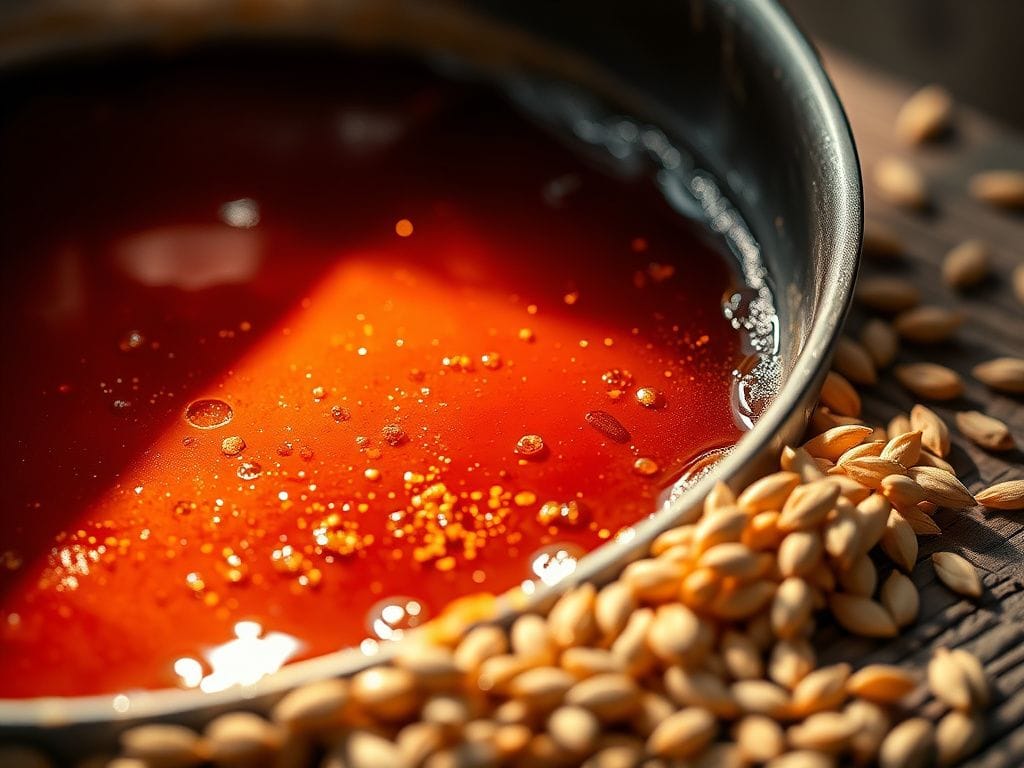
Harnessing the Maillard reaction in the kettle allows brewers to forge profound malt complexity and nuanced flavor profiles without relying on crystal malts. This advanced technique leverages precise control over temperature, pH, and sugar/amino acid concentrations during the boil, creating rich melanoidin development, enhanced color, and bready, toasted, or caramel notes, ultimately yielding highly fermentable, intricate beers.
Kettle Maillard Reaction Parameters: Critical Control Points
| Parameter | Optimal Range/Value | Impact on Maillard | Measurement Method | Corrective Action |
|---|---|---|---|---|
| Kettle pH | 5.0 – 5.8 (Post-Boil) | Alkaline conditions accelerate browning; acidic conditions favor lighter melanoidins. Higher pH promotes faster reaction kinetics and deeper color. | Calibrated pH meter (post-mash runoff, pre-boil, post-boil samples). | Add food-grade lactic acid or phosphoric acid to lower pH; add calcium carbonate or chalk to raise pH (less common for kettle Maillard). |
| Boil Temperature | 100°C+ (Vigorous Boil) | Higher temperatures significantly increase reaction rate. Reaction is minimal below boiling, accelerates exponentially above 100°C. | Calibrated thermometer (ambient liquid temperature). | Increase heat input for more vigorous boil; insulate kettle for heat retention. |
| Boil Time | 90 – 180 minutes | Extended boils intensify Maillard products, leading to darker color and more pronounced flavors. Directly proportional to reaction extent. | Timer. | Adjust boil duration based on desired color and flavor intensity; monitor liquid level due to evaporation. |
| Reducing Sugar Concentration | 1.0 – 1.5 kg Dextrose Equivalent per 20L (or significant DME/LME addition) | Higher concentrations of reducing sugars (glucose, fructose) provide more reactants for the Maillard reaction. Maltose reacts slower. | Refractometer/Hydrometer (pre-boil gravity, calculated dextrose addition for target OG). | Add dextrose, DME, or LME directly to kettle at start of boil to increase sugar load. |
| Free Amino Nitrogen (FAN) | >200 ppm in wort | FAN provides amino groups, essential reactants. Higher FAN promotes greater melanoidin formation and complexity. | Laboratory analysis (e.g., ninhydrin assay) or correlation with malt bill (e.g., Vienna, Munich, Pilsner malts are higher in FAN). | Select malts with inherently high Free Amino Nitrogen (FAN) content (Munich, Vienna, Pilsner); optimize mash parameters (temp/pH) for protease activity. |
Maillard Reaction Kinetics: Simplified Color Change Calculation
The Maillard Reaction’s rate, and thus its contribution to color and flavor, is highly dependent on temperature, time, and reactant concentrations. While true kinetics are complex, we can illustrate the concept of color development based on increased boil duration and sugar addition.
Consider a standard wort with a pre-boil gravity (PBG) of 1.050 and a 60-minute boil. We aim to achieve a 15% increase in Maillard-derived color (measured in SRM) through an extended boil and dextrose addition.
Baseline Scenario:
PBG = 1.050 (approx. 12.4°P)
Boil Time (T₁) = 60 minutes
Estimated SRM increase from Maillard (SRM₁) for a 60-min boil is approximately 1-2 SRM points, depending on wort composition. Let’s assume 1.5 SRM for this example.
Enhanced Maillard Scenario:
Target SRM Increase = SRM₁ * 1.15 = 1.5 SRM * 1.15 = 1.725 SRM
To achieve this, we can extend the boil and/or add more reducing sugars. For Maillard, temperature and time are key drivers. A common approximation for reaction rate doubling is every 10°C increase, but in the kettle, temperature is largely constant at 100°C. Thus, time becomes the primary lever, alongside reactant concentration.
Let’s assume a simplified relationship where Maillard color development is roughly proportional to the square of boil time at constant temperature and directly proportional to sugar concentration (within limits):
SRM_Maillard ≈ k * T² * S
Where:
k = reaction constant
T = boil time (in hours)
S = sugar concentration factor (e.g., 1 for baseline, 1.25 for 25% increase in sugars)
If we extend the boil from 60 minutes (1 hour) to 90 minutes (1.5 hours) and add 500g dextrose to a 20L batch, increasing effective sugar concentration by 10% (S = 1.1):
Baseline (T₁=1hr, S₁=1): SRM₁ ≈ k * (1)² * 1 = k
New Scenario (T₂=1.5hr, S₂=1.1): SRM₂ ≈ k * (1.5)² * 1.1 = k * 2.25 * 1.1 = k * 2.475
Ratio of SRM₂ to SRM₁ = 2.475 / 1 = 2.475
This implies a 147.5% increase in Maillard-derived color (not total SRM). If our baseline Maillard contribution was 1.5 SRM, the new contribution would be 1.5 * 2.475 ≈ 3.71 SRM. This significant increase contributes to profound color and flavor shifts.
Practical Dextrose Addition Calculation:
To increase fermentable sugar concentration by 1.0 °P in 20 liters:
1 °P ≈ 10 g sugar/L * 20 L = 200 g sugar.
If we aim for an additional 2.5 °P contribution from dextrose for enhanced Maillard:
Required Dextrose = 2.5 °P * 200 g/°P = 500 g.
This added sugar not only boosts gravity but critically provides additional reducing sugars for the Maillard reaction, intensifying the kettle-derived complexity.
The Maillard Reaction in the Kettle: Enhancing Malt Complexity Without Crystal Malt – A Master Guide
The Maillard reaction, a complex series of non-enzymatic browning reactions, is fundamental to the formation of color and flavor in countless foods, including beer. While it occurs extensively during malting, roasting, and even mashing, its deliberate manipulation within the brewing kettle offers a unique pathway to developing profound malt complexity. This technique allows brewers to imbue beers with rich melanoidin character, reminiscent of bread crust, toasted nuts, and subtle caramel, without the use of crystal or caramel malts, thereby retaining a high degree of fermentability and avoiding the often cloying sweetness associated with specialty grains.
Understanding and controlling the Maillard reaction in the kettle represents a mastery of brewing chemistry. It enables the creation of nuanced flavor profiles that are both complex and dry, distinguishing the resulting beer from those relying on highly roasted or caramelized malts. This method is particularly valued in styles where melanoidin richness is desired but a crisp, attenuated finish is paramount, such as traditional German Melanoidin-rich lager styles like Doppelbock, Dunkel, and Bock.
Chemical Mechanism: The Foundation of Flavor
At its core, the Maillard reaction involves the condensation of an amino group (from amino acids or peptides) with a reducing sugar (containing a free aldehyde or ketone group). This initial reversible condensation forms an unstable Schiff base, which then undergoes an intramolecular rearrangement to produce Amadori products (from aldoses) or Heyns products (from ketoses). These stable intermediates are largely flavorless but are crucial precursors to the vast array of flavor and aroma compounds that define Maillard reactions.
From the Amadori/Heyns products, the reaction pathways diverge extensively, influenced by pH, temperature, and water activity. Key pathways include:
Dehydration: Leading to furans (e.g., furfural, hydroxymethylfurfural), which contribute caramel and nutty notes.
Fission: Breaking down into dicarbonyl compounds, aldehydes (e.g., diacetyl, acetaldehyde, Strecker aldehydes), and pyrazines. Pyrazines are critical for roasted, bready, and nutty aromas.
Cyclization: Forming pyrroles, oxazoles, and thiazoles, adding to the savory and meaty notes.
Polymerization: The subsequent reactions of these intermediates, along with further condensation reactions, lead to the formation of high molecular weight, colored polymers known as melanoidins. Melanoidins are largely responsible for the brown color of Maillard-rich foods and contribute significant body, mouthfeel, and bready, toasted, and sometimes even burnt sugar flavors to beer. They are complex and not fully characterized, but their presence is undeniable in kettle-Maillard enhanced brews.
The entire cascade is non-enzymatic and requires elevated temperatures, making the kettle a prime environment for its deliberate initiation and control. Unlike enzymatic reactions that can be finely tuned by specific enzymes, Maillard’s complexity arises from the multitude of parallel and sequential reactions occurring simultaneously.
Key Parameters and Their Control in the Kettle
Mastering kettle Maillard requires meticulous control over several critical parameters. Deviations can lead to either insufficient development or unwanted off-flavors.
1. pH: The pH Switchboard
pH is arguably the most influential factor in directing the Maillard reaction pathways. In general, more alkaline conditions (higher pH) accelerate the reaction and favor the formation of dark melanoidins and intense browning. Conversely, more acidic conditions (lower pH) slow the reaction, favoring different intermediates and often leading to lighter, more delicate flavor compounds. In the brewing kettle:
Boil pH: The pH of wort typically drops during the boil due to the precipitation of calcium phosphate and the buffering action of proteins. For kettle Maillard, aiming for a post-boil pH slightly higher than a typical pale ale (e.g., 5.0-5.8) can enhance melanoidin formation. However, excessively high pH (above 6.0) can lead to harsh, astringent flavors and increased extraction of silicates and polyphenols from the grain husks. Most brewers target a pre-boil pH around 5.2-5.4, allowing it to drop to 5.0-5.2 post-boil. For specific Maillard effects, a slight increase (e.g., aiming for 5.4-5.6 post-boil) might be explored, but with caution.
Water Chemistry: The alkalinity and mineral content of your brewing water significantly impact mash and boil pH. Harder water with higher bicarbonate levels will resist pH drops, potentially leading to a higher boil pH more conducive to Maillard. Understanding your water profile and making precise mineral additions (e.g., calcium carbonate or chalk to raise pH, lactic or phosphoric acid to lower) is paramount. Consult your local brewing resources for water chemistry calculators and guidance.
2. Temperature: The Kinetic Accelerator
The Maillard reaction is highly temperature-dependent. Its rate increases exponentially with temperature. While the kettle temperature is largely constant at 100°C (or slightly higher at elevation), a vigorous, rolling boil ensures consistent heat distribution and maximal reaction rate. Insufficient heat input can lead to slower reaction progression, resulting in less developed flavors and color.
3. Time: The Intensity Dial
Boil duration directly dictates the extent of the Maillard reaction. A standard 60-minute boil provides some melanoidin development, but for significant kettle Maillard character, extended boils are essential. Extended Kettle Boils of 90, 120, or even 180 minutes dramatically increase the time for reactions to occur, leading to deeper color and more intense flavor compounds. This extended time also means increased boil-off, which concentrates sugars and amino acids, further accelerating the reaction. Brewers must account for this increased evaporation when planning their batch size and pre-boil gravity.
4. Reducing Sugar Concentration: The Fuel
The Maillard reaction requires reducing sugars. In wort, these are primarily glucose, fructose, and maltose. While maltose is the most abundant sugar, glucose and fructose react more readily. To enhance kettle Maillard:
Malt Bill Selection: Grains like Munich and Vienna malt contribute significant amounts of reducing sugars. Pilsner malt also contains sufficient precursors.
Dextrose/DME Additions: Adding simple sugars like dextrose (glucose) or dried malt extract (DME) directly to the kettle at the start of the boil provides a readily available source of reducing sugars, significantly boosting the reaction. A common practice is to add 0.5-1.5 kg of dextrose per 20L batch for pronounced effects, considering the impact on fermentability and final gravity.
High Gravity Boil: Brewing a higher gravity wort, which is then diluted post-fermentation, naturally increases the concentration of reducing sugars in the kettle, accelerating Maillard development. This is a common technique for producing strong, dark lagers.
5. Amino Acid Concentration (FAN): The Nitrogen Source
Free Amino Nitrogen (FAN) represents the total concentration of amino acids and small peptides available in the wort. These provide the essential amino groups for the Maillard reaction. Higher FAN levels correlate with greater potential for melanoidin formation.
Malt Selection: Malts rich in protein and well-modified (e.g., Munich, Vienna, Pilsner) tend to have higher FAN levels compared to highly kilned specialty malts. Using a significant proportion of these base or character malts forms the backbone for kettle Maillard.
Mash Parameters: Optimizing mash temperature and pH for proteolytic enzyme activity (e.g., a protein rest at 50-55°C for 15-30 minutes, or a well-designed single infusion mash with appropriate pH) can maximize FAN extraction. However, excessive protein rest can lead to overly thin body and head retention issues.
Flavor Profiles Generated
The beauty of kettle Maillard lies in the diverse spectrum of flavors it produces. These are often more nuanced and less overtly sweet than those from crystal malts:
Melanoidins: Contribute bready, toasted, biscuit, and sometimes dried fruit or stewed fruit notes. They also enhance body and mouthfeel.
Pyrazines: Offer distinct roasted, nutty, coffee, and even earthy aromas. These are crucial for the depth found in dark lagers.
Furans: Provide caramel, treacle, and sometimes slightly burnt sugar or woody notes, but generally more subtle than crystal malt contributions.
Aldehydes: Can contribute to bready, malty, or sometimes sherry-like notes, depending on the specific aldehyde and its concentration.
The overall impression is one of complex malt depth, a rich color ranging from amber to deep ruby-brown, and a palate that avoids the syrupy sweetness of crystal malts, finishing drier and cleaner.
Practical Application in Brewing
Implementing kettle Maillard requires a thoughtful approach to recipe formulation and process execution:
Malt Bill Design: Focus on a base of well-modified malts with good FAN content. Pilsner, Munich, and Vienna malts are excellent choices. A typical recipe might include 50-70% Pilsner, 20-40% Munich, and 5-10% Vienna, or even 100% Munich for a truly rich base. Avoid malts that are already heavily roasted or crystalized if the goal is purely kettle Maillard character, as they can obscure the nuances.
Mash pH and Temperature: Ensure mash pH is optimized for optimal protease activity (e.g., 5.2-5.4). A single infusion mash at 66-68°C is often sufficient, especially with well-modified malts. For maximizing FAN, a short protein rest at 50-55°C can be considered, but carefully to avoid a thin body.
Kettle Additions: Consider adding dextrose (glucose) at the start of the boil. This provides a readily available reducing sugar that reacts faster than maltose, significantly boosting Maillard development. Aim for 0.5-1.5 kg per 20L batch, adjusting based on desired intensity. This will also increase your original gravity, which needs to be factored into fermentation and ABV calculations.
Boil Vigor and Duration: A truly vigorous, rolling boil is critical. Ensure your heat source can maintain this for the entire extended boil. Plan for extended boil times—90 minutes is a good starting point, but 120-180 minutes will yield more profound results. Remember that an extended boil will increase evaporation. Adjust your pre-boil volume accordingly to hit your target post-boil volume. This also means you’ll need to account for increased hop utilization, so adjust your hop additions downward to avoid excessive bitterness.
pH Monitoring: Monitor the kettle pH throughout the boil. If starting pH is too low (e.g., below 5.0), a small addition of calcium carbonate or even baking soda (very sparingly) can be used to raise it slightly, promoting Maillard. However, extreme pH adjustments should be avoided as they can introduce their own problems.
Troubleshooting and Considerations
While powerful, kettle Maillard also presents potential challenges:
Scorching: High sugar concentrations and extended boils increase the risk of scorching on the bottom of the kettle, especially with direct-fired systems. Stirring frequently, especially if adding adjuncts, can mitigate this. Ensure proper heat dispersion.
Hop Utilization: Extended boils lead to increased hop isomerization, meaning more bitterness from the same hop addition. Adjust hop schedules by reducing bittering additions or shifting additions later in the boil.
Off-flavors: Excessive pH or extreme boil duration without proper control can lead to harsh, burnt, or acrid notes. A balance must be struck. High pH can also lead to more pronounced DMS (dimethyl sulfide) if the boil is not vigorous enough to drive it off.
Water Loss: Extended boils necessitate larger initial volumes of wort to account for evaporation. This impacts brewing capacity and water usage.
Process Scaling: Scaling up kettle Maillard for larger commercial batches can be challenging due to increased energy requirements and heat transfer complexities. Precision brewing tools and automated systems become more critical.
Comparison to Crystal Malts
The primary advantage of kettle Maillard over crystal malts is fermentability and flavor nuance. Crystal malts undergo a controlled kilning and stewing process, converting starches within the kernel into unfermentable sugars and caramelized compounds. This contributes significant body, sweetness, and distinct caramel/toffee flavors, but also leaves behind a high percentage of unfermentable sugars that can lead to a cloying finish or limit attenuation.
Kettle Maillard, by contrast, relies on reactions between fermentable sugars and amino acids. While melanoidins themselves are largely unfermentable, the vast majority of the sugars in the wort remain fermentable. This allows brewers to achieve rich, complex malt character and deep color while maintaining a dry, crisp finish, especially beneficial for lagers and other highly attenuated styles. The resulting flavors tend to be more “bready” and “toasted” rather than overtly “caramel” or “toffee,” offering a different dimension of malt complexity.
Beer Styles Benefiting from Kettle Maillard
This technique is particularly well-suited for styles where a deep, complex malt backbone is desired, along with a clean, fermentable finish:
Doppelbock & Bock: Traditional examples often feature significant kettle Maillard development, contributing to their malty richness, deep color, and underlying toasted notes without being overly sweet.
Dunkel & Schwarzbier: These dark lagers benefit from the bready, lightly roasted, and chocolate-like notes that kettle Maillard can provide, offering complexity without the harshness of highly roasted malts.
Vienna Lager: Can gain enhanced toasty and slightly caramelly notes, deepening its character while remaining balanced.
Scottish Ales (e.g., Wee Heavy): While often using crystal malts, a subtle kettle Maillard approach can add layers of dried fruit and bready character, contributing to their malty sweetness without excessive residual sugar.
Certain Brown Ales and Porters: For versions seeking a drier finish with complex toasted, nutty, and bread crust notes, kettle Maillard offers a superior alternative to relying solely on crystal or chocolate malts.
Conclusion: The Art of Deliberate Browning
The deliberate orchestration of the Maillard reaction in the kettle is an advanced brewing technique that separates the artisan from the novice. It offers a powerful means to sculpt profound malt complexity, achieve rich color, and develop intricate toasted, bready, and dried fruit flavors without compromising fermentability. By precisely controlling pH, temperature, boil duration, and reactant concentrations, brewers can unlock a spectrum of flavors unattainable through simpler methods. Mastering kettle Maillard not only elevates the character of the finished beer but also deepens a brewer’s understanding of the intricate chemical transformations that define the brewing process, pushing the boundaries of what is achievable with malt and water.
This approach allows for a cleaner, more refined expression of malt, moving beyond the often one-dimensional contributions of conventional crystal malts. It demands patience, meticulous attention to detail, and a willingness to experiment, but the rewards are beers of exceptional depth, balance, and fermentable complexity.