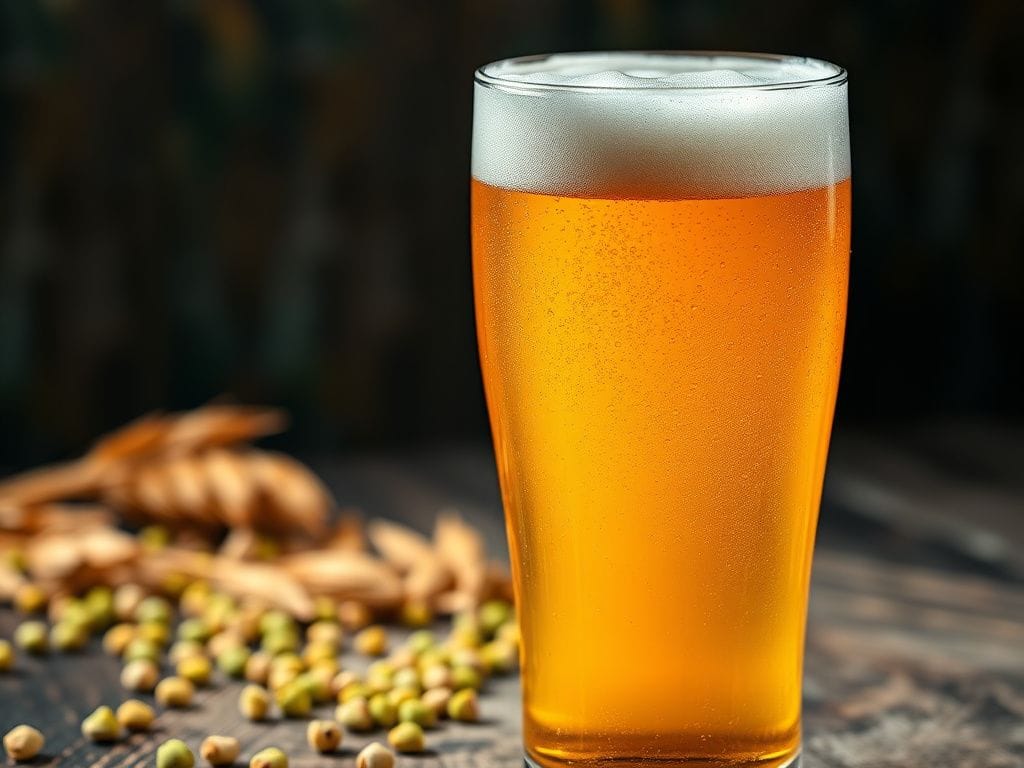
Recreating Russian River’s Pliny the Younger demands meticulous process control and precise ingredient management. This guide dissects the intricate malt bill, aggressive multi-stage hopping, specific water chemistry, and nuanced fermentation required for a high-gravity Triple IPA. Master advanced techniques from biotransformation to oxygen mitigation to achieve this legendary clone.
Recipe at a Glance: Pliny the Younger Clone
This table provides a high-level overview of the critical components and their roles in cloning Pliny the Younger. Specific quantities and detailed instructions follow in the deep dive.
| Category | Component | Type/Quantity/Timing | Primary Role | Notes/Considerations |
|---|---|---|---|---|
| Grain Bill | North American 2-Row Pale Malt | ~90-92% of grist | Base fermentable sugars, light body | High extract potential, clean base. Target OG ~1.088-1.092. |
| Grain Bill | Weyermann Carafoam/Briess Carapils | ~3-5% of grist | Head retention, body, dextrins | Non-fermentable dextrins without adding color/sweetness. |
| Grain Bill | Crystal Malt (e.g., Crystal 10L-20L) | ~3-5% of grist | Subtle caramel, color, mouthfeel | Minimal usage to prevent cloying sweetness or excessive color. |
| Grain Bill | Acidulated Malt | ~0.5-1% of grist (as needed) | Mash pH adjustment | Ensures optimal enzymatic activity, prevents astringency. |
| Hops | Columbus (CTZ) | Boil: FWH, 60-0 min; Dry Hop | Bittering, pungent aroma, biotransformation precursor | High alpha acid, dank/resinous character. Multiple additions. |
| Hops | Simcoe | Boil: 60-0 min; Whirlpool; Dry Hop (multiple stages) | Pine, dank, passionfruit, citrus; bitterness | Complex profile, key to Younger’s signature aroma. |
| Hops | Centennial | Boil: 30-0 min; Whirlpool; Dry Hop | Floral, citrus (lemon, lime), slight pine | Brightens hop profile, contributes to citrus notes. |
| Hops | Amarillo | Boil: 30-0 min; Whirlpool; Dry Hop (multiple stages) | Orange, grapefruit, floral, stone fruit | Adds sweet citrus and fruity complexity. |
| Yeast | White Labs WLP001 California Ale Yeast / Wyeast 1056 American Ale Yeast / Fermentis SafAle US-05 | Two to three healthy, active liquid yeast packs or equivalent rehydrated dry yeast. Proper starter critical. | Clean fermentation, high attenuation, low ester production | Essential for allowing hop profile to dominate. Ferment cool (~65-68°F). |
| Water Adjuncts | Calcium Chloride (CaCl2) | Mash & Sparge | Mouthfeel, sweetness perception, mash pH buffering | Contributes chloride for softness. Target Cl:SO4 ratio of ~1:1 or slightly higher Cl. |
| Water Adjuncts | Gypsum (CaSO4) | Mash & Sparge | Hop assertiveness, dryness, mash pH buffering | Contributes sulfate for hop crispness. Target SO4:Cl ratio ~1:1 or slightly higher SO4. |
| Water Adjuncts | Lactic Acid / Phosphoric Acid | Mash & Sparge | Target mash pH adjustment | Crucial for achieving 5.2-5.4 mash pH. |
| Misc. | Irish Moss / Whirlfloc | Boil: 10-15 min | Improved hot and cold break, clarity | Aids in protein flocculation, contributes to clearer beer. |
| Misc. | Yeast Nutrient (e.g., Fermax, Wyeast Yeast Nutrient) | Boil: 10 min | Provides essential micronutrients for yeast health | Crucial for strong fermentation in high-gravity wort. |
Hop Utilization and IBU Calculation Example (Simplified Multi-Stage)
Objective: Achieve ~100-110 IBU for Pliny the Younger.
This calculation demonstrates a simplified approach to estimating IBU contributions from multiple hop additions. Actual utilization varies by boil vigor, wort gravity, pH, and hop processing. We use a modified Rager formula for approximation.
Rager Formula (Simplified): IBU = (Hop Weight (oz) * Alpha Acid (%) * Utilization Factor * 7490) / Volume (Gallons)
Assumptions:
- Batch Size: 5.5 Gallons (post-boil)
- Boil Gravity: 1.080 (average during boil)
- Utilization Factors (Approximation for 1.080 wort):
- 60 min: 20%
- 30 min: 15%
- 15 min: 10%
- 5 min: 5%
- 0 min/Whirlpool: 2% (due to reduced isomerization at lower temps)
Hop Schedule Example:
- Columbus (CTZ): 1.5 oz, 15% AA, 60 min boil
- Simcoe: 1.0 oz, 13% AA, 30 min boil
- Centennial: 1.0 oz, 10% AA, 15 min boil
- Amarillo: 1.0 oz, 9% AA, 5 min boil
- Simcoe/Centennial/Amarillo (Whirlpool): 2.0 oz total, 0 min / 20 min steep @ 170°F
Calculations:
1. Columbus (60 min):
IBU = (1.5 oz * 15% * 0.20 * 7490) / 5.5 Gal
IBU = (1.5 * 0.15 * 0.20 * 7490) / 5.5
IBU = (337.05) / 5.5 = 61.28 IBU
2. Simcoe (30 min):
IBU = (1.0 oz * 13% * 0.15 * 7490) / 5.5 Gal
IBU = (1.0 * 0.13 * 0.15 * 7490) / 5.5
IBU = (146.055) / 5.5 = 26.56 IBU
3. Centennial (15 min):
IBU = (1.0 oz * 10% * 0.10 * 7490) / 5.5 Gal
IBU = (1.0 * 0.10 * 0.10 * 7490) / 5.5
IBU = (74.9) / 5.5 = 13.62 IBU
4. Amarillo (5 min):
IBU = (1.0 oz * 9% * 0.05 * 7490) / 5.5 Gal
IBU = (1.0 * 0.09 * 0.05 * 7490) / 5.5
IBU = (33.705) / 5.5 = 6.13 IBU
5. Whirlpool Hops (Simcoe/Centennial/Amarillo blend):
Assume average AA for blend: (13+10+9)/3 = 10.67%. Using total 2.0 oz.
IBU = (2.0 oz * 10.67% * 0.02 * 7490) / 5.5 Gal
IBU = (2.0 * 0.1067 * 0.02 * 7490) / 5.5
IBU = (32.00) / 5.5 = 5.82 IBU
Total Estimated IBU:
61.28 + 26.56 + 13.62 + 6.13 + 5.82 = 113.41 IBU
This total is within the target range. Note that dry hopping contributes negligible measured bitterness but significant perceived bitterness. Utilize brewing software for precise calculations, accounting for kettle volume, evaporation, and specific hop forms.
The Definitive Master-Guide: Cloning Russian River’s Pliny the Younger at Home
Introduction: The Everest of Homebrewing
Recreating Russian River’s Pliny the Younger is not merely brewing a beer; it is an expedition into the zenith of hop-forward brewing, a masterclass in balance, complexity, and technical precision. This Triple IPA is renowned for its intense, multi-layered hop aroma and flavor, deceptive drinkability despite its high ABV (~10.25%), and a fleeting annual availability that elevates its mystique. Cloning Younger demands meticulous attention to every stage: water chemistry, malt selection, an aggressive multi-stage hop schedule, precise fermentation control, and stringent cold-side oxygen management. This guide provides the deep technical insight required to ascend this brewing summit.
I. Water Chemistry: The Foundation of Flavor
Water is the silent partner in any brew, but for a beer of Younger’s magnitude, it is an active determinant of perceived bitterness, hop expression, and overall mouthfeel. Pliny the Younger is brewed in Santa Rosa, California, with water that is notably soft. However, for a high-gravity, intensely hopped beer, adjusting the mineral profile is paramount. The goal is to support hop character without harshness or astringency, while providing sufficient calcium for enzymatic activity and yeast health.
A target water profile for Younger should emphasize a balanced sulfate-to-chloride ratio, perhaps slightly favoring sulfate to accentuate hop crispness, but not so much as to create a flinty or overly dry finish that clashes with the beer’s body. Aim for a profile similar to a softened Burton-on-Trent or a slightly modified San Diego profile. The key ions:
- Calcium (Ca++): 100-120 ppm. Essential for mash pH stabilization, enzyme activity, protein coagulation during the boil, and yeast flocculation. Too low, and your mash pH will struggle; too high, and you risk a chalky mouthfeel.
- Magnesium (Mg++): 10-20 ppm. Contributes to mash pH and acts as a yeast nutrient. Higher concentrations can impart an astringent or tart flavor.
- Sodium (Na+): <50 ppm. Enhances mouthfeel and rounds out flavors in moderation. Higher levels can contribute a salty character.
- Sulfate (SO4–): 150-250 ppm. Amplifies hop bitterness and perceived dryness. Crucial for that characteristic West Coast IPA “snap.”
- Chloride (Cl-): 120-200 ppm. Enhances mouthfeel, sweetness perception, and rounds out flavors. Balances sulfate.
- Bicarbonate (HCO3-): <50 ppm. Aim for very low levels to ensure mash pH can be easily adjusted downwards.
Mash pH Target: A critical factor. Target a mash pH of 5.2-5.4 at mash temperature (corrected to ~5.0-5.2 at room temperature). This range optimizes beta-amylase activity for fermentable sugars, leading to high attenuation, and minimizes extraction of astringent tannins from the grain husks. Use lactic acid or phosphoric acid to dial in your mash pH, in conjunction with gypsum (CaSO4) and calcium chloride (CaCl2) additions. Always measure your source water profile and use a brewing water calculator to guide your additions. Consistent water chemistry is foundational for successful high-gravity brewing and hop expression.
II. The Malt Bill: A Canvas for Hops
While Younger is hop-dominated, its malt profile provides crucial structural support, contributing to body, mouthfeel, color, and a subtle sweetness that balances the immense bitterness. The goal is a highly fermentable wort with enough dextrins for body without cloying sweetness. The grist should be relatively simple, showcasing the hops.
- Base Malt (~90-92%): High-quality North American 2-Row Pale Malt is the standard. Brands like Briess Pale Malt or Rahr 2-Row are excellent choices. Their high diastatic power ensures efficient conversion of starches to fermentable sugars. Avoid overly characterful base malts (like Maris Otter) that might compete with the hops, though a small percentage can add subtle depth if desired. Aim for an Original Gravity (OG) between 1.088 and 1.092.
- Dextrin Malt (~3-5%): Weyermann Carafoam or Briess Carapils. These malts contribute non-fermentable dextrins, which significantly enhance head retention and provide a perception of body without adding sweetness or color. Absolutely essential for a beer of this strength and hop intensity, preventing it from feeling thin.
- Light Crystal Malt (~3-5%): Crystal 10L-20L. Use sparingly. A very small percentage provides a hint of caramel sweetness and color, subtly rounding out the mouthfeel. Overuse will lead to a cloying, sugary character that detracts from the hop profile. The goal is barely perceptible caramel, just enough to add depth.
- Acidulated Malt (~0.5-1%): Included as needed for mash pH adjustment. If your water profile and other grist components push your mash pH too high, acidulated malt (containing lactic acid) provides a natural way to lower it without relying solely on phosphoric or lactic acid additions. It’s a precise tool for maintaining optimal mash conditions.
Mashing Strategy: A single infusion mash at 150-152°F (65-66.5°C) for 60-75 minutes is ideal. This temperature range favors beta-amylase activity, producing a highly fermentable wort necessary for achieving high attenuation and a dry finish. A mash out at 168°F (75.5°C) for 10 minutes will halt enzymatic activity and reduce wort viscosity for efficient lautering. Sparge slowly to avoid compacting the grain bed and extracting tannins.
III. The Hop Schedule: An Aromatic Onslaught
This is where Pliny the Younger truly distinguishes itself. Younger is famous for its “four C’s” plus Simcoe: Columbus (CTZ), Centennial, Chinook, and Cascade, with Simcoe playing a starring role. However, published recipes often show a focus on Simcoe, Amarillo, and Columbus/CTZ, with Centennial and sometimes Cascade for support. For our clone, we will emphasize the prominent players, recognizing that precise varietal selection and sourcing are crucial.
The hop schedule is multi-stage, involving first-wort hopping (FWH), multiple bittering additions, significant late-boil additions, whirlpool additions, and multiple dry hopping stages. Total IBUs often exceed 100, but perceived bitterness is tempered by the high ABV and residual sweetness.
- Key Hop Varieties:
- Columbus/Tomahawk/Zeus (CTZ): The workhorse for bittering and contributing a dank, resinous, pungent aroma. Used from FWH through dry hopping. Alpha acid content typically 14-18%.
- Simcoe: A signature hop for Younger. Provides strong pine, dank, earthy, and passionfruit notes, with undertones of citrus. Used throughout. Alpha acid 12-14%.
- Amarillo: Contributes bright orange, grapefruit, floral, and stone fruit aromas. Crucial for balancing the dankness of CTZ and Simcoe with sweeter citrus. Alpha acid 8-11%.
- Centennial: Offers clean, crisp citrus (lemon, lime, grapefruit) and floral notes. Brightens the overall hop profile. Alpha acid 9-12%.
- Chinook/Cascade (Optional): While Chinook adds pine and grapefruit, and Cascade classic floral/grapefruit, they can be used sparingly in later additions or dry hops to add complexity without overshadowing the core profiles.
- Hop Schedule Breakdown (Example for 5.5 gallons):
- First Wort Hopping (FWH): 0.5 oz CTZ (15% AA). Added to the kettle as you collect the first runnings. Enhances hop aroma and flavor stability, contributes a smoother bitterness.
- 60 Minutes: 1.5 oz CTZ (15% AA). Primary bittering charge.
- 30 Minutes: 1.0 oz Simcoe (13% AA). Contributes bitterness and early hop flavor.
- 15 Minutes: 1.0 oz Centennial (10% AA) + 1.0 oz Amarillo (9% AA). Flavor and aroma development.
- 5 Minutes: 1.0 oz Simcoe (13% AA) + 0.5 oz CTZ (15% AA). Late addition for aroma complexity.
- Flameout/Whirlpool (20-30 min steep at 170°F/77°C): This is critical for maximizing hop aroma and flavor compounds without extracting excessive bitterness. Aim for 3-5 oz total.
- Example: 1.5 oz Simcoe + 1.5 oz Amarillo + 1.0 oz Centennial.
- Dry Hop #1 (Primary Fermentation – Day 3-5, actively fermenting, ~1.040 SG): Add 3-4 oz total. This stage is crucial for hop biotransformation. The yeast enzymes (beta-glucosidases) interact with hop glycosides, releasing potent aromatic compounds (terpene alcohols like geraniol, linalool, citronellol). This creates unique fruity and floral notes not achievable with later dry hopping.
- Example: 1.5 oz Simcoe + 1.5 oz Amarillo + 1.0 oz CTZ.
- Duration: 3-5 days.
- Dry Hop #2 (After Primary Fermentation – Day 7-10, ~1.015-1.020 SG, krausen dropping): Add 4-6 oz total. This addition maximizes the fresh, vibrant hop aroma and mitigates some of the “hop creep” risk associated with very late dry hopping (see “Advanced Techniques”).
- Example: 2.0 oz Simcoe + 2.0 oz Amarillo + 1.0 oz Centennial + 1.0 oz CTZ.
- Duration: 3-5 days.
- Dry Hop #3 (After Cold Crash / Conditioning – Day 14-18, ~35-40°F/1.7-4.4°C): Add 4-6 oz total. This final dry hop is about layering fresh, bright aromatics that might otherwise dissipate. The cold temperature helps preserve volatile hop oils.
- Example: 2.0 oz Simcoe + 2.0 oz Amarillo + 1.0 oz Centennial + 1.0 oz CTZ.
- Duration: 2-3 days, then package.
- Total Hops: Expect to use upwards of 15-20+ ounces of hops for a 5-gallon batch, excluding FWH.
IV. Yeast and Fermentation: The Unseen Architect
The choice of yeast and precise control of fermentation are paramount for a beer like Pliny the Younger. A clean-fermenting, highly attenuative American ale yeast is non-negotiable. It must be robust enough to handle the high gravity while producing minimal esters and phenols, allowing the colossal hop profile to shine without competition.
- Yeast Strain:
- Wyeast 1056 American Ale Yeast: The gold standard for West Coast IPAs. Clean, high attenuation, flocculates well.
- White Labs WLP001 California Ale Yeast: Genetically identical to Wyeast 1056.
- Fermentis SafAle US-05: The dry yeast equivalent. Excellent performance and consistency.
- Pitch Rate: This is a high-gravity brew. Under-pitching will lead to a sluggish, incomplete fermentation, potential off-flavors (diacetyl, acetaldehyde), and poor attenuation. Aim for at least 1.0-1.5 million cells/mL/°Plato. For a 5.5-gallon batch at 1.090 OG, this means roughly 400-500 billion healthy yeast cells. This typically requires a substantial starter (2-3 liters) from liquid yeast or 3-4 packets of rehydrated dry yeast. Use a yeast calculator to determine precise needs.
- Oxygenation: High-gravity worts require significantly more oxygen for healthy yeast propagation and fermentation. After cooling the wort, aerate thoroughly. Use pure O2 with a diffusion stone for 60-90 seconds, or vigorously shake for 5-10 minutes. Oxygenation should be performed cold to minimize hot-side aeration.
- Fermentation Temperature: Control is key. Begin fermentation at 65°F (18°C) for the first 2-3 days. As fermentation activity subsides, slowly ramp up the temperature to 68-70°F (20-21°C) to ensure full attenuation and to encourage diacetyl clean-up. Maintaining a consistent temperature prevents unwanted ester production and fusel alcohols.
- Fermentation Duration: Primary fermentation will typically take 7-10 days, followed by a diacetyl rest for 2-3 days at the higher temperature. Monitor specific gravity with a hydrometer; ensure it stabilizes for several days before considering it complete. Target a Final Gravity (FG) of 1.010-1.015, yielding an ABV of ~10.25%.
V. Process Control: Precision from Start to Finish
Executing a Pliny the Younger clone demands rigorous process control. Every step, from crushing grain to packaging, impacts the final product.
- Crush: Ensure an adequate crush, exposing the endosperm without pulverizing the husks. A good crush yields efficient extraction and prevents a stuck sparge.
- Boil: A vigorous 90-minute boil is recommended for high-gravity worts. This promotes good hot break formation, sterilizes the wort, and drives off undesirable volatile compounds like DMS (dimethyl sulfide precursors). Add yeast nutrients (e.g., Fermax, Wyeast Yeast Nutrient) and kettle finings (e.g., Irish Moss, Whirlfloc) in the last 10-15 minutes of the boil for clarity and yeast health.
- Chilling: Rapid chilling to fermentation temperature (65°F/18°C) is crucial to prevent DMS formation and reduce the risk of infection. Use an immersion chiller, plate chiller, or counterflow chiller efficiently.
- Sanitation: Impeccable sanitation is non-negotiable. With high hop rates and delicate hop oils, any infection will be immediately noticeable and ruin the beer. Clean, sanitize, and rinse every piece of equipment that touches the cold side.
- Diacetyl Rest: After primary fermentation subsides and gravity drops, raise the fermenter temperature to 70°F (21°C) for 2-3 days. This encourages the yeast to reabsorb and metabolize diacetyl (a buttery off-flavor) and its precursor, alpha-acetolactate. Verify diacetyl levels using a forced diacetyl test if possible.
- Cold Crash: Once fermentation is complete and diacetyl is cleaned up, cold crash the beer to 32-35°F (0-2°C) for 24-48 hours. This helps to drop yeast and hop particulates out of suspension, leading to a clearer beer.
VI. Advanced Techniques: Elevating Your Clone
To truly capture the essence of Pliny the Younger, incorporating advanced techniques is essential.
- Oxygen Management (Cold Side): This is perhaps the single most critical advanced technique for any hop-forward beer, especially a Triple IPA destined for intense dry hopping. Oxygen ingress after fermentation causes rapid oxidation of hop oils, leading to “wet cardboard,” stale, or onion/garlic off-flavors.
- Closed Transfer: Utilize CO2 to purge carboys, kegs, and transfer lines. Perform transfers from fermenter to keg (or secondary) under a blanket of CO2 using a closed transfer system (e.g., pressure transferring from a fermenter to a purged keg).
- Purge Dry Hops: When adding dry hops, purge the fermenter headspace with CO2 after opening. Consider using hop socks/mesh bags weighted down to sink quickly, minimizing atmospheric exposure.
- Packaging: Package under CO2 counter pressure into purged kegs or bottles.
- Hop Biotransformation: As mentioned, the first dry hop addition during active fermentation leverages yeast enzymes (beta-glucosidases) to convert non-aromatic hop glycosides into highly aromatic volatile compounds. This technique significantly enhances the fruity and tropical notes, adding a layer of complexity not achievable otherwise. Ensure the yeast is active and healthy for this.
- Hop Creep Mitigation: Dry hopping, especially with large quantities of hops, can introduce diastatic enzymes that can break down dextrins into fermentable sugars, leading to a secondary, unwanted fermentation (“hop creep”). This can increase final gravity, produce off-flavors, and potentially lead to over-carbonation or even exploding bottles/kegs.
- Mitigate by ensuring all dry hopping stages occur *after* the bulk of primary fermentation, and consider shorter dry hop contact times (e.g., 2-4 days per addition).
- Cold crashing the beer before the final dry hop can reduce enzyme activity.
- Alternatively, pasteurizing the beer if bottling/canning, though not typically done for fresh IPAs, eliminates the risk. For kegging, strict cold storage and prompt consumption are the best defenses.
- Acidulated Malt: While listed in the malt bill, its precise use is an advanced pH management tool. Instead of solely relying on mineral acids, acidulated malt naturally lowers mash pH while contributing to the grist. This results in a more natural pH adjustment and avoids any potential tartness from excessive acid additions.
VII. Conditioning and Carbonation: The Final Polish
Once fermentation and dry hopping are complete, a brief conditioning period at cold temperatures (32-35°F/0-2°C) allows flavors to meld and improves clarity. This beer is designed to be consumed fresh.
- Conditioning: After the final dry hop and cold crash, transfer the beer to a purged keg. Allow it to condition for 3-5 days at cold temperatures.
- Carbonation: Target a carbonation level of 2.4-2.6 volumes of CO2. Force carbonating in a keg is ideal for precise control and minimal oxygen exposure. Connect the CO2 at serving pressure (e.g., 10-12 psi) and allow it to carbonate over several days, or use the “set it and forget it” method at higher pressure for faster carbonation. If bottling, ensure bottles are properly sanitized and purged, and use an accurate priming sugar calculator for your desired carbonation level and beer temperature.
VIII. Quality Control and Sensory Evaluation
Even with meticulous planning, brewing is an iterative process. Take detailed notes throughout. Measure your:
- Original Gravity (OG) and Final Gravity (FG) to calculate actual ABV and attenuation.
- Mash pH and Wort pH.
- Water profile adjustments.
- Fermentation temperatures and duration.
After packaging, conduct sensory evaluations. Look for:
- Aroma: Intense, complex hop aroma – pine, citrus (orange, grapefruit, lemon), tropical fruit (passionfruit), dank, resinous. No off-aromas (DMS, diacetyl, acetaldehyde, solventy fusels, oxidation).
- Appearance: Pale gold, slightly hazy (from hops), brilliant white, persistent head.
- Flavor: Mirroring the aroma, with a powerful hop bitterness balanced by the substantial malt backbone and alcohol warmth. Clean, dry finish. No cloying sweetness or astringency.
- Mouthfeel: Medium-full body, smooth, warming alcohol, moderate carbonation.
Compare your beer to the real Pliny the Younger if you can, or to highly-rated commercial Triple IPAs. Focus on identifying areas for improvement in your next batch.
Conclusion: The Pursuit of Perfection
Cloning Russian River’s Pliny the Younger is an ambitious undertaking, but one that offers immense rewards in terms of brewing knowledge and sensory satisfaction. It pushes the boundaries of homebrewing technique, demanding a holistic understanding of how every ingredient and process decision impacts the final product. By adhering to this detailed guide, embracing advanced techniques, and relentlessly focusing on precision and sanitation, you can produce a formidable Triple IPA that stands proudly as an homage to one of brewing’s most iconic creations. This challenge offers a unique opportunity to refine your skills and master the art of crafting exceptional beer at home.