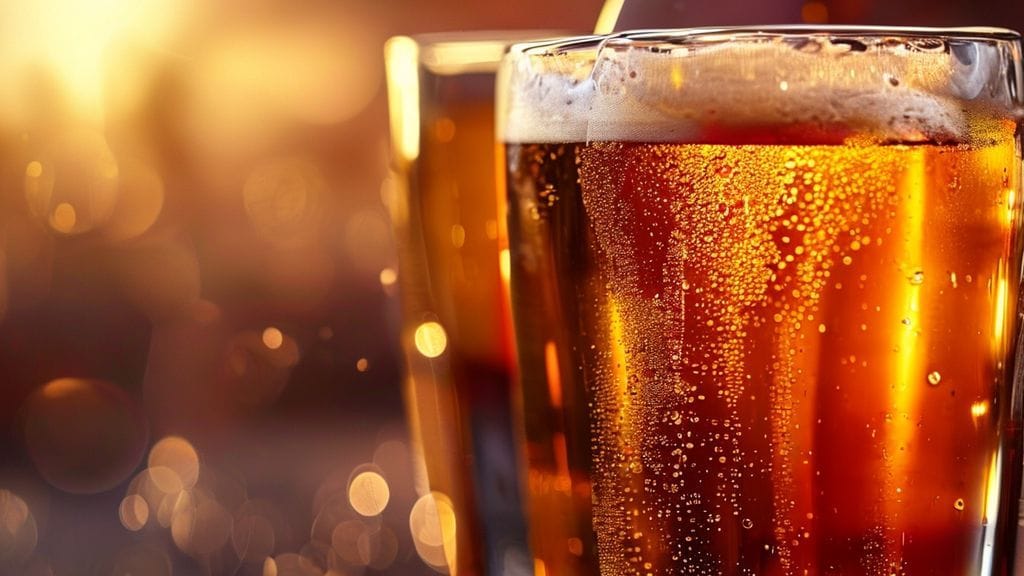
Kolsch and Altbier, while both originating from specific historical brewing regions and undergoing cold conditioning, represent distinct ale traditions. Kolsch is a crisp, pale, highly attenuated ale fermented cool and lagered for clarity and a delicate fruitiness, often featuring a significant Pilsner malt base. Altbier is a darker, maltier, more bitter ale with a richer, complex profile derived from a blend of specialty malts and more pronounced hop character, fermented warmer yet also cold-conditioned for smoothness.
| Metric | Kölsch | Altbier |
|---|---|---|
| Original Gravity (OG) | 1.044 – 1.050 | 1.046 – 1.052 |
| Final Gravity (FG) | 1.007 – 1.011 | 1.010 – 1.014 |
| Alcohol By Volume (ABV) | 4.4% – 5.2% | 4.3% – 5.5% |
| Color (SRM) | 3 – 5 | 13 – 17 |
| Bitterness (IBU) | 20 – 30 | 30 – 50 |
| Primary Fermentation Temp | 13°C – 18°C (55°F – 64°F) | 15°C – 20°C (59°F – 68°F) |
| Lagering/Conditioning Temp | 0°C – 4°C (32°F – 39°F) | 0°C – 4°C (32°F – 39°F) |
| Yeast Type (Examples) | Ale yeast (e.g., Wyeast 2565 Kölsch, WLP029 German Ale/Kölsch) | Ale yeast (e.g., Wyeast 1007 German Ale, WLP036 Düsseldorf Alt) |
The Brewer’s Hook: Navigating the Nuances of German Ales
When I first ventured into the world of traditional German ales, specifically the Kölsch and Altbier, I confess I made the classic rookie mistake of assuming their similarities outweighed their differences. Both are top-fermented, both are cold-conditioned, and both hail from regions renowned for their meticulous brewing. “How different can they really be?” I pondered, as I stared at two seemingly similar yeast packets. My initial attempts, while producing palatable beer, lacked the distinct character that defines each style. My Kölsch was a bit too malty, my Altbier a shade too light and lacking depth. It took a deep dive into water chemistry, precise temperature control, and a rigorous sensory analysis to truly appreciate the subtle, yet profound, distinctions that elevate these beers from merely “good” to “authentic.” It’s a journey I’m thrilled to share, complete with the data points that truly matter.
The Math Behind the Brew: Calculation Guide and Grain Bills
Understanding the mathematical backbone of a recipe is paramount for consistency and successful replication. It’s not just about throwing ingredients into a kettle; it’s about predicting outcomes and making informed adjustments. Here, I’ll break down the key calculations and typical grain bill percentages for both Kölsch and Altbier.
Grain Bill Percentages
These percentages represent a 20-liter (5-gallon) batch, adjusted for a system efficiency of 75%.
| Ingredient | Kölsch (Example) | Altbier (Example) |
|---|---|---|
| Pilsner Malt | 92% (approx. 4.5 kg) | – |
| Wheat Malt | 8% (approx. 0.4 kg) | – |
| Pale Ale Malt (or Maris Otter) | – | 65% (approx. 3.2 kg) |
| Munich Malt (Light) | – | 20% (approx. 1.0 kg) |
| CaraMunich I (or Crystal 40L) | – | 10% (approx. 0.5 kg) |
| Chocolate Malt (350L) | – | 5% (approx. 0.25 kg) |
| Total Malt | 4.9 kg | 4.95 kg |
Key Calculation Formulas
- Apparent Attenuation (AA): This tells you how much sugar the yeast consumed.
AA = ((OG - FG) / (OG - 1)) * 100- For a Kölsch with OG 1.048 and FG 1.009:
((1.048 - 1.009) / (1.048 - 1)) * 100 = (0.039 / 0.048) * 100 = 81.25%. This high attenuation is typical for Kölsch. - For an Altbier with OG 1.050 and FG 1.012:
((1.050 - 1.012) / (1.050 - 1)) * 100 = (0.038 / 0.050) * 100 = 76%. Still high, but slightly less than Kölsch, contributing to a fuller body.
- Alcohol By Volume (ABV): The most common formula I use for homebrewing accuracy.
ABV = (OG - FG) * 131.25- Kölsch:
(1.048 - 1.009) * 131.25 = 0.039 * 131.25 = 5.12% ABV - Altbier:
(1.050 - 1.012) * 131.25 = 0.038 * 131.25 = 4.98% ABV
- Strike Water Volume: Essential for hitting your mash thickness. I typically aim for 2.5-3 liters per kilogram of grain.
Strike Water Volume (L) = (Grain Weight (kg) * Mash Thickness (L/kg)) + (Dead Space (L))- For 4.9kg grain at 2.8 L/kg in a tun with 2L dead space:
(4.9 * 2.8) + 2 = 13.72 + 2 = 15.72 L
Step-by-Step Execution: Brewing Both Styles
While sharing a common philosophical approach to brewing—cleanliness, precision, and cold conditioning—the execution for Kölsch and Altbier diverges significantly at the ingredient selection and initial fermentation stages. Here’s how I approach each style.
Kölsch Brewing Process
- Milling: Crush grains finely enough to expose the endosperm but avoid pulverizing husks. My roller mill gap is typically set to **0.9mm (0.035 inches)**.
- Mashing: My preferred Kölsch mash schedule is a single infusion with a protein rest if using heavily modified malt, though modern malts often negate this.
- Mash In at **52°C (126°F)** for 15 minutes (protein rest, optional but can aid clarity and head retention).
- Raise to **65°C (149°F)** for 60 minutes (saccharification rest for fermentability).
- Mash Out at **76°C (169°F)** for 10 minutes.
- Lautering & Sparge: Recirculate for 15 minutes until clear. Sparge gently with water heated to **77°C (171°F)**, aiming for an initial run-off gravity of around 1.060. My water profile for Kölsch is soft, with Ca: 50 ppm, Mg: 10 ppm, SO4: 50 ppm, Cl: 60 ppm.
- Boiling: Total boil time of 90 minutes for DMS precursor reduction.
- **60-minute addition:** 20g Hallertau Mittelfrüh (4.0% AA) for ~20 IBU.
- **15-minute addition:** 15g Tettnang (4.5% AA) for ~5 IBU.
- **Flameout addition:** 10g Spalt Select for aroma.
- Chilling: Chill rapidly to **12-14°C (54-57°F)** using a plate chiller.
- Fermentation:
- Pitch a healthy, highly viable yeast starter (e.g., Wyeast 2565 Kölsch) at a rate of 0.75 million cells/ml/°P.
- Primary fermentation at **13°C (55°F)** for the first 3-4 days, then allow to free rise to **18°C (64°F)** for a further 3-4 days to ensure full attenuation and diacetyl cleanup.
- Target FG of 1.007-1.011.
- Conditioning (Lagering): Once FG is stable, cold crash to **0°C (32°F)** and lager for 4-6 weeks. This step is critical for developing its characteristic crispness and brilliant clarity.
- Packaging: Carbonate to 2.5-2.7 volumes of CO2.
Altbier Brewing Process
- Milling: Similar to Kölsch, a fine crush is desired. My mill gap remains at **0.9mm (0.035 inches)**.
- Mashing: I find a single infusion works best, focusing on body and fermentability.
- Mash In at **67°C (153°F)** for 60 minutes (saccharification rest).
- Mash Out at **76°C (169°F)** for 10 minutes.
- Lautering & Sparge: Recirculate for 15 minutes. Sparge with water heated to **77°C (171°F)**. My water profile for Altbier is slightly harder than Kölsch, with Ca: 70 ppm, Mg: 15 ppm, SO4: 80 ppm, Cl: 50 ppm, to accentuate hop bitterness and malt depth.
- Boiling: Total boil time of 90 minutes.
- **60-minute addition:** 30g Spalt Select (5.0% AA) for ~25 IBU.
- **30-minute addition:** 20g Tettnang (4.5% AA) for ~10 IBU.
- **5-minute addition:** 15g Hersbrucker (4.0% AA) for aroma.
- Chilling: Chill rapidly to **15-17°C (59-63°F)**.
- Fermentation:
- Pitch a robust Altbier yeast (e.g., Wyeast 1007 German Ale) at 0.75 million cells/ml/°P.
- Primary fermentation at **16°C (61°F)** for 5-7 days, then allow to free rise to **20°C (68°F)** for 2-3 days to ensure full attenuation and diacetyl cleanup.
- Target FG of 1.010-1.014.
- Conditioning (Lagering): Once FG is stable, cold crash to **0°C (32°F)** and lager for 3-5 weeks. This process smooths out the bitterness and allows the malt complexity to shine.
- Packaging: Carbonate to 2.2-2.4 volumes of CO2.
Troubleshooting: What Can Go Wrong and My Fixes
Even with meticulous planning, brewing these nuanced styles can present challenges. I’ve certainly encountered my share, and learning from them has been invaluable. Here are some common issues and my personal remedies.
Kölsch Specific Issues
- Phenolic Off-Flavors (Clove/Band-Aid): My early Kölsch batches sometimes had a faint phenolic note. I traced this to two culprits: stressed yeast from underpitching or improper temperature control during the free rise. My fix: Always overbuild my starter by 10-15% and strictly adhere to the initial low fermentation temperature before allowing a controlled rise. Ensure pH is optimal at **5.2-5.4** for mash.
- Haze: Kölsch demands clarity. If it’s hazy, it could be protein haze from insufficient cold crashing, or yeast in suspension. My solution: extended lagering, often up to 6 weeks, at near-freezing temperatures, and sometimes a fining agent like BioFine Clear at 1 ml/L during the last week of lagering.
- Lack of Crispness: If it tastes a bit “flabby,” it’s often due to insufficient attenuation or inadequate lagering. My remedy: ensure fermentation finishes completely by taking consistent gravity readings, and don’t rush the cold conditioning phase.
Altbier Specific Issues
- Harsh Bitterness: Early on, my Altbiers could taste a bit rough. I discovered this was often due to improper water chemistry (too much sulfate for the level of bitterness) or insufficient lagering time. My fix: Adjusting my water profile to ensure a balanced SO4:Cl ratio (closer to 1.5:1 for Altbier, compared to 0.8:1 for Kölsch) and extending lagering to 4-5 weeks to mellow the hop character.
- Under-attenuation/Sweetness: If the beer finishes too sweet, it suggests the yeast didn’t do its job fully or the mash temperature was too high. My remedy: Verify mash temperature accuracy with multiple thermometers and ensure a healthy, active starter is pitched. A controlled diacetyl rest (allowing temperature to rise slightly at the end of fermentation) helps ensure full attenuation.
- Diacetyl (Butterscotch): This is a classic indicator of a rushed fermentation or conditioning. My experience showed that even with ale yeasts, a brief diacetyl rest followed by thorough cold conditioning is essential. My fix: A 2-3 day period at **20°C (68°F)** after primary fermentation completes, then a slow ramp down to lagering temperature.
For more troubleshooting guides and in-depth articles, be sure to check out BrewMyBeer.online, where I regularly share my insights.
Sensory Analysis: Decoding the Glass
The true appreciation of Kölsch and Altbier comes from dissecting their sensory profiles. This is where their subtle differences truly shine, revealing the master craftsmanship behind each sip. My tasting notes are always detailed.
Kölsch Sensory Profile
- Appearance: Brilliant straw to pale gold, often with exceptional clarity, especially after proper lagering. A delicate, persistent white head. My Kölsch strives for crystal clear, like looking through liquid glass.
- Aroma: Very clean, with a subtle bready or cracker-like malt aroma from the Pilsner malt. Low to very low noble hop aroma (floral, spicy). A faint, delicate fruity ester (pear, apple, white grape) may be present from the specific Kölsch yeast strain, but should not be dominant. No diacetyl or DMS.
- Mouthfeel: Light to medium-light body, with a crisp, refreshing, and clean finish. High carbonation (2.5-2.7 volumes) accentuates the effervescence.
- Flavor: A delicate balance between soft malt sweetness and a clean hop bitterness. The malt character is subtle, bready, and lightly sweet, never cloying. Hop flavor is low, mirroring the aroma. Very highly attenuated, leading to a dry finish. The slight fruity notes from the yeast are present but restrained, leading to a “lager-like” character despite being an ale.
Altbier Sensory Profile
- Appearance: Ranges from deep amber to coppery-brown, with good clarity. A dense, rocky, off-white to cream-colored head. The color is distinctly darker than Kölsch, a visual cue to its malt complexity.
- Aroma: Distinct malt character dominates, offering notes of toasted bread, caramel, and sometimes a hint of roast or nutty complexity. Medium noble hop aroma, often spicy or earthy. Very low to no fruity esters. Clean fermentation profile is key here; no phenols or diacetyl.
- Mouthfeel: Medium body, smoother than Kölsch, with a clean and often lingering finish. Carbonation is moderate (2.2-2.4 volumes), supporting the malt backbone without being overly effervescent.
- Flavor: A pronounced malt backbone featuring toasted, biscuity, and caramel notes, balanced by a firm, assertive hop bitterness. The bitterness is clean and well-integrated, not harsh, providing balance rather than overwhelming the malt. The finish is drier than the initial sweetness suggests, inviting another sip. The slight roast character from chocolate malt adds complexity without being acrid.
Frequently Asked Questions
Can I use the same yeast for both Kölsch and Altbier?
While technically possible to ferment both with some German ale strains, I strongly advise against it if you’re aiming for authenticity. Kölsch yeast (e.g., Wyeast 2565 or WLP029) is specifically selected for its ability to ferment cleanly at cool ale temperatures, producing delicate esters and high attenuation for that characteristic crisp finish. Altbier yeast (e.g., Wyeast 1007 or WLP036) typically offers a slightly different ester profile and can contribute a subtle complexity while still finishing dry. Using the wrong yeast will lead to a beer that misses the mark on either style’s nuanced flavor profile.
What’s the ideal serving temperature for these beers?
Both Kölsch and Altbier are best enjoyed slightly chilled, but not ice-cold. For Kölsch, I recommend serving between **7-10°C (45-50°F)**. This temperature allows its delicate fruitiness and crispness to shine without muting the subtle aromas. Altbier benefits from a slightly warmer serving temperature of **10-13°C (50-55°F)**, which helps to unlock its complex malt character and balance its assertive bitterness without becoming overly warm and flabby. Too cold, and you lose the intricate flavors; too warm, and they can feel heavy.
Why is brilliant clarity so important for Kölsch?
Clarity in Kölsch is not merely an aesthetic preference; it’s a defining characteristic of the style. Historically, in the brewing region of Cologne, it was a mark of quality and careful brewing. From a sensory perspective, brilliant clarity enhances the perception of crispness and cleanliness. Any haze, whether yeast or protein-derived, can introduce off-flavors or alter mouthfeel, detracting from the beer’s delicate balance. My personal mantra for Kölsch is: if it’s not clear, it’s not Kölsch. Extensive lagering, proper fining, and careful cold crashing are all non-negotiable steps.
How critical is water chemistry for these styles?
Extremely critical. While often overlooked by novice brewers, water chemistry profoundly impacts the final beer. For Kölsch, I aim for a very soft water profile, with low minerality to let the delicate Pilsner malt and noble hops shine without harshness. High sulfate in Kölsch can make it seem overly bitter and thin. For Altbier, a slightly harder water with a moderate sulfate-to-chloride ratio (SO4:Cl around 1.5:1) helps to accentuate the hop bitterness and support the richer malt backbone. Ignoring water chemistry will lead to a beer that simply lacks the authentic taste and balance of these classic styles. It’s a fundamental pillar of traditional brewing, one that I continually refine in my own practice, and an area where BrewMyBeer.online has many detailed resources.