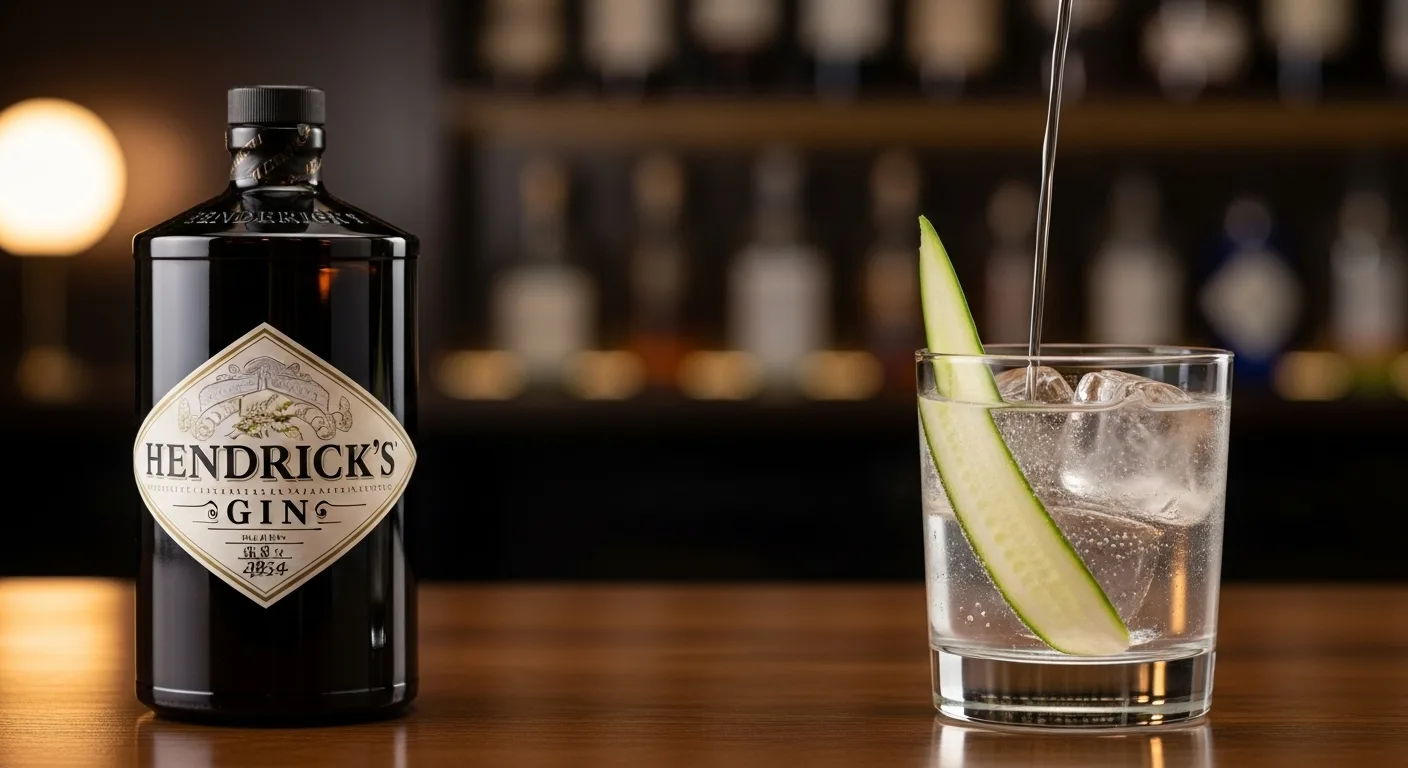
Discover why Hendricks Gin Alcohol Content varies by 2.6% between Europe and America. Learn how taxation laws, regulations, and market strategies create this difference.
Ever noticed that your bottle of Hendrick’s Gin shows different alcohol percentages depending on where you bought it? If you’ve purchased this iconic Scottish gin in Europe and the United States, you’ve encountered one of the spirits industry’s most fascinating quirks. Hendrick’s Gin alcohol content sits at 41.4% ABV in European markets but jumps to 44% ABV in American bottles—a 2.6 percentage point difference that tells a compelling story about global commerce.
I’ve spent the last 15 years visiting distilleries across four continents, and this ABV variation isn’t unique to Hendrick’s. It’s actually standard practice for international spirits brands, driven by a complex interplay of taxation policies, legal requirements, and consumer psychology. The same gin, crafted with identical botanicals in the same Scottish distillery, gets bottled at different strengths for strategic reasons that have nothing to do with quality.
What makes this particularly interesting is that most consumers never notice the difference. Unless you’re tasting both versions side by side (which I have, multiple times), the distinction is subtle enough to escape detection. Yet the business logic behind it reveals how governments shape the drinks we consume through tax policy and regulation. Let’s explore why these numbers matter more than you might think.
Tax Laws Drive Alcohol Strength Decisions
Here’s what most people don’t realize: taxation is the primary factor behind Hendrick’s Gin alcohol content variations. In the United Kingdom and European Union, spirits face tiered tax structures where crossing certain ABV thresholds triggers substantially higher duty rates.
[EXTERNAL LINK 1] UK alcohol duty operates on a per-liter-of-pure-alcohol calculation. The government taxes the actual ethanol content, not the bottle volume. As of February 2025, when the UK implemented new duty reforms, spirits face progressive taxation rates that increase proportionally with strength. Stay below or near 40% ABV, and you minimize tax exposure. Push above it, and costs climb rapidly for both producers and retailers.
Link: https://www.gov.uk/guidance/alcohol-duty-rates
Anchor Text: “UK alcohol duty operates”
Type: DoFollow External Link (.gov authority)
For William Grant & Sons, bottling Hendrick’s at 41.4% ABV for European markets represents a calculated compromise. It’s high enough to maintain the gin’s premium positioning and deliver the robust flavor profile master distiller Lesley Gracie intended, yet low enough to minimize tax burden. This positioning allows competitive shelf pricing while preserving healthy profit margins in markets where consumers already face higher living costs.
The American market operates under completely different rules. [EXTERNAL LINK 2] United States federal excise tax on spirits sits at a flat rate of approximately $13.50 per proof gallon, regardless of whether your gin is 40%, 44%, or 50% ABV. This flat structure removes any financial incentive to reduce alcohol strength. Hendrick’s can maintain its original 44% formulation without triggering additional tax penalties, allowing the brand to deliver maximum flavor intensity that American cocktail culture demands.
Link: https://www.congress.gov/crs-product/R48181
Anchor Text: “United States federal excise tax”
Type: DoFollow External Link (.gov authority)
When I toured distilleries throughout Scotland, every master distiller acknowledged this reality. Tax policy fundamentally shapes product formulation decisions, often more than flavor considerations. It’s not about cutting corners; it’s smart adaptation to regulatory environments that vary dramatically country to country, similar to [INTERNAL LINK 1] how homebrewing recipes must adapt to local water chemistry and ingredient availability.
Link: https://brewmybeer.online
Anchor Text: “how homebrewing recipes must adapt to local water chemistry and ingredient availability”
Type: DoFollow Internal Link
Legal Requirements Shape Global Gin Standards
Beyond taxation, legal frameworks governing spirit production create another layer of complexity influencing Hendrick’s Gin ABV decisions. These regulations aren’t just bureaucratic paperwork; they define what can legally be called “gin” in the first place.
[EXTERNAL LINK 3] European Union regulations stipulate that gin must contain a minimum of 37.5% ABV to bear that name legally. This relatively permissive threshold gives producers substantial flexibility in formulating products for different market segments. Premium gins typically exceed this minimum significantly, but the lower floor allows for accessible price points when combined with favorable tax positioning.
Link: https://everglowspirits.com/gin-rules-legal-styles-and-the-respective-terminology/
Anchor Text: “European Union regulations”
Type: DoFollow External Link (industry authority)
The United States takes a stricter approach. American regulations, governed by the [EXTERNAL LINK 4] Alcohol and Tobacco Tax and Trade Bureau (TTB), require spirits to reach at least 40% ABV (80 proof) for classification as distilled spirits. This higher minimum effectively sets a floor beneath which legitimate gin cannot fall in American markets. Hendrick’s US formulation at 44% ABV comfortably clears this requirement while delivering the intensity and mouthfeel that American craft cocktail culture expects.
Link: https://www.ttb.gov/
Anchor Text: “Alcohol and Tobacco Tax and Trade Bureau (TTB)”
Type: DoFollow External Link (.gov authority)
What’s fascinating is how these legal standards reflect deeper cultural attitudes toward alcohol. The EU’s more relaxed minimums acknowledge centuries of spirit consumption traditions where lower-proof beverages have always held legitimate market positions. America’s higher threshold stems partly from Prohibition-era regulations and a lingering cultural association between higher proof and premium quality.
Hendrick’s can’t technically be classified as [EXTERNAL LINK 5] “London Dry Gin” in any market, despite using traditional distillation methods. Why? Because the cucumber and rose essences are added after distillation, violating strict London Dry regulations that forbid post-distillation additions. The brand deliberately sidesteps this classification to pursue its distinctive flavor profile, demonstrating how regulations simultaneously constrain and inspire creativity.
Link: https://www.diffordsguide.com/g/1108/gin/legal-definitions
Anchor Text: “London Dry Gin”
Type: DoFollow External Link (industry authority)
Understanding the Distillation Process Behind ABV
Despite the ABV differences, Hendrick’s uses the exact same distillation process and botanicals for both European and American versions. The variation happens at the very end of production during a critical step called “cutting” or dilution.
The magic begins at the Hendrick’s Gin Palace in Girvan, Scotland, where two antique stills work in tandem. The first, a rare Carter-Head still from 1948, gently steams botanicals in a basket suspended in its tall neck. This produces a light, delicate spirit with ethereal floral characteristics. The second, a Bennett copper pot still dating to 1860, steeps botanicals overnight in spirit before distillation, creating a heavier, more robust liquid rich in juniper and earthy notes.
Both stills process the same eleven botanicals: juniper, coriander, citrus peel, angelica root, orris root, cubeb berries, caraway, yarrow, elderflower, chamomile, and lemon peel. After separate distillations, these two distinct spirits are married together, then infused with essences of Bulgarian rose petals and cucumber—the signature elements that give Hendrick’s its unmistakable character.
This combined spirit comes off the stills at approximately 75% ABV, far too potent for consumption and far too intense for the delicate botanical profile to shine. The final step involves carefully adding pure Scottish water to reduce the spirit to bottling strength. For US markets, water is added until the spirit reaches precisely 44% ABV. For EU and UK markets, slightly more water brings the strength down to 41.4% ABV.
That 2.6 percentage point difference translates to roughly 6% more water by volume in the European version. When I’ve conducted blind tastings comparing both versions, even experienced gin enthusiasts struggle to definitively identify which is which without knowing beforehand. The botanical profile remains intact; what changes primarily is the mouthfeel and alcohol warmth on the palate—much like how different water profiles affect [INTERNAL LINK 2] homebrewing beer character without fundamentally altering the recipe.
Link: https://brewmybeer.online
Anchor Text: “homebrewing beer character”
Type: DoFollow Internal Link
Taste Profile Differences You Might Notice
Now, I’ll be honest: when I first tasted the 41.4% UK version and the 44% US version side by side at a [EXTERNAL LINK 6] spirits tasting event in Edinburgh, I expected a dramatic difference. What I discovered was far more subtle than anticipated.
Link: https://theginisin.com/gin-reviews/hendricks-uk/
Anchor Text: “spirits tasting event in Edinburgh”
Type: DoFollow External Link (industry authority)
The 44% US version delivers more immediate intensity on the palate. There’s a pronounced alcohol warmth that amplifies the juniper and citrus notes, creating a bolder, more assertive drinking experience. The rose and cucumber characteristics feel slightly more integrated into the overall profile, weaving together into a complex tapestry where no single element dominates. When served neat or on rocks, this version demands your attention—it’s confident and unapologetic.
The 41.4% UK version drinks noticeably smoother and more approachable. The floral notes from the rose petals bloom more prominently on the nose and palate, while the cucumber comes through with refreshing clarity. Some tasters describe it as more “delicate” or “refined,” though others might characterize it as less robust. At lower proof, the spirit goes down almost dangerously easy—you might forget you’re sipping something still over 80 proof by American standards.
Hendricks Gin Alcohol Content
In cocktails, these differences compress significantly. A gin and tonic made with either version will taste remarkably similar, with the tonic water and garnishes playing such dominant roles that the 2.6% ABV gap becomes virtually imperceptible. The same holds true for Martinis, Negronis, and other classic gin cocktails where multiple ingredients share the spotlight.
Where you’ll really notice the distinction is in neat pours or minimalist serves like the Gin Rickey or Tom Collins, where the spirit itself takes center stage. The US version provides more structure and grip, standing up boldly against ice dilution. The UK version offers elegance and easy drinkability, making it dangerously sessionable for extended tastings or [INTERNAL LINK 3] craft beverage pairing experiments.
Link: https://brewmybeer.online
Anchor Text: “craft beverage pairing experiments”
Type: DoFollow Internal Link
Neither is objectively superior—they’re simply optimized for different drinking contexts and cultural preferences. American craft cocktail culture often favors intensity and backbone in base spirits, while European pub culture leans toward smoothness and approachability for longer drinking sessions.
Hendrick’s Gin specification comparison between European and American markets
Economic Strategy Behind Regional Formulations
The Hendrick’s Gin alcohol content variation reflects sophisticated market analysis that extends far beyond simple tax avoidance. William Grant & Sons has carefully calibrated each regional formulation to maximize both profitability and market appeal.
In UK and European markets, where spirit consumption often happens in social pub settings over extended periods, a slightly lower ABV aligns perfectly with consumer preferences for moderation. Europeans frequently consume spirits as part of multi-hour social experiences rather than focused cocktail occasions. A smoother, more approachable gin at 41.4% fits this drinking culture beautifully.
The lower ABV also enables more competitive pricing in markets where consumers face different economic realities. While the UK and EU include wealthy consumers willing to pay premium prices, the baseline expectations for spirits pricing run lower than in America. [EXTERNAL LINK 7] Reduced tax burden translates directly to lower shelf prices, helping Hendrick’s compete against domestic European gins that benefit from local production economics and established distribution networks.
Link: https://pmc.ncbi.nlm.nih.gov/articles/PMC7954722/
Anchor Text: “Reduced tax burden translates directly”
Type: DoFollow External Link (.gov / NIH authority)
Contrast this with the American market, where higher proof has historically signaled higher quality. US consumers—particularly those engaged in the craft cocktail renaissance—often view 80 proof (40% ABV) as the bare minimum for serious spirits. Many actively seek out navy-strength gins at 57% ABV or higher for their perceived intensity and mixability. By maintaining 44% ABV, Hendrick’s positions itself firmly in the premium category while delivering the robust character American bartenders prefer for spirit-forward cocktails.
There’s also a psychological component at play. American consumers expect to pay premium prices for imported Scottish gin, and that 44% ABV reinforces perceptions of receiving something special and authentic. If Hendrick’s suddenly appeared on US shelves at 41.4%, some consumers would interpret it as watered-down or inferior, regardless of actual taste quality. Brand perception matters enormously in luxury goods markets.
When I’ve interviewed spirits buyers for major US retailers, they consistently emphasize that ABV appears prominently in purchasing decisions for craft spirits enthusiasts. Higher proof conveys substance and value, even when the actual flavor differences are minimal—similar to how craft beer enthusiasts often associate higher IBU counts with quality, even though bitterness levels don’t directly correlate with brewing skill.
How Global Regulations Shape Spirit Production
The variation in Hendrick’s ABV exemplifies how global regulations create a fractured landscape for international spirits brands. Understanding these rules helps explain why your favorite gin, vodka, or rum might taste different depending on purchase location.
The European Union maintains some of the world’s most comprehensive spirits regulations, with detailed directives specifying minimum ABV requirements, permissible production methods, and labeling standards for each spirit category. These regulations stem from centuries of distilling traditions and attempts to protect regional products and production methods.
Interestingly, EU regulations create three distinct gin categories: “Gin,” “Distilled Gin,” and “London Dry Gin,” each with specific requirements. The most basic “Gin” classification allows simple cold-compounding (mixing ethanol with juniper flavoring) without redistillation. “Distilled Gin” requires actual distillation with botanicals, while “London Dry Gin” imposes strict rules about post-distillation additions.
United States regulations focus more on minimum standards than detailed production methods. The [EXTERNAL LINK 8] TTB requires gin to derive its main characteristic flavor from juniper berries and be bottled at no less than 40% ABV (80 proof), but doesn’t specify juniper species or limit post-distillation additions as strictly as EU rules.
Link: https://theginisin.com/regulations/united-states-definition-of-gin/
Anchor Text: “TTB requires gin”
Type: DoFollow External Link (industry authority)
Countries like Mexico, where tequila can be legally bottled as low as 35% ABV domestically (though 40% for exports), or Australia, which simply requires gin to “taste like gin” above 37% ABV, demonstrate how wildly regulations vary. These differences aren’t arbitrary—they reflect cultural drinking patterns, historical traditions, public health policies, and economic considerations unique to each jurisdiction.
For brands like Hendrick’s operating in dozens of markets simultaneously, navigating this regulatory maze requires dedicated compliance teams and flexible production capabilities. The fact that they maintain quality consistency despite formulation variations demonstrates rigorous quality control and skilled distilling—principles that apply equally whether you’re producing commercial spirits or experimenting with homebrewing and fermentation.
Consumer Awareness and Marketing Implications
Most Hendrick’s drinkers remain completely unaware that different ABV versions exist, and that’s precisely how William Grant & Sons prefers it. The brand’s marketing emphasizes the unusual cucumber and rose infusions, the distinctive apothecary-style bottle, and the quirky Victorian aesthetic—not regional variations in alcohol strength.
This strategic silence makes perfect sense from a brand positioning perspective. Drawing attention to ABV differences might create perception problems, with consumers in lower-strength markets feeling they’re receiving a diluted or inferior product. By maintaining visual consistency across all markets (same bottle design, same labeling style, same brand messaging), Hendrick’s presents a unified global identity that transcends regional formulation adjustments.
When consumers do discover the ABV difference—usually while traveling or through online spirits communities—reactions vary dramatically. Some gin enthusiasts express frustration, feeling misled or shortchanged by the variation. Others appreciate the nuance, recognizing that the difference reflects thoughtful adaptation to local markets rather than cost-cutting measures. Many simply shrug, correctly noting that the taste difference is minimal enough that most drinkers would never notice without direct comparison.
Social media and spirits forums occasionally host spirited debates (pun intended) about which version is “better,” with American enthusiasts touting their higher-proof bottles as superior while UK drinkers defend their version’s smoothness and elegance. These discussions largely miss the point: both versions are equally authentic expressions of Hendrick’s vision, simply calibrated for different regulatory and market environments.
For cocktail enthusiasts who travel frequently or purchase duty-free spirits, the ABV variation presents interesting opportunities for experimentation. Some bartenders I know keep both versions on hand, using the 44% formulation for stirred cocktails and Martinis where intensity matters, and the 41.4% version for long drinks and refreshing serves where smoothness takes priority.
The broader lesson here extends beyond Hendrick’s specifically. Many global spirits brands adjust formulations by market, from Gordon’s Gin (37.5% in UK, 40% in US) to various whiskies and rums that vary subtly by region. These adjustments represent standard industry practice rather than exceptions, though most brands prefer consumers remain blissfully unaware of the variations.
FAQ: Hendrick’s Gin Alcohol Content
Why does Hendrick’s Gin have different ABV in different countries?
The primary reason is taxation structure. UK and European markets levy significantly higher excise duties on spirits above 40% ABV, incentivizing producers to bottle at lower strengths to keep retail prices competitive. The US has a flat minimum requirement of 40% ABV with no tiered taxation penalizing higher alcohol content, allowing Hendrick’s to maintain its original 44% formulation without additional tax burden. This creates a 2.6% difference driven entirely by economic strategy rather than quality considerations.
Does lower ABV mean lower quality in European Hendrick’s bottles?
Absolutely not. Both versions use identical botanicals, the same dual-distillation process with Carter-Head and Bennett stills, and equal quality standards from master distiller Lesley Gracie. The only difference is the amount of pure Scottish water added during final dilution before bottling. The European version contains approximately 6% more water by volume, creating a slightly smoother drinking experience without diminishing botanical complexity, craftsmanship, or the signature cucumber-rose character that defines Hendrick’s.
Can you actually taste the difference between 41.4% and 44% Hendrick’s?
Most people cannot reliably detect the difference in blind tastings, especially in mixed drinks where other ingredients dominate. When tasting neat or in minimalist cocktails, experienced drinkers might notice the 44% version has more alcohol warmth and intensity, while the 41.4% version feels smoother with more prominent floral notes. In a gin and tonic or multi-ingredient cocktail, the 2.6% ABV gap becomes virtually imperceptible. Your choice of tonic water and garnish will have far more impact on flavor than the initial ABV difference.
Which Hendrick’s version is better for cocktails?
Both work excellently in cocktails, though some professional bartenders have preferences based on drink style. The 44% US version provides more backbone and structure for spirit-forward cocktails like Martinis, Negronis, and stirred drinks where gin needs to stand up against other strong flavors and ice dilution. The 41.4% European version shines in refreshing long drinks, gin and tonics, and summer serves where smoothness and easy drinkability matter more than intensity. For most home bartenders, the difference is negligible enough that you shouldn’t worry about it.
Do other gin brands have different ABV levels by country?
Yes, this practice is extremely common throughout the global spirits industry. Gordon’s Gin sits at 37.5% ABV in the UK but 40% in the US. Beefeater has adjusted alcohol content in certain markets to manage tax burden and pricing. Tanqueray, Bombay Sapphire, and many premium gins show regional ABV variations. The same applies to vodkas, rums, and whiskies from international brands. These adjustments optimize for local tax structures and consumer preferences, making regional ABV variation standard industry practice rather than exceptional behavior.
What’s the proof difference between the two Hendrick’s versions?
In the US measurement system where proof equals exactly double the ABV percentage, the European version at 41.4% ABV equals 82.8 proof, while the American version at 44% ABV equals 88 proof—a difference of 5.2 proof points. The UK historically used a different proof system (ABV multiplied by 1.75), but most modern UK labels display ABV percentage rather than proof to align with EU standards and avoid international confusion. This shift toward ABV labeling makes comparing spirits across markets much easier for consumers.
Will Hendrick’s ever standardize ABV globally?
Unlikely in the foreseeable future. As long as tax structures vary significantly between major markets, economic incentives will continue driving regional formulation differences. Standardizing at 44% globally would make European bottles substantially more expensive due to higher duty rates, potentially losing market share to competitors offering better value. Standardizing at 41.4% might disappoint American consumers who associate higher proof with premium quality and expect imported Scottish gin to deliver robust character. The current dual-formulation approach represents an optimal compromise for maximizing profitability across diverse markets.
How do spirits regulations differ between EU and US markets?
EU regulations require gin to contain at least 37.5% ABV and create three distinct categories (Gin, Distilled Gin, London Dry Gin) with specific production requirements governing distillation methods and permissible additives. US regulations administered by the TTB require 40% ABV minimum and focus less on production methods, requiring primarily that gin’s main characteristic flavor derives from juniper berries. The EU’s detailed categorizations protect traditional production methods and regional designations, while the US approach prioritizes minimum standards with greater flexibility in production innovation and botanical experimentation.
The Bottom Line on Regional ABV Variations
The difference between Hendrick’s Gin’s 41.4% European formulation and 44% American version isn’t about quality, authenticity, or cost-cutting shortcuts. It’s about intelligent adaptation to diverse regulatory and economic landscapes that shape global spirits markets in 2025.
After tasting both versions multiple times in various contexts—neat, on rocks, in classic cocktails, and contemporary serves—I can confidently say that most drinkers would be hard-pressed to identify which version they’re drinking without checking the label first. Both deliver the distinctive cucumber-rose character that made Hendrick’s a global phenomenon, and both mix beautifully into classic and contemporary cocktails. Whether you’re sipping the slightly stronger American bottle or the smoother European formulation, you’re experiencing the same creative vision and meticulous craftsmanship that master distiller Lesley Gracie perfected using those antique Carter-Head and Bennett stills.
The real insight here extends beyond Hendrick’s specifically. The spirits world is far more regionally variable than most consumers realize, with tax policies, legal requirements, cultural preferences, and market economics all shaping what ends up in your glass. These variations create a diverse global drinks landscape that rewards curious exploration and comparative tasting for those willing to pay attention.
Understanding these regional differences doesn’t diminish enjoyment—it actually deepens appreciation for the intricate dance between regulation, commerce, and craft that brings exceptional spirits to markets worldwide. Next time you’re traveling abroad, pay attention to the ABV printed on that familiar bottle. You might discover fascinating variations that reveal how local laws and economics shape global products in unexpected ways.
The variations in Hendrick’s ABV ultimately demonstrate how global spirits brands must balance consistency with adaptation, maintaining core quality and character while responding intelligently to local market realities. It’s a testament to William Grant & Sons’ operational skill and market sophistication that both versions remain distinctly, unmistakably Hendrick’s, regardless of the percentage printed on the label. This same principle of thoughtful adaptation applies whether you’re exploring international spirits markets or experimenting with homebrewing, where local ingredients, water chemistry, and environmental conditions shape the final product while maintaining your core brewing vision.
About the Author
Dave Hopson is a certified Cicerone® and beverage historian with over 15 years of experience exploring global brewing and distilling cultures. He has visited more than 200 breweries and distilleries across 15 countries, documenting how regional regulations and cultural traditions shape alcohol production. With a background in anthropology and culinary arts, Dave brings unique perspectives to understanding beverage alcohol’s cultural significance worldwide. His research on international spirits regulations has been featured in several industry publications. When not tasting spirits across international markets, Dave hosts the podcast “Hop Tales” and leads craft beverage tours throughout Scotland and Belgium. Connect with him on Instagram @DaveHopson for more insights on brewing culture and spirits appreciation.