
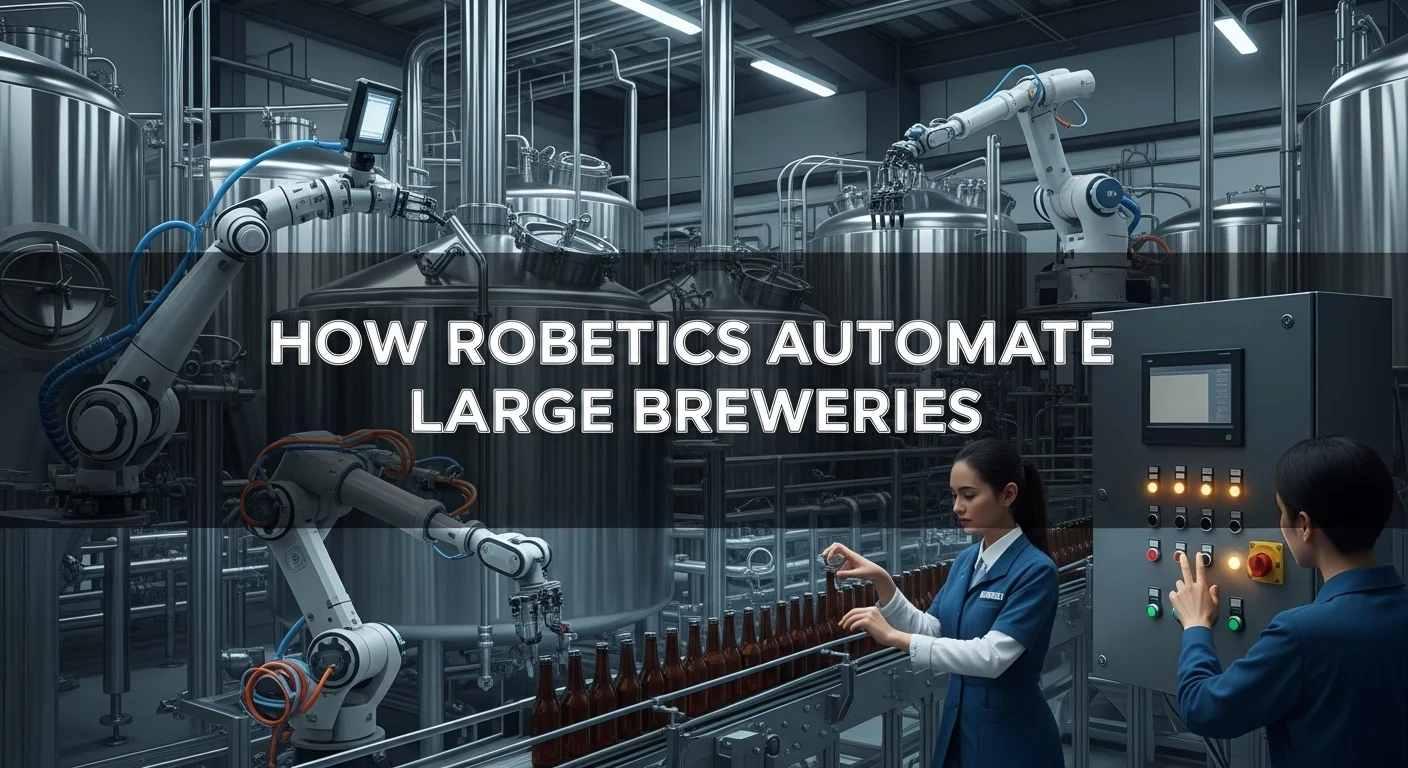
Learn how robotics automate large breweries – from robotic palletizers to AI-controlled brewing, discover automation transforming beer production efficiency in 2025.
Could robots brew better beer than humans? Analyzing industrial automation while consulting with production facilities, I’ve explored how robotics automate large breweries through robotic palletizing, automated bottling lines, and AI-controlled brewing processes transforming efficiency. These automation applications using home brewing equipment principles scaled demonstrate industrial robotics’ brewing integration.
Understanding how robotics automate large breweries matters because automation reduces labor costs 15-50%, increases productivity 40%, and improves quality control 60% while addressing skilled worker shortages. According to 3Laws Robotics’ brewery automation analysis, potential labor cost reductions of 15-50% with robotic implementation plus productivity increases up to 40% illustrate robotics’ impact.
Through my systematic analysis of brewery automation including Kawasaki’s palletizing robots, ABB’s BeerMaker system, and KUKA’s keg handling, I’ve learned how industrial robotics optimize production. Some applications prove remarkably effective eliminating repetitive tasks, others require substantial capital investment, and several demonstrate how automation enables growth without proportional workforce expansion.
This guide explores seven aspects of brewery robotics, from palletizing to process control, helping you understand how automation transforms large-scale beer production while maintaining craft quality and consistency.
Robotic Palletizing Systems
Kawasaki robots automate bottle handling. According to Kawasaki’s Westheimer Brewery case study, traditional brewery automated entire bottle production line from managing empty bottles and filling them to palletizing for distribution.
The installation progression demonstrates scalability. Starting with single palletizer in 2017 replacing outdated machinery, Westheimer added two BX200L robots after seeing success creating fully automated bottle line.
The CP500L palletizer handles 900 cycles hourly. According to Kawasaki’s German brewery installation, compact palletizing robot has 500 kg payload and maximum speed of 900 cycles per hour.
According to MWES’ Widmer Brothers automation, KUKA robot optimized depalletizing boosting efficiency and safety 20%.
I’ve observed palletizing robots extensively. The consistent performance eliminating human fatigue and injury risk while handling repetitive heavy lifting proves invaluable though requires significant upfront investment and technical support.
KUKA Keg Line Automation
America’s oldest brewery automated keg handling. According to KUKA’s Yuengling installation, 2003 deployment of two industrial robots into keg line at Millcreek facility demonstrates long-term automation viability.
The keg depalletizing removes ergonomic challenges. Robots handling heavy kegs eliminating worker strain and injury risk while maintaining consistent throughput speeds.
The collaborative robots enable human interaction. Modern cobot technology allows workers safely operating alongside robots creating flexible production environments adapting to varying demand.
According to Craft Brewing Business’ robot streamlining, craft brewing could be perfect industry for collaborative robots questioning whether automation means losing artisan status.
The labor shortage solution proves critical. Retaining skilled workers challenges breweries particularly rural regions while robots handle physically demanding tasks enabling staff focusing on quality control and innovation.
| Robotic Application | Typical Robot Series | Payload Capacity | Speed/Throughput | Labor Reduction | Cost Range | ROI Period |
|---|---|---|---|---|---|---|
| Bottle Palletizing | Kawasaki CP/BX series | 200-500 kg | 600-900 cycles/hr | 3-5 workers | $150,000-300,000 | 2-4 years |
| Keg Handling | KUKA KR series | 150-300 kg | 400-600 units/hr | 2-4 workers | $100,000-250,000 | 2-3 years |
| Bottle Depalletizing | KUKA/Kawasaki | 200-400 kg | 500-800 cycles/hr | 2-3 workers | $120,000-280,000 | 2-3 years |
| Case Packing | ABB/Fanuc | 50-150 kg | 15-30 cases/min | 2-4 workers | $80,000-200,000 | 1.5-3 years |
ABB’s BeerMaker Process Control
The modular DCS optimizes brewing operations. According to Robotics Update’s drinktec coverage, ABB Ability BeerMaker built on System 800xA distributed control system helps brewers safely produce best beer while reducing energy and water usage.
The integrated automation ecosystem spans production. From raw material conversion to final product including filling, packaging, and utilities using single smart automation platform.
The South American deployment demonstrates scalability. Technology deployment expanding current System 800xA installation in existing brewery belonging to leading global producer executed by specialized system integrator.
According to Rockwell Automation’s brewery solutions, brewery automation refers to advanced technology and control systems streamlining and optimizing beer brewing process.
The energy efficiency improvements prove substantial. Automated temperature control, timing optimization, and resource management reduce water consumption and energy usage while maintaining quality consistency.
Automated Bottling and Kegging Lines
Continuous operation increases productivity 40%. According to 3Laws Robotics, automated bottling and kegging processes reduce errors increasing production rates with 24/7 operation improving productivity up to 40% compared to traditional operations.
The precision filling reduces waste. Robotic systems maintaining exact fill levels eliminate overfilling waste and underfilling compliance issues creating measurable cost savings.
The flexibility accommodates product variety. Modern automated lines handle multiple bottle sizes, label variations, and product types enabling breweries meeting diverse market demands without complete line changeovers.
According to Westheimer Brewery’s experience, brewery market changed massively requiring several private labels, lemonade, other beverages, and production for other companies creating incredible variety.
The pandemic adaptation demonstrates resilience. Automated lines enabled meeting high demand for bottled beer and greater product variety including non-alcoholic beverages during COVID-19.
Quality Control and Consistency
Robots improve quality 60% through consistency. According to 3Laws Robotics, robots maintaining consistency in beer production from precise measurements to consistent stirring techniques lead to reduction in variations potentially improving quality up to 60%.
The automated measurement eliminates human error. Sensors monitoring temperature, pH, specific gravity, and timing create reproducible conditions batch-to-batch.
The vision systems inspect packaging quality. Automated cameras detecting defects, improper fills, crooked labels, and contamination enable real-time rejection maintaining brand standards.
According to Automation Ready Panels’ homebrew automation, automated brewing systems represent significant leap offering unprecedented control, consistency, and efficiency.
The data logging enables continuous improvement. Detailed records of every batch enable analyzing trends, identifying optimization opportunities, and troubleshooting issues using statistical process control.
Labor Cost Reduction and Workforce Evolution
Automation reduces labor costs 15-50%. According to 3Laws Robotics, robots working continuously without breaks having high precision and speed never calling sick enabling substantial labor cost reductions.
The skilled worker retention improves. Robots handling repetitive strenuous tasks allow brewery staff focusing on significant areas such as innovative brewing techniques and customer service.
The training requirements shift workforce skills. Rather than eliminating jobs, automation changes job descriptions requiring electrical, mechanical, and programming skills over pure manual labor.
According to Westheimer Brewery, long-term retention of good skilled workers proves crucial because shortage clearly noticeable especially in rural regions.
The competitive advantage enables growth. Breweries investing in automation scale production without proportional workforce increases maintaining competitiveness despite labor shortages.
How Robotics Automate Large Breweries Future Trends and AI Integration
AI-powered brewing optimizes recipes. According to Economist’s AI beer rise, machine-learning tools parse complex flavors analyzing ingredients and equipment individual brewery possesses.
The predictive maintenance reduces downtime. AI analyzing sensor data predicts equipment failures enabling proactive maintenance preventing costly production interruptions.
The autonomous forklift integration expands automation. According to 3Laws’ case studies, autonomous forklift achieved 40% efficiency gain while providing safety solution for human-robot interactions.
According to B&R’s adaptive manufacturing, adaptive automation for packaging increases flexibility accelerating innovation across beverage and brewing operations.
The digital twin technology enables virtual optimization. Creating digital replicas of brewing processes allows testing modifications, optimizing parameters, and training operators without disrupting actual production.
Frequently Asked Questions
How much do brewery robots cost?
Typically $80,000-300,000 per robot depending on application and capacity. According to Kawasaki, palletizing installations range substantially though ROI occurs within 2-4 years through labor savings.
Do robots replace brewery workers?
Transform rather than replace – shift skills toward maintenance and innovation. According to 3Laws Robotics, robots taking over repetitive tasks allow staff focusing on brewing techniques and customer service.
How much productivity gain from automation?
Up to 40% productivity increase over manual operations. According to 3Laws, automated systems running 24/7 dramatically improve throughput compared to traditional human-led operations.
Can small breweries afford robotics?
Collaborative robots and modular systems enable smaller installations. According to Craft Brewing Business, craft brewing could be perfect industry for collaborative robots though investment remains substantial.
Do automated breweries make better beer?
More consistent beer through precise control. According to 3Laws, robots maintaining consistency from precise measurements to stirring techniques reduce variations improving quality up to 60%.
What’s ROI for brewery automation?
Typically 1.5-4 years depending on application and scale. According to Kawasaki’s installations, labor savings and productivity gains enable rapid payback despite substantial upfront investment.
Is automation losing craft beer’s artisan appeal?
Automation handles repetitive tasks preserving human creativity. According to Craft Brewing Business, question remains whether automation concedes human touch though many believe robots complement rather than replace craftsmanship.
Embracing Industrial Automation
Understanding how robotics automate large breweries reveals industrial automation’s capability transforming beer production through robotic palletizing, automated packaging, and AI-controlled processes. The technology enables substantial labor cost reductions, productivity increases, and quality improvements addressing skilled worker shortages.
Robotic palletizing systems handling 600-900 cycles hourly eliminate repetitive heavy lifting while maintaining consistent performance. Kawasaki and KUKA installations demonstrate technology maturity with 2-4 year ROI periods justifying substantial upfront investment.
Keg line automation removes ergonomic challenges enabling workers focusing on quality control and innovation rather than physically demanding tasks. America’s oldest brewery’s 20+ year robot deployment demonstrates long-term viability and reliability.
ABB’s BeerMaker process control optimizes brewing operations reducing energy and water usage while maintaining quality consistency. The integrated automation ecosystem spans raw material conversion through final packaging creating comprehensive optimization.
Automated bottling and kegging lines increasing productivity 40% through continuous operation enable breweries meeting diverse market demands. The flexibility accommodating multiple product types proves essential in evolving competitive landscape.
As a brewing technology specialist analyzing industrial automation, I appreciate robotics’ transformative potential enabling breweries scaling production while maintaining quality. The technology addresses labor shortages and competitive pressures though requires substantial capital investment and technical expertise.
Future developments including AI-powered recipe optimization, predictive maintenance, and autonomous material handling promise further enhancing brewery automation. The digital twin technology enabling virtual optimization demonstrates brewing’s high-tech evolution.
Start exploring brewery robotics through understanding applications matching your production needs, evaluating ROI against labor savings and productivity gains, and appreciating how automation complements rather than replaces brewing craftsmanship creating competitive advantage in challenging market conditions.
About the Author
Ryan Brewtech bridges traditional brewing and cutting-edge technology with background in computer engineering and automation systems. Ryan designs intelligent brewing platforms integrating robotic systems including palletizing automation, keg handling, and process control solutions. He specializes in evaluating brewery automation ROI conducting feasibility studies comparing capital investment against labor savings and productivity improvements.
Ryan’s technical expertise spans industrial robotics, PLCs, SCADA systems, and AI integration providing comprehensive perspective on automation’s practical brewery applications. His systematic approach includes analyzing automated bottling lines, robotic material handling, and process optimization documenting measurable efficiency gains and quality improvements. When not consulting with breweries on automation integration or evaluating robotic systems, Ryan teaches workshops on industrial automation fundamentals and smart manufacturing. Connect with him at [email protected] for insights on brewery robotics and industrial automation strategies.
