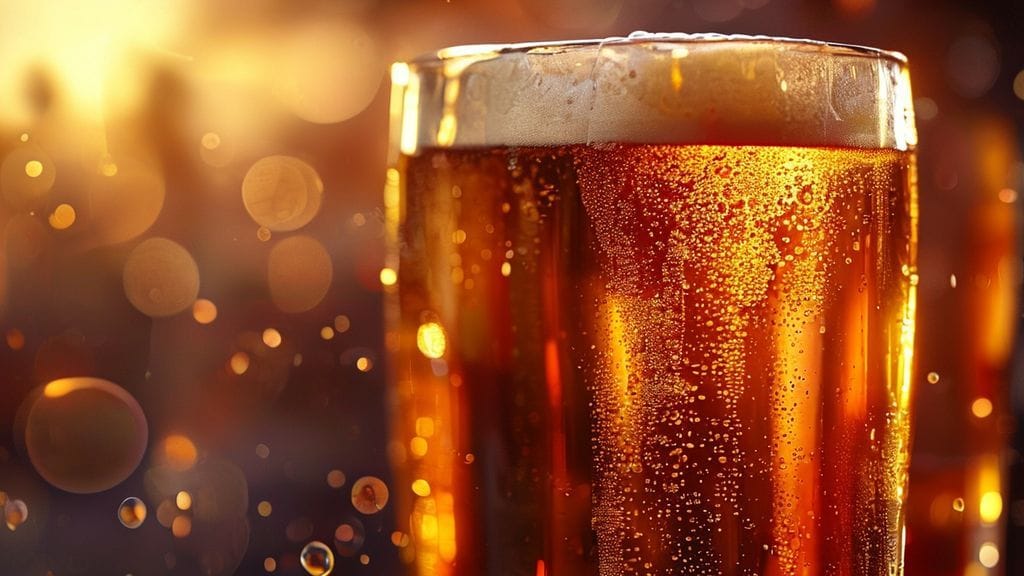
Doppelbock is a strong, full-bodied German lager renowned for its rich malt complexity, often displaying notes of bread crust, caramel, and dried fruit, with a warming alcohol presence. Historically brewed by monks, it undergoes an extended cold fermentation and lagering period, resulting in exceptional smoothness, clarity, and a clean, albeit malty, finish. Typical gravity ranges from 1.072 to 1.120 OG, yielding 7-10% ABV.
| Metric | My Target Range | BJCP Range (Category 9B) |
|---|---|---|
| Original Gravity (OG) | 1.078 – 1.084 | 1.072 – 1.120 |
| Final Gravity (FG) | 1.018 – 1.024 | 1.016 – 1.024 |
| Alcohol By Volume (ABV) | 7.8% – 8.9% | 7.0% – 10.0% |
| Bitterness (IBU) | 18 – 25 | 16 – 26 |
| Color (SRM) | 18 – 24 | 14 – 28 |
| Fermentation Temp | 9°C – 12°C | (Style Dependent) |
| Lagering Temp | 0°C – 2°C | (Style Dependent) |
Brewing the Ultimate Doppelbock: My 20-Year Journey to Malt Perfection
When I first ventured into brewing Doppelbock nearly two decades ago, I made the classic mistake of underestimating the importance of a meticulous lagering schedule. My initial batches, while flavorful, often presented with a slightly harsh edge and lacked that glass-like clarity I craved. I learned quickly that patience isn’t just a virtue in brewing; it’s a non-negotiable requirement for styles like this. Over the years, I’ve refined my approach, meticulously documenting every variable from mash pH to diacetyl rest timing. This isn’t just a recipe; it’s a distillation of my trials, errors, and ultimate triumphs in crafting a Doppelbock that truly sings with deep, complex malt character and exceptional smoothness. Let me share with you the hard-won knowledge I’ve accumulated, so you can bypass my early missteps and brew a Doppelbock worthy of a veteran.
The Math Behind the Malt: Deconstructing Your Doppelbock Recipe
Achieving a balanced, powerful Doppelbock isn’t about guesswork; it’s about precision. I always start with the numbers. My core philosophy for this style revolves around maximizing malt character without becoming cloying, balancing sweetness with a clean fermentation, and achieving a robust ABV. Here’s how I break down the key calculations for a typical 20-liter (5-gallon) batch.
Grain Bill Formulation: The Foundation of Flavor
The malt bill is paramount for Doppelbock. I’ve found that a careful blend of highly kilned German malts provides the signature bready, caramel, and sometimes chocolate notes without any roasted harshness. My preferred grain percentages are designed to build a complex foundation.
| Malt Type | Percentage (%) | Typical Contribution |
|---|---|---|
| German Munich II (15-20L) | 50-60% | Deep malt, bread crust, rich aroma, significant color. |
| German Pilsner Malt (1.5-2L) | 20-30% | Base fermentable, lighter color, enzymatic power. |
| CaraMunich III (50-60L) | 5-8% | Sweet caramel, depth, mouthfeel, increased color. |
| Melanoidin Malt (20-30L) | 3-5% | Intense maltiness, “decoction flavor,” color enhancement. |
| Dehusked Carafa III (400-500L) | 1-2% | Deep reddish-brown color without harsh roast. |
For a target OG of 1.080 and a 75% brewhouse efficiency, I’d typically calculate roughly 7.5 kg (16.5 lbs) of total grist for a 20-liter batch. Adjust accordingly for your specific efficiency.
Alcohol By Volume (ABV) Calculation
Understanding your final ABV is crucial for assessing fermentability and overall strength. I use the following formula, which I’ve found to be highly reliable:
ABV = (Original Gravity - Final Gravity) * 131.25
For example, if your OG is 1.080 and your FG is 1.020:
ABV = (1.080 - 1.020) * 131.25 = 0.060 * 131.25 = 7.875%
Apparent Attenuation (AA) Calculation
Apparent Attenuation tells me how much of the sugars the yeast has consumed. It’s a great indicator of yeast health and mash efficiency.
AA = ((Original Gravity - Final Gravity) / (Original Gravity - 1)) * 100
Using the previous example (OG 1.080, FG 1.020):
AA = ((1.080 - 1.020) / (1.080 - 1)) * 100 = (0.060 / 0.080) * 100 = 75%
A healthy German lager yeast should typically achieve 70-78% apparent attenuation for this style.
Bitterness Units (IBU) – My Approach
For Doppelbock, I aim for a firm but restrained bitterness that merely supports the malt, never dominates it. I calculate IBUs based on hop alpha acid (AA%) and utilization, which is influenced by boil time and wort gravity. For my 20-liter batch, I target 20-22 IBU.
Example: To achieve roughly 20 IBU in a 1.080 OG wort boiled for 90 minutes, I typically use 50 grams of Hallertau Mittelfrüh (4.0% AA) at 60 minutes. The higher gravity of a Doppelbock slightly reduces hop utilization, so I factor that into my brewing software or manual calculations. I avoid late hop additions entirely, as they introduce hop aroma and flavor that are atypical for the style.
My Step-by-Step Execution: Brewing a Flawless Doppelbock
This is where the rubber meets the road. My process for Doppelbock is thorough, demanding precision and patience. This assumes an all-grain system; adjust for extract brewing, focusing on fermentation and lagering techniques.
1. Water Treatment (Brew Day – Day 0)
I start with good quality brewing water, often reverse osmosis (RO) water, and build my profile. For Doppelbock, I lean towards a slightly higher calcium content to aid mash pH and yeast health, but avoid excessive sulfates that can sharpen bitterness. My target profile for 20 liters:
- Calcium (Ca²⁺): 70 ppm
- Magnesium (Mg²⁺): 10 ppm
- Sodium (Na⁺): 20 ppm
- Chloride (Cl⁻): 80 ppm
- Sulfate (SO₄²⁻): 50 ppm
- Mash pH target: 5.4-5.5 at mash temperature. I often use a small addition of lactic acid to hit this.
2. Mashing: The Decoction Advantage (Optional, but Recommended)
While a multi-step infusion can work, I strongly advocate for a single-decoction mash for Doppelbock. It develops unparalleled malt depth, melanoidin richness, and slightly improves fermentability. If you don’t have the setup or experience for decoction, a stepped infusion will still produce excellent results.
- Mash-In: Aim for a mash thickness of 2.8-3.0 L/kg (1.3-1.4 qt/lb). Dough in your crushed grain at 58°C (136°F). Mix thoroughly to eliminate dough balls and ensure even hydration. Check pH immediately.
- Protein Rest (Optional): Hold at 58°C (136°F) for 15 minutes. I only do this if I’m using less modified Pilsner malt; with modern malts, it’s often unnecessary and can thin the body.
- Saccharification Rest 1 (Beta-Amylase): Raise temperature to 64°C (147°F) and hold for 45 minutes. This promotes beta-amylase activity, yielding more fermentable sugars.
- Decoction Pull: Pull approximately 30-35% of the mash into a separate vessel. Heat this portion slowly to 70°C (158°F) for 10 minutes, then bring to a rolling boil for 15-20 minutes, stirring constantly to prevent scorching. The boiling helps convert starches, darkens the wort, and develops melanoidins.
- Mash Out: Slowly add the boiling decoction back to the main mash, stirring vigorously, to raise the entire mash to 76°C (169°F). Hold for 10 minutes to halt enzymatic activity. This also thins the mash for easier lautering.
If you opt for a stepped infusion, aim for 64°C (147°F) for 60 minutes, then mash out at 76°C (169°F) for 10 minutes.
3. Lautering and Sparging
Recirculate your wort until it runs clear, typically 15-20 minutes. Sparge with water heated to 77°C (170°F), collecting wort until your pre-boil volume (e.g., 26-27 liters for a 20-liter finished batch) is reached and your gravity drops below 1.010. Over-sparging extracts harsh tannins.
4. The Boil: Concentration and Clarity
My Doppelbock boils are typically 90 minutes. This longer boil helps concentrate the wort, develop color, and drive off any potential DMS precursors.
- First Hop Addition: Add 50g of Hallertau Mittelfrüh (4.0% AA) at 60 minutes remaining in the boil for bittering (approximately 20 IBU).
- Whirlfloc/Irish Moss: Add 1/2 tablet or 1 tsp at 10 minutes remaining to aid clarity.
- Yeast Nutrient: Add at 10 minutes remaining. High gravity worts benefit immensely from nutrient additions.
5. Chilling and Oxygenation
Rapidly chill the wort to fermentation temperature, ideally 9-10°C (48-50°F). Thoroughly oxygenate the wort – I use pure O₂ with a diffusion stone for 60-90 seconds for high-gravity lagers. This provides the yeast with the energy needed for a healthy fermentation.
6. Fermentation: The Long, Cold Road
This is where the magic (and patience) happens for a clean lager.
- Yeast Pitch: Pitch a healthy, adequately sized starter of a clean German Lager yeast (e.g., WLP830 German Lager, WLP833 Bock Lager, or SafLager S-23). For a 1.080 OG, I aim for at least 1.5-2 million cells/mL/°P, which often means a 2-3 liter starter for 20 liters of wort.
- Primary Fermentation: Maintain temperature at 9-10°C (48-50°F) for the first 5-7 days. As fermentation activity subsides (around day 7-10), allow the temperature to slowly free-rise to 12°C (54°F) for a diacetyl rest. Hold for 2-3 days.
- Diacetyl Rest: This slightly warmer period allows the yeast to clean up diacetyl and other off-flavors. Once the FG is stable for two consecutive days (check with a hydrometer), proceed to cold crashing. My FG target is typically 1.018-1.024.
7. Lagering: The Key to Smoothness and Clarity
This is arguably the most critical step for Doppelbock. My rule of thumb is “a week per percent ABV, plus one month.”
- Cold Crash: Drop the temperature rapidly to 0-2°C (32-35°F). Hold here for 3-4 days to drop out most yeast and trub.
- Transfer and Lager: Carefully rack the beer to a clean, sanitized secondary fermenter or serving keg, leaving behind as much yeast as possible. Store at 0-2°C (32-35°F) for a minimum of 6-8 weeks, or even longer (up to 3-4 months) for truly exceptional results. This extended cold conditioning is what refines the flavor, smooths out any harshness, and produces brilliant clarity.
8. Packaging
Once lagering is complete and the beer is crystal clear, package it. I prefer kegging and force carbonating to around 2.3-2.5 volumes of CO₂ for a soft, creamy mouthfeel. If bottling, ensure you use sturdy bottles and condition for another 2-3 weeks at cellar temperature before chilling. Check out more packaging tips at BrewMyBeer.online.
What Can Go Wrong: Troubleshooting Your Doppelbock
Even with meticulous planning, brewing can throw curveballs. Here are common issues I’ve encountered and how to address them:
- Stuck Fermentation/Under-attenuation: This is common with high-gravity worts.
- Cause: Under-pitching yeast, insufficient oxygenation, too low fermentation temperature, or nutrient deficiency.
- Fix: Ensure adequate yeast pitch rates for high gravity. Oxygenate thoroughly. Consider a yeast nutrient addition at 10 minutes remaining in the boil. If stuck, gently raise temperature to 18-20°C (64-68°F) for 2-3 days to rouse yeast activity, or rouse the yeast by swirling. Repitch with fresh, active yeast if necessary.
- Hazy Beer/Poor Clarity: Lack of brilliance detracts from the experience.
- Cause: Insufficient cold crash, inadequate lagering time, too many polyphenols (over-sparging), or bacterial/wild yeast contamination.
- Fix: Extend cold crash and lagering. Ensure sparge water temperature is not too high and you stop collecting wort below 1.010 gravity. Use finings like gelatin or BioFine Clear during lagering. Ensure impeccable sanitation.
- Harsh or Astringent Flavor: An unpleasant dryness or rough sensation.
- Cause: Over-sparging, mashing at too high a pH, or excessive dark roasted malts (though not typical for Doppelbock if Carafa is dehusked).
- Fix: Monitor mash pH, especially when building water profiles. Stop sparging when gravity drops. Ensure grains are correctly milled.
- Excessive Esters/Fruity Off-flavors: While some esters are okay, too much is atypical for a clean lager.
- Cause: Fermentation temperature too high for a lager yeast.
- Fix: Maintain strict temperature control during primary fermentation. Use a dedicated fermentation chamber.
- Diacetyl (Buttery/Butterscotch): A tell-tale sign of an incomplete or skipped diacetyl rest.
- Cause: Yeast didn’t have enough time or energy to clean up diacetyl precursors.
- Fix: Ensure a proper diacetyl rest at the end of primary fermentation (2-3 days at 12-16°C / 54-61°F). Longer lagering often helps yeast reabsorb diacetyl, but prevention is key.
Sensory Analysis: My Ideal Doppelbock Profile
After all that meticulous work, here’s what I expect to find in my glass. My goal is a beer that is both robust and refined, a true testament to the style.
- Appearance: A captivating deep ruby red to dark brown hue, often with mahogany highlights when held to light. Clarity should be brilliant, free of haze, allowing light to truly penetrate. A thick, creamy, persistent tan head, with excellent lacing.
- Aroma: Rich and intense malt-forward. I look for pronounced bread crust, toasted bread, and deep caramel notes. Subtle hints of dark dried fruits like plums or raisins are desirable, along with a clean, low hop aroma. There should be absolutely no diacetyl or harsh fusel alcohol notes, only a gentle warming alcoholic presence.
- Mouthfeel: Full-bodied and undeniably smooth, almost chewy in texture. Carbonation should be moderate, providing a creamy yet refreshing finish. The alcohol warmth is present but well-integrated, never burning. There should be a noticeable viscosity, coating the palate without being cloying.
- Flavor: Dominated by complex malt sweetness, reminiscent of rich malty bread, toasted nuts, and deep caramel. This sweetness is beautifully balanced by a low, firm bitterness that prevents it from becoming sugary. I often detect dark fruit esters (plum, prune) and a hint of chocolate or coffee from the darker malts, always without roast astringency. The finish should be clean for a lager, allowing the malt flavors to linger pleasantly.
Frequently Asked Questions About Doppelbock Brewing
What’s the best yeast for Doppelbock?
In my experience, a clean, highly attenuating German lager yeast is critical. My favorites include WLP830 German Lager Yeast, WLP833 Bock Lager Yeast, and SafLager S-23. The key is to pitch a large, healthy starter and maintain strict temperature control to minimize unwanted esters and ensure thorough fermentation in a high-gravity wort.
Is decoction mashing necessary for Doppelbock?
While not strictly “necessary” to brew a good Doppelbock, I find decoction mashing highly beneficial. It enhances malt complexity, deepens color, and creates those unique melanoidin flavors often described as “toasty” or “bready,” which are characteristic of traditional German lagers. If you’re chasing authenticity and maximum flavor depth, I recommend giving it a try. For a detailed guide on decoction, you might find more resources on BrewMyBeer.online.
How long should I lager my Doppelbock?
This is where patience truly pays off. My rule of thumb is a minimum of 6-8 weeks at near-freezing temperatures (0-2°C / 32-35°F), but I’ve had exceptional results with lagering periods extending to 3-4 months. The longer lagering time allows harsh flavors to mellow, promotes brilliant clarity, and integrates the alcohol seamlessly into the malt profile, creating that signature smoothness this style is known for.
Can I brew a good Doppelbock using extract?
Absolutely! While all-grain gives you ultimate control, you can brew a fantastic extract Doppelbock by focusing on high-quality malt extract (e.g., Munich LME or DME), supplementing with specialty grains for steeping (CaraMunich, Melanoidin, Carafa III), and meticulously following the fermentation and lagering schedule. The yeast management and cold conditioning steps are just as critical for extract brewers as for all-grain brewers in achieving the style’s characteristics.