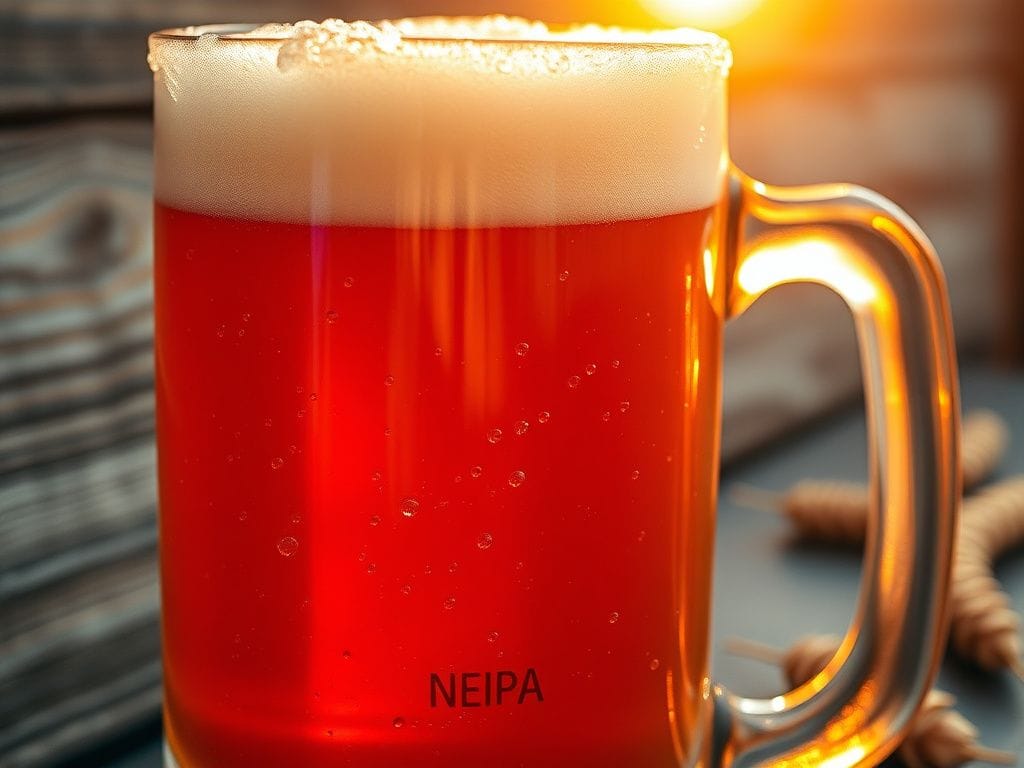
This definitive guide meticulously details the process for cloning Tree House ‘Julius’ NEIPA (Version 2.0). Achieve its signature hazy opacity, intense tropical fruit aromatics, and low bitterness through precise water chemistry, complex hop scheduling, and optimal fermentation protocols. Master the techniques for a professional-grade hazy IPA.
Tree House ‘Julius’ NEIPA (Version 2.0) Clone Recipe
This recipe targets a 5.5-gallon (20.8 L) batch size, assuming 75% brewhouse efficiency.
| Ingredient | Quantity/Value | Type | Purpose | Notes |
|---|---|---|---|---|
| Pale Malt (2-Row) | 10.0 lbs (4.54 kg) | Base Malt | Fermentable Base | North American 2-Row preferred. |
| Flaked Oats | 2.0 lbs (0.91 kg) | Adjunct | Haze, Mouthfeel | Raw, contributes protein for haze and body. |
| White Wheat Malt | 1.5 lbs (0.68 kg) | Specialty Malt | Haze, Head Retention | Unmalted wheat also works for more haze. |
| Carapils (Dextrine Malt) | 0.5 lbs (0.23 kg) | Specialty Malt | Body, Head Retention | Enhances mouthfeel without sweetness. |
| Acidulated Malt | 0.25 lbs (0.11 kg) | Specialty Malt | Mash pH Adjustment | Adjust as needed for target mash pH 5.2-5.4. |
| Citra Pellets | 1.0 oz (28 g) | Hop – Whirlpool | Aroma, Flavor | @ 175°F (79°C) for 20 min. |
| Mosaic Pellets | 1.0 oz (28 g) | Hop – Whirlpool | Aroma, Flavor | @ 175°F (79°C) for 20 min. |
| Galaxy Pellets | 1.0 oz (28 g) | Hop – Whirlpool | Aroma, Flavor | @ 175°F (79°C) for 20 min. |
| Citra Pellets | 3.0 oz (84 g) | Hop – Dry Hop (Day 3) | Biotransformation, Aroma | Add when gravity hits ~1.030. |
| Mosaic Pellets | 2.0 oz (56 g) | Hop – Dry Hop (Day 3) | Biotransformation, Aroma | Add when gravity hits ~1.030. |
| Galaxy Pellets | 2.0 oz (56 g) | Hop – Dry Hop (Day 3) | Biotransformation, Aroma | Add when gravity hits ~1.030. |
| Citra Pellets | 3.0 oz (84 g) | Hop – Dry Hop (Day 7/Crash) | Aroma Saturation | Add 24-48 hrs before cold crash/packaging. |
| Mosaic Pellets | 2.0 oz (56 g) | Hop – Dry Hop (Day 7/Crash) | Aroma Saturation | Add 24-48 hrs before cold crash/packaging. |
| Galaxy Pellets | 2.0 oz (56 g) | Hop – Dry Hop (Day 7/Crash) | Aroma Saturation | Add 24-48 hrs before cold crash/packaging. |
| Wyeast 1318 London Ale III | 1 vial/smack pack | Liquid Yeast | Fermentation | Pitch 2-liter starter for optimal health. Or Imperial Yeast A38 Juice/Omega OYL-006. |
| Calcium Chloride (CaCl₂) | 10-15 g | Water Salt | Flavor, Mouthfeel, pH | Adjust to target Cl:SO4 ratio of 2:1 to 3:1. |
| Gypsum (CaSO₄) | 3-5 g | Water Salt | Flavor, Hops, pH | Adjust to target Cl:SO4 ratio of 2:1 to 3:1. |
| Epsom Salt (MgSO₄) | 2-3 g | Water Salt | Yeast Health, Flavor | Provides Mg for yeast and sulfate for dryness. |
| Lactic Acid 88% | 5-10 mL | Acid | Mash pH Adjustment | Adjust for target mash pH of 5.2-5.4. |
| Whirlfloc/Irish Moss | 1 tablet/1 tsp | Fining Agent (Boil) | Trub Coagulation | Add 10-15 min before end of boil. |
Technical Brewing Calculations
Water Salt Addition Calculation (for 5.5 gallons from RO Water to Target Profile)
Target Profile for NEIPA (ppm): Calcium 100-120, Magnesium 10-15, Sodium 10-20, Chloride 180-220, Sulfate 60-80, Bicarbonate 0-50.
Assuming 5.5 gallons (20.8 L) final volume, with 7 gallons (26.5 L) mash/sparge water total from RO:
Goal: Achieve a Chloride:Sulfate ratio of approximately 2.5:1 (e.g., Cl 200 ppm, SO4 80 ppm).
To add 100 ppm Calcium, 200 ppm Chloride, 80 ppm Sulfate, 10 ppm Magnesium to 26.5 L RO Water:
- Calcium Chloride (CaCl₂): ~13.5 grams (contributes 49 ppm Ca, 137 ppm Cl per 5g/20.8L)
- Gypsum (CaSO₄): ~4.5 grams (contributes 28 ppm Ca, 67 ppm SO₄ per 5g/20.8L)
- Epsom Salt (MgSO₄): ~2.5 grams (contributes 6 ppm Mg, 26 ppm SO₄ per 5g/20.8L)
Note: Use a brewing water calculator (e.g., Bru’n Water, Brewer’s Friend) with your specific water volume and desired profile for precise additions. These are approximations.
IBU Calculation (Estimated for Late/Whirlpool Hops)
For NEIPAs, traditional IBU calculations are less relevant due to minimal boil hops and high whirlpool/dry hop additions. However, we can estimate impact:
Formula (Simplified for Whirlpool – often assumed 0.1-0.2 Utilization Factor for 170°F, 20 min):
IBU = (Hop Weight (g) * %Alpha Acid * Utilization Factor * 1000) / (Volume (L) * Gravity Adjustment)
Example Whirlpool (3 oz total, 7% AA, 0.15 UF, 20.8 L, 1.065 wort):
3 oz = 84 grams
Gravity Adjustment (for wort above 1.050) = 1 + ((OG – 1.050) / 0.2)
If OG = 1.065, Gravity Adjustment = 1 + ((1.065 – 1.050) / 0.2) = 1 + (0.015 / 0.2) = 1 + 0.075 = 1.075
IBU = (84 g * 0.07 * 0.15 * 1000) / (20.8 L * 1.075)
IBU = 882 / 22.36 ≈ 39.4 IBU (Highly Estimated)
Note: This is a rough estimation. True NEIPA bitterness is perceived as much lower due to high hop oil saturation and lower isomerization. Aim for a perceived bitterness of 20-30 IBU.
ABV Calculation
Formula: ABV = (OG – FG) * 131.25
Assumed Values: Original Gravity (OG) = 1.065, Final Gravity (FG) = 1.012
ABV = (1.065 – 1.012) * 131.25
ABV = 0.053 * 131.25
ABV ≈ 6.96%
Dry Hop Concentration Calculation
Formula: Dry Hop Rate (g/L) = Total Dry Hop Weight (g) / Fermenter Volume (L)
Example: Total Dry Hop Weight = 3 oz Citra + 2 oz Mosaic + 2 oz Galaxy (Day 3) + 3 oz Citra + 2 oz Mosaic + 2 oz Galaxy (Day 7) = 14 oz = 396 grams
Fermenter Volume = 5.5 gallons = 20.8 Liters
Dry Hop Rate = 396 g / 20.8 L ≈ 19.04 g/L (or ~5.0 oz/gallon)
Note: This high dry hop rate is characteristic of modern NEIPAs and contributes significantly to the intense aroma and flavor profile.
Deep Dive: Mastering the ‘Julius’ NEIPA Clone (Version 2.0)
Cloning a beer as iconic as Tree House’s ‘Julius’ NEIPA demands an uncompromising, scientific approach to every facet of the brewing process. This isn’t merely a recipe; it’s a technical manifesto for achieving the precise balance of haze, aroma, flavor, and mouthfeel that defines the benchmark for the style. We delve into the granular details, focusing on the critical interdependencies of ingredients and process.
Water Chemistry: The Foundation of Haze and Mouthfeel
The role of water chemistry in NEIPA production is paramount, arguably as critical as the hop bill itself. For ‘Julius,’ the objective is to create a soft, full mouthfeel while promoting and stabilizing the characteristic haze. This mandates a specific mineral profile that deviates significantly from traditional IPA water.
The primary focus is a high Chloride (Cl) to Sulfate (SO₄) ratio, typically in the range of 2:1 to 3:1. Chloride enhances the perception of fullness and sweetness, contributing to the “juicy” character, while excessive sulfate would promote a sharper, drier bitterness that is undesirable in a NEIPA. Our target chloride levels should be between 180-220 ppm, with sulfates kept to 60-80 ppm. Calcium (Ca) levels are crucial for yeast health, enzyme function, and protein coagulation, targeting 100-120 ppm. Magnesium (Mg) at 10-15 ppm supports yeast metabolism and subtle flavor nuances. Sodium (Na) should be kept low, ideally under 20 ppm, to avoid any salty perception.
Starting with Reverse Osmosis (RO) water is highly recommended as it provides a blank slate, allowing for precise mineral additions without contending with unpredictable municipal water profiles. Calcium Chloride (CaCl₂) is the primary source of chloride and calcium, while Gypsum (CaSO₄) contributes sulfate and calcium in moderation. Epsom Salt (MgSO₄) provides magnesium and a small amount of sulfate. Accurate measurement and calculation via a brewing water software tool (e.g., Bru’n Water) are indispensable. Finally, mash pH management is crucial. Aim for a mash pH between 5.2 and 5.4. This range optimizes enzymatic activity for fermentability and extract efficiency, but also plays a role in haze stability and flavor. Lactic Acid (88%) is typically used to adjust the mash pH downwards if necessary, especially with a grist containing significant flaked adjuncts that lack buffering capacity.
Grain Bill Philosophy: Building the Hazy Canvas
The grist for ‘Julius’ is designed to contribute fermentable sugars, body, and, critically, haze. It’s a precise balance of base malts and haze-contributing adjuncts.
A high percentage (70-80%) of a light, neutral North American 2-Row Pale Malt forms the backbone. This provides the primary fermentable sugars without imparting excessive color or assertive malt character that would compete with the hop profile. The remaining 20-30% comprises the haze and mouthfeel constituents. Flaked Oats (typically 15-20% of the grist) are non-malted and rich in beta-glucans and proteins, which are instrumental in creating and stabilizing the persistent haze. They also contribute a silky, creamy mouthfeel, reducing the perceived harshness of high hop loads. White Wheat Malt (5-10%) also provides protein for haze and head retention, contributing a subtle bready character. Some brewers may opt for unmalted wheat for even higher protein content. Carapils (or Dextrine Malt) at 2-5% adds unfermentable dextrins, boosting body and head retention without contributing residual sweetness or color, which could dull the vibrant hop character. Crystal malts are generally avoided or used in minimal quantities (<1%) as their complex sugars and color can negatively impact haze stability and introduce caramel notes that clash with the desired tropical fruit profile. Finally, a small amount of Acidulated Malt (1-2%) is often included to naturally lower mash pH, ensuring it falls within the optimal range for enzyme function, which impacts both sugar conversion and eventual haze stability.
Hop Schedule: The Art and Science of NEIPA Flavor
The hop profile of ‘Julius’ is its defining characteristic: intense, multilayered tropical fruit and citrus aroma with minimal bitterness. This is achieved through a meticulously orchestrated hop schedule that prioritizes late additions, whirlpool additions, and biotransformative dry hopping.
Traditional bittering additions (60-minute boil) are minimized or entirely eliminated. If any is used, a small charge (<0.25 oz) of a neutral hop during the first wort hopping (FWH) or at 60 minutes can establish a foundational bitterness without introducing harshness. The true magic begins in the Whirlpool/Hop Stand. After the boil, the wort is cooled rapidly to 170-180°F (77-82°C). This temperature range is critical: it’s hot enough to extract significant hop oils and polyphenols but cool enough to minimize alpha acid isomerization, preventing excessive bitterness. Citra, Mosaic, and Galaxy are the triad of choice for ‘Julius,’ delivering an explosion of passionfruit, mango, orange, berry, and stone fruit notes. A substantial charge (1 oz each for a 5.5-gallon batch) should steep for 20-30 minutes before chilling to pitching temperature. This “hop stand” saturates the wort with flavor and aroma compounds without generating the perceived bitterness of boiled hops.
The dry hopping schedule is equally intricate and divided into two phases. The first dry hop is performed during active fermentation, typically on Day 3 or 4, as the krausen begins to subside and gravity drops to approximately 1.030-1.020. This is the stage for biotransformation. Yeast enzymes (specifically beta-glucosidases and beta-lyases) interact with hop compounds (e.g., glycosides, thiols) to unlock and convert precursors into highly aromatic volatile compounds, enhancing the tropical fruit character and complexity. Again, heavy charges of Citra, Mosaic, and Galaxy are added directly to the fermenter. Maintaining fermentation temperature (68-72°F / 20-22°C) during this phase is important for optimal yeast activity. The second dry hop occurs post-fermentation, often 24-48 hours before cold crashing or packaging. This “cold dry hop” or “terminal dry hop” primarily aims for aroma saturation and contributes significantly to the upfront hop impact and perceived juiciness. It’s crucial to minimize oxygen exposure during both dry hop additions, often by purging the headspace with CO₂ before opening the fermenter, and by utilizing a fermenter designed for minimal oxygen ingress during additions.
The cumulative hop load for a ‘Julius’ clone is very high, often exceeding 5 oz/gallon (19 g/L) across all stages. This emphasis on late and dry hopping minimizes traditional bitterness perception, allowing the massive hop aroma and flavor to dominate, which defines the NEIPA style guidelines.
Yeast Strain and Fermentation: The Haze-Forming Engine
The choice of yeast is non-negotiable for a ‘Julius’ clone. Wyeast 1318 London Ale III (or its equivalents like Imperial Yeast A38 Juice or Omega OYL-006) is the standard for a reason. This strain is renowned for its unique characteristics perfectly suited for NEIPAs:
- Low Flocculation: It remains in suspension for an extended period, contributing directly to the characteristic stable haze.
- High Ester Production: It produces significant fruit esters that complement the hop profile, enhancing the “juicy” perception.
- Moderate Attenuation: It typically attenuates around 70-75%, leaving enough residual body and sweetness to balance the hop load without being cloying.
A healthy and properly sized yeast pitch is paramount. For a 5.5-gallon batch, a 2-liter starter for a liquid yeast vial is strongly recommended to ensure sufficient cell count and vitality. Fermentation temperature is typically maintained in the mid to high range for ale yeast, generally 68-72°F (20-22°C). This temperature promotes the desirable ester profile while ensuring efficient fermentation. While NEIPA strains are generally robust, monitoring fermentation progress via gravity readings is important. Initial oxygenation of the wort prior to pitching is critical for healthy yeast growth, but subsequent oxygen exposure post-fermentation must be rigorously avoided.
Mashing, Lautering, and Boiling: Precision and Simplicity
The mashing process for a ‘Julius’ clone is straightforward but precise. A single infusion mash at 152-154°F (67-68°C) for 60-75 minutes is ideal. This temperature range strikes a balance between fermentability (for a respectable ABV) and dextrin production (for body). Mash pH must be monitored and adjusted to 5.2-5.4. Due to the high percentage of flaked adjuncts, the mash can be quite thick and potentially difficult to lauter. Recirculation should be gentle and thorough to set the grain bed, but do not seek sparkling clarity, as some particulate matter contributes to the haze. Sparge slowly and avoid sparging with water above 170°F (77°C) or below a gravity of 1.010, which can extract tannins and lead to astringency.
The boil for a NEIPA is typically shorter than traditional ales, often 60 minutes. As discussed, there are minimal to no hop additions during this phase. The primary functions of the boil are sanitation, enzyme deactivation, and protein coagulation (though haze is desired, large protein clumps are not). A fining agent like Whirlfloc or Irish Moss can be added 10-15 minutes before the end of the boil to aid in hot break formation and prevent chill haze (though this is distinct from the desired permanent haze).
Whirlpool and Cooling: The Hop Extract Phase
After the boil, rapid chilling to the whirlpool temperature of 170-180°F (77-82°C) is essential to preserve hop compounds and prevent excessive isomerization. The whirlpool should be maintained for 20-30 minutes with the specified hop additions. Following the whirlpool, the wort must be chilled rapidly to yeast pitching temperature (typically 66-68°F / 19-20°C). A counterflow chiller or plate chiller is highly efficient here. Rapid chilling helps create a significant cold break, which is beneficial for yeast health and overall beer stability.
Oxygen Management: The NEIPA Brewer’s Nemesis
Low Oxygen Brewing (LODO) techniques are not merely an optimization for NEIPAs; they are fundamental requirements for haze stability and flavor preservation. Once the wort is chilled and oxygenated for yeast pitching, any subsequent exposure to oxygen must be scrupulously avoided. Oxygen reacts with hop compounds, polyphenols, and yeast components, leading to “haze crash” (where the desired haze falls out of suspension) and the development of stale, cardboard, or sherry-like off-flavors. This is particularly problematic in heavily dry-hopped beers. Strategies include:
- Closed Transfers: Moving beer from fermenter to keg/packaging vessel without exposing it to air.
- CO₂ Purging: Filling receiving vessels (kegs, bottles) with CO₂ to displace oxygen before transfer.
- Minimal Headspace: Filling vessels as full as possible to reduce the volume of oxygen-containing air.
- Avoiding Excessive Racking: Each transfer increases oxidation risk.
- Purging Dry Hops: If adding dry hops through a port, purge the port with CO₂ first.
Adopting low oxygen brewing techniques is one of the most significant steps a brewer can take to elevate their NEIPA quality and shelf life. For comprehensive guides and tools to optimize your process, consult BrewMyBeer.online for advanced brewing techniques.
Clarification and Packaging: Haze, Not Clarity
Unlike traditional IPAs, no fining agents (e.g., gelatin, BioFine) should be used post-fermentation in a NEIPA. The goal is a stable, opaque haze, not crystal clarity. A cold crash (dropping temperature to 35-40°F / 2-4°C) for 24-48 hours is usually sufficient to settle out some bulk yeast and hop matter, which can prevent “hop creep” or over-carbonation, but it should not clarify the beer entirely. Kegging is the preferred packaging method for NEIPAs due to superior oxygen control. Counter-pressure filling can be employed for bottles, but the shelf life of bottled NEIPAs, even with meticulous technique, is significantly shorter due to the inherent oxidation sensitivity. Aim for consumption within 4-6 weeks for optimal freshness.
Sensory Evaluation: The ‘Julius’ Experience
The sensory profile of a successful ‘Julius’ clone should be unmistakable:
- Appearance: Opaque, milky, or turbid. A pale straw to light orange color, vibrant and hazy. Persistent, creamy white head.
- Aroma: Explosive and complex, dominated by tropical fruits (mango, passionfruit, pineapple), citrus (orange, grapefruit), and stone fruit (apricot, peach). Minimal to no dank, grassy, or vegetal notes.
- Flavor: Mirrors the aroma – juicy, fruity, and intensely hop-forward. Bitterness is soft, perceived as minimal, supporting the fruit rather than dominating. Clean fermentation character.
- Mouthfeel: Full, soft, creamy, and smooth. Not thin or watery. Low perceived carbonation enhances the silkiness.
- Finish: Clean, refreshing, with a lingering hop flavor but very little bitterness. Not cloying or sticky.
Troubleshooting and Advanced Tips
Achieving a perfect NEIPA clone can be challenging, but understanding common pitfalls helps. Haze instability often stems from oxidation, but can also be influenced by an insufficient protein-rich grain bill, unhealthy yeast, or insufficient hop polyphenols. Lack of aroma usually points to old or poor-quality hops, insufficient hop charges, or improper dry hopping techniques (e.g., too high temperature causing stripping of volatiles, or too short contact time). Grassy or vegetal notes can arise from excessive dry hop contact time, especially at warmer temperatures, or from poor hop quality. For those using Brew-in-a-Bag (BIAB) methods, ensure sufficient volume for the high grain bill and good agitation during the mash to prevent dough balls. Harvesting yeast from a previous healthy NEIPA fermentation can provide a robust and active pitch for future batches, further enhancing consistency.
Mastering this clone requires dedication to process and a deep understanding of ingredient interactions. By meticulously controlling water chemistry, executing a sophisticated hop schedule, managing fermentation, and eliminating oxygen, you can replicate the distinctive character of Tree House ‘Julius.’ Explore further resources and innovative recipes to perfect your craft at BrewMyBeer.online.