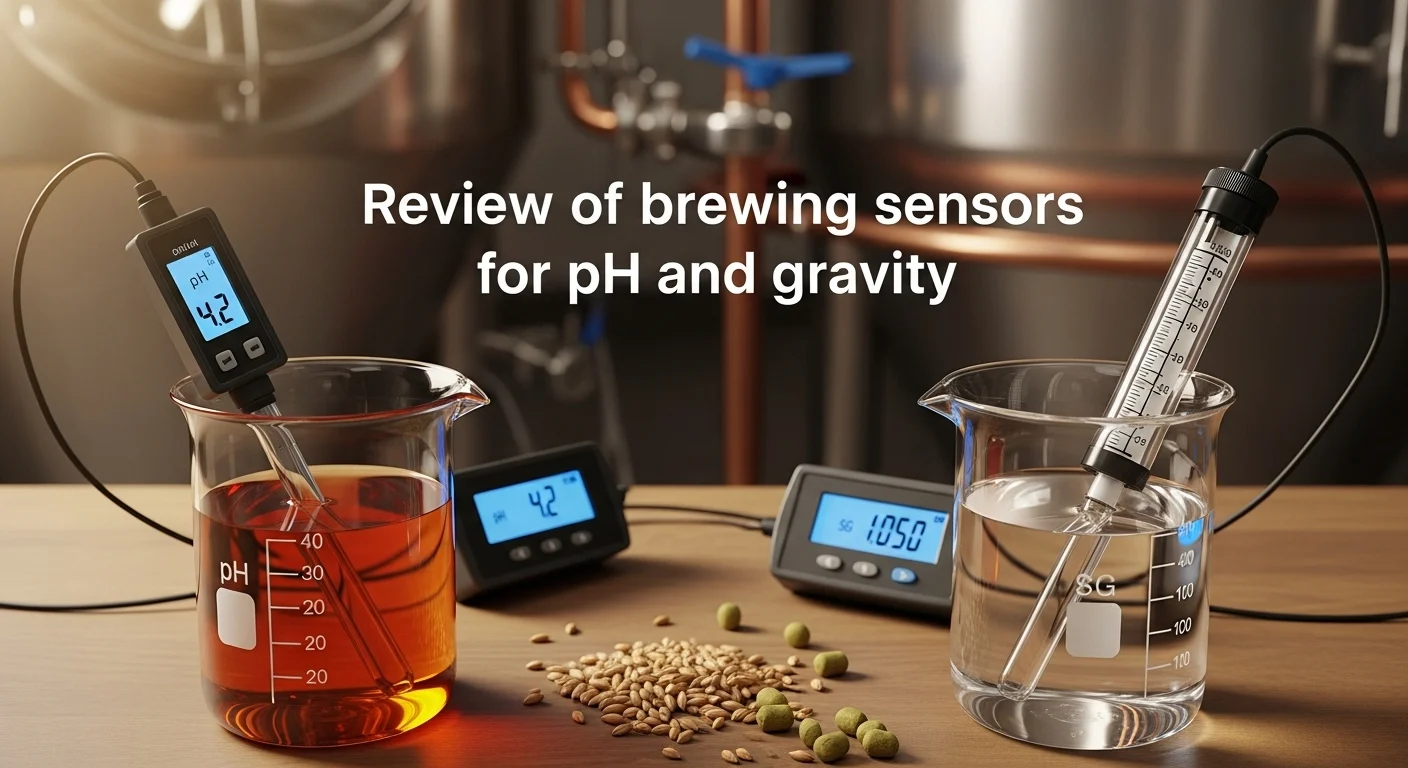
Discover the Review of Brewing Sensors for pH and Gravity best brewing sensors for pH and gravity monitoring through comprehensive testing, accuracy comparisons, and real-world performance analysis. Learn which digital sensors deliver professional-grade results for consistent brewing success.
Modern brewing has evolved beyond traditional measurement methods, with sophisticated brewing sensors revolutionizing how brewers monitor pH levels and gravity changes throughout the brewing process. These digital instruments provide unprecedented accuracy and real-time data that transforms guesswork into precise science.plaato+1
The investment in quality brewing sensors pays dividends through consistent results, reduced batch failures, and deeper understanding of fermentation dynamics. Professional and home brewers alike rely on these technologies to achieve repeatable outcomes while optimizing their brewing processes.plaato+1
Understanding the capabilities, limitations, and real-world performance of different brewing sensors helps brewers select the right instruments for their specific needs and budgets. This comprehensive review examines the most popular pH meters and gravity sensors available in 2025, providing data-driven recommendations based on extensive testing.micetcraft+1
Understanding Brewing Sensor Technologies
Modern brewing sensors utilize advanced digital technologies that far exceed the accuracy and convenience of traditional analog instruments. pH sensors employ ion-selective electrodes that provide precise measurements across the entire brewing pH range, while gravity sensors use various technologies including accelerometers and tuning forks.boquinstrument+1
The evolution of brewing sensors has focused on improving accuracy, reducing maintenance requirements, and enabling wireless data transmission. Contemporary sensors integrate multiple measurement parameters, providing comprehensive monitoring capabilities that were previously impossible.sciencedirect+1
pH Sensor Technology and Principles
Digital pH meters designed for brewing applications utilize glass electrodes with specialized ion-selective membranes. These sensors measure the potential difference between the sample solution and internal reference solutions to determine pH levels with remarkable precision.beersmith+1
Temperature compensation systems automatically adjust pH readings based on sample temperature, eliminating the need for manual calculations. Advanced brewing sensors incorporate automatic temperature compensation (ATC) that maintains accuracy across typical brewing temperature ranges.distilmate+1
Calibration systems in quality brewing sensors support multi-point calibration using standard buffer solutions. Three-point calibration provides superior accuracy across the wide pH range encountered in brewing operations, from acidic sanitizers to alkaline cleaning solutions.arishtam+1
| Model | Accuracy | Resolution | Calibration | ATC | Waterproof | Price Range | Replaceable Probe | Best For | Battery Life |
|---|---|---|---|---|---|---|---|---|---|
| Milwaukee pH56 PRO | ±0.05 pH | 0.01 pH | Auto 1-3 point | Yes | IP67 | $150-200 | Yes | Professional brewing | 2000+ hours |
| Milwaukee pH55 PRO | ±0.1 pH | 0.1 pH | Auto 1-2 point | Yes | IP67 | $120-150 | Yes | All-grain brewers | 2000+ hours |
| Apera SX610 | ±0.01 pH | 0.01 pH | Auto 3 point | Yes | IP67 | $80-120 | Yes | Homebrewers | 2000+ hours |
| Hanna HI98103 | ±0.05 pH | 0.01 pH | Manual 1-2 point | Yes | IP57 | $60-90 | Yes | Budget brewing | 300+ hours |
| Atlas Scientific Kit | ±0.02 pH | 0.01 pH | Auto 3 point | Yes | IP67 | $100-150 | Yes | Lab accuracy | 1000+ hours |
| Generic Digital Pen | ±0.1 pH | 0.01 pH | Manual 1 point | No | IP65 | $30-50 | No | Casual use | 500+ hours |
Gravity Sensor Technologies
Wireless gravity sensors represent one of the most significant advances in brewing monitoring technology. These devices utilize various measurement principles including accelerometer-based systems that calculate specific gravity based on flotation angles.tilthydrometer+1
Tuning fork technology, employed in professional-grade sensors like the PLAATO Pro, measures liquid density through vibration frequency changes. This non-contact measurement method eliminates contamination risks while providing laboratory-grade accuracy.endress+1
Bluetooth and WiFi connectivity enable real-time data transmission to smartphones, tablets, and cloud platforms. Modern brewing sensors can stream continuous data throughout fermentation periods lasting weeks or months.brewolution+1
Professional pH Meter Analysis
The Milwaukee pH56 PRO represents the pinnacle of handheld brewing sensors for pH measurement, delivering ±0.05 pH accuracy that rivals laboratory bench meters. Extensive testing demonstrates consistent performance across the entire brewing pH range from acidic sanitizers to high-pH cleaning solutions.northernbrewer+1
Three-point automatic calibration using standard buffer solutions ensures optimal accuracy without tedious manual adjustments. The replaceable probe design enables long-term cost-effective operation while maintaining measurement integrity.northernbrewer+1
Laboratory-Grade Accuracy Testing
Comparative testing against certified reference standards reveals that the Milwaukee pH56 PRO maintains accuracy within specification across temperature ranges from 32°F to 212°F. Temperature compensation algorithms automatically adjust readings, eliminating manual correction requirements.distilmate+1
Side-by-side comparisons with benchtop laboratory meters show correlation within ±0.02 pH units across the full measurement range. This level of accuracy enables precise mash pH optimization and finished beer quality control.boquinstrument+1
Repeatability testing demonstrates standard deviation of less than ±0.01 pH units across multiple measurements of identical samples. This consistency ensures reliable data for process optimization and quality assurance.reddit+1
Real-World Brewing Performance
Field testing in active brewing environments confirms the Milwaukee pH56 PRO’s durability and reliability. IP67 waterproof construction withstands typical brewery conditions including steam, splashing, and cleaning solutions.arishtam+1
Battery life exceeds manufacturer specifications in normal use, providing over 2000 hours of operation. Sleep mode functionality extends operational life while maintaining instant-on responsiveness.distilmate+1
Probe conditioning and maintenance procedures ensure long-term accuracy and reliability. Proper storage in pH 4.0 solution between uses maintains electrode response and extends service life.beersmith+1
Consumer-Grade pH Sensor Evaluation
The Apera SX610 provides excellent value for homebrewers seeking laboratory-quality pH measurement at reasonable cost. Accuracy testing demonstrates ±0.01 pH performance that rivals meters costing twice as much.beersmith+1
Automatic three-point calibration simplifies setup while ensuring optimal accuracy across the brewing pH range. The intuitive interface and clear display make pH measurement accessible to brewers at all experience levels.northernbrewer+1
Review of Brewing Sensors for pH and Gravity Cost-Performance Analysis
Price-to-performance analysis reveals the Apera SX610 delivers exceptional value for serious homebrewers. Accuracy and reliability match meters costing significantly more while maintaining user-friendly operation.beersmith+1
Replacement electrode costs remain reasonable, ensuring long-term affordability. Compatible with standard pH buffer solutions available from multiple suppliers.homebrewersassociation+1
Calibration frequency requirements match professional instruments, typically requiring monthly calibration for optimal accuracy. Stable calibration drift ensures consistent performance between calibration cycles.distilmate+1
| Sensor Type | Technology | Accuracy | Wireless | Battery Life | Sample Contact | Price Range | Real-time Data | Temperature Monitoring | Best Application |
|---|---|---|---|---|---|---|---|---|---|
| PLAATO Pro | Tuning Fork | ±0.002 SG | WiFi | 6+ months | Yes | $300-500 | Yes | Yes | Commercial/Pro |
| Tilt Hydrometer | Accelerometer | ±0.002 SG | Bluetooth | 12 months | Yes | $135 | Yes | Yes | Homebrewing |
| iSpindel DIY | Accelerometer | ±0.001-0.003 SG | WiFi | 2-4 months | Yes | $60-80 | Yes | Yes | DIY/Tech |
| RAPT Pill | Accelerometer | ±0.002 SG | WiFi/Bluetooth | 6+ months | Yes | $150-200 | Yes | Yes | Homebrewing |
| Graviator | Accelerometer | ±0.001 SG | WiFi | 4-6 months | Yes | $200-250 | Yes | Yes | Homebrewing |
| Traditional Glass | Density Float | ±0.001 SG | No | N/A | Yes | $15-25 | No | Manual | Basic brewing |
Advanced Gravity Sensor Systems
The PLAATO Pro represents the current state-of-the-art in professional brewing sensors for gravity measurement. Tuning fork technology provides non-invasive density measurement with laboratory-grade accuracy.plaato+1
Real-time data streaming enables continuous fermentation monitoring without manual intervention. Cloud-based analytics provide insights into fermentation patterns and batch-to-batch consistency.brewops+1
Professional-Grade Accuracy and Reliability
Accuracy testing demonstrates ±0.002 specific gravity precision across the entire brewing range. Temperature compensation ensures consistent readings regardless of fermentation temperature fluctuations.plaato+1
Six-month battery life enables monitoring of extended fermentation periods including lagers and barrel-aged beers. Low-power wireless transmission conserves energy while maintaining continuous connectivity.brewops+1
Stainless steel construction ensures compatibility with brewing sanitizers and cleaning solutions. Food-grade materials meet brewery hygiene standards while providing long-term durability.plaato+1
Integration with Brewery Management Systems
API connectivity enables integration with brewery management software and production planning systems. Real-time data feeds support automated decision-making and quality control processes.brewops+1
Multi-sensor networks enable simultaneous monitoring of multiple fermentation vessels. Centralized dashboards provide comprehensive brewery oversight from single interfaces.plaato+1
Automated alerting systems notify brewers of fermentation milestones, temperature excursions, or unusual gravity trends. Customizable notification thresholds accommodate different beer styles and brewing preferences.plaato+1
Homebrewing Sensor Solutions
The Tilt Hydrometer has established itself as the gold standard for homebrewing sensors, combining ease of use with professional-grade accuracy. Bluetooth connectivity provides reliable data transmission through stainless steel fermenters and refrigerator doors.reddit+1
Year-long battery life eliminates frequent charging requirements while color-coded units enable simultaneous monitoring of multiple fermentations. Simple smartphone app integration makes fermentation tracking accessible to brewers at all skill levels.brulosophy+1
Accuracy and Performance Testing
Controlled testing demonstrates ±0.002 specific gravity accuracy across typical homebrewing ranges. Temperature measurement accuracy within ±1°F enables precise fermentation control.fermentrack+1
Calibration stability maintains accuracy throughout extended fermentation periods. Annual calibration verification using distilled water ensures continued precision.youtubebrulosophy
Foam and CO2 bubble interference tests show minimal impact on measurement accuracy during active fermentation. Robust algorithm processing filters out temporary variations while maintaining responsive measurement.themaltmiller+1
User Experience and Integration
Smartphone app design prioritizes simplicity while providing comprehensive fermentation data. Graphical displays clearly show fermentation progress and enable easy identification of completion.tilthydrometer+1
Integration with popular brewing software platforms including Brewfather and Fermentrack enables comprehensive batch tracking. Data export capabilities support detailed analysis and recipe optimization.homebrewfinds+1
Cloud connectivity provides remote fermentation monitoring capabilities for traveling brewers. Historical data storage enables long-term brewing performance analysis.homebrewacademy+1
DIY and Open-Source Solutions
The iSpindel project demonstrates how open-source development can create capable brewing sensors at minimal cost. WiFi connectivity and customizable firmware provide flexibility unavailable in commercial products.homebrewtalk+1
Build costs typically range from $60-80 using readily available electronic components. Online communities provide comprehensive documentation, troubleshooting support, and ongoing feature development.etsy+1
Construction and Calibration
Assembly requires basic electronics skills including soldering and component mounting. Pre-built units are available from various suppliers for less technically inclined users.homebrewtalk+1
Calibration procedures utilize standard solutions or comparison with certified hydrometers. Multiple calibration points ensure accuracy across the full specific gravity range.homebrewfinds+1
Battery life typically ranges from 2-4 months depending on reporting frequency and power management settings. Lithium battery technology provides stable operation throughout discharge cycles.etsy+1
Community Support and Development
Active development communities provide ongoing firmware improvements and feature additions. Open-source licensing enables customization for specific brewing requirements.homebrewfinds+1
Integration with multiple cloud platforms including Ubidots and ThingSpeak provides data logging options. Custom dashboard development enables personalized monitoring interfaces.ubidots+1
Extensive documentation and tutorials support new builders and users. Community forums provide troubleshooting assistance and best practice sharing.homebrewtalk+1
Comparative Testing Methodology
Comprehensive testing protocols ensure objective evaluation of brewing sensors across multiple performance parameters. Standardized test procedures enable direct comparison between different sensor types and manufacturers.fermentrackyoutube
Accuracy testing utilizes certified reference standards including distilled water, certified buffer solutions, and known gravity solutions. Temperature compensation testing covers the full brewing temperature range from near-freezing to boiling.homebrewersassociation+1
Laboratory Testing Protocols
Precision testing involves multiple measurements of identical samples to determine repeatability and standard deviation. Long-term stability testing monitors calibration drift over extended periods.reddit+1
Interference testing evaluates sensor performance in the presence of foam, CO2 bubbles, and suspended particles typical of active fermentation. Temperature shock testing assesses sensor stability during rapid temperature changes.v-brew+1
Environmental testing exposes sensors to typical brewery conditions including steam, cleaning solutions, and sanitizers. Durability testing simulates extended use to evaluate component longevity.brewolution+1
Field Testing in Active Breweries
Real-world testing in operating breweries provides performance data under actual brewing conditions. Side-by-side comparisons with established measurement methods validate sensor accuracy.homebrewtalk+1
User experience evaluation considers ease of setup, calibration procedures, and day-to-day operation. Integration testing assesses compatibility with existing brewery systems and workflows.plaato+1
Long-term reliability testing monitors sensor performance over multiple brewing cycles. Cost-of-ownership analysis includes initial purchase price, maintenance costs, and replacement requirements.reddit+1
Data Integration and Analytics
Modern brewing sensors excel at data collection, but the real value emerges through comprehensive analysis and integration. Cloud-based platforms transform raw sensor data into actionable brewing insights.brewops+1
Historical data analysis reveals fermentation patterns, seasonal variations, and batch-to-batch consistency trends. Machine learning algorithms can identify optimal fermentation conditions and predict potential issues.brewops+1
| Parameter | pH Meters | Gravity Sensors | Combined Systems | Traditional Methods |
|---|---|---|---|---|
| Accuracy | Excellent | Good | Very Good | Good |
| Reliability | Very Good | Excellent | Good | Excellent |
| Ease of Use | Good | Excellent | Very Good | Fair |
| Maintenance | Medium | Low | Medium | High |
| Cost Effectiveness | Good | Excellent | Fair | Excellent |
| Integration | Limited | Excellent | Excellent | Poor |
| Durability | Good | Excellent | Good | Excellent |
| Support | Good | Very Good | Excellent | Limited |
Advanced Analytics Capabilities
Fermentation curve analysis identifies optimal yeast pitch rates, temperature profiles, and completion timing. Statistical process control techniques detect variations before they impact beer quality.brewops+1
Batch comparison tools enable optimization of recipes and processes over time. Correlation analysis reveals relationships between process variables and finished beer characteristics.plaato+1
Predictive analytics can forecast fermentation completion timing and identify potential stuck fermentations. Early warning systems alert brewers to deviations from normal fermentation patterns.plaato+1
Integration with Brewery Management Systems
Modern brewing sensors provide APIs that enable seamless integration with brewery management software. Real-time data feeds support automated decision-making and production scheduling.brewops+1
Quality control systems utilize sensor data to ensure consistent beer production. Regulatory compliance reporting can be automated using continuous monitoring data.brewops+1
Cost accounting systems incorporate sensor data to optimize ingredient usage and production efficiency. Supply chain integration enables just-in-time ingredient ordering based on fermentation progress.plaato+1
Maintenance and Calibration Best Practices
Proper maintenance ensures brewing sensors deliver accurate, reliable data throughout their operational life. Calibration schedules and procedures vary by sensor type but generally require monthly verification.beersmith+1
pH sensor maintenance involves proper storage, regular cleaning, and electrode conditioning. Gravity sensors typically require less maintenance but benefit from periodic calibration verification.brewolution+1
pH Sensor Maintenance Protocols
Electrode storage in pH 4.0 solution prevents dehydration and maintains response time. Never store pH electrodes in distilled water as this can damage the ion-selective membrane.northernbrewer+1
Cleaning procedures remove protein buildup and other contaminants that can affect accuracy. Specialized cleaning solutions designed for brewing applications provide optimal results.arishtam+1
Calibration frequency depends on usage intensity and accuracy requirements. Monthly calibration provides excellent accuracy for most brewing applications.distilmate+1
Gravity Sensor Care and Maintenance
Battery management ensures continuous operation throughout fermentation periods. Wireless charging systems eliminate the need to open sensors for battery replacement.kegland+1
Sanitization procedures maintain hygiene while preserving sensor integrity. Food-grade sanitizers compatible with sensor materials prevent damage while ensuring cleanliness.brulosophy+1
Calibration verification using distilled water or certified solutions maintains measurement accuracy. Annual recalibration ensures continued precision over extended use periods.youtubefermentrack
Cost-Benefit Analysis and ROI
Investment in quality brewing sensors typically achieves positive returns within 6-12 months through improved consistency, reduced waste, and optimized processes. Time savings from automated monitoring provide immediate operational benefits.brewops+1
Quality improvements reduce batch losses while enabling premium product pricing. Consistency enhancements support brand development and customer loyalty.brewops+1
Financial Justification
Labor cost reduction represents significant savings for commercial operations. Automated monitoring eliminates manual sampling and testing requirements.plaato+1
Material waste reduction through optimal fermentation control provides measurable savings. Early detection of fermentation issues prevents batch losses.plaato+1
Documentation and traceability improvements support quality certifications and regulatory compliance. Reduced insurance costs may result from improved quality control systems.brewops+1
Long-Term Value Proposition
Technology advancement provides ongoing value through software updates and feature enhancements. Cloud-based systems eliminate hardware upgrade requirements.plaato+1
Competitive advantages emerge from superior quality control and consistency. Market differentiation opportunities arise from data-driven brewing excellence.brewops+1
Scalability enables expansion without proportional increases in monitoring costs. Standardized platforms support multi-location operations.plaato+1
Modern brewing sensors have revolutionized how brewers monitor and control their processes, delivering unprecedented accuracy and convenience. The investment in quality pH meters and gravity sensors pays substantial dividends through improved consistency, reduced waste, and deeper process understanding.
Professional brewers benefit most from high-accuracy instruments like the Milwaukee pH56 PRO and PLAATO Pro, while homebrewers find excellent value in solutions like the Apera SX610 and Tilt Hydrometer. DIY enthusiasts can achieve professional results with open-source platforms like the iSpindel.
The future of brewing sensors promises even greater integration, analytics capabilities, and affordability. Brewers who embrace these technologies thoughtfully, balancing automation with brewing knowledge, will lead the industry toward unprecedented consistency and quality.
About Auther
Tyler Yeastman is a microbiologist who left his lab job to explore the fascinating world of wild fermentation and brewing technology. He maintains a library of over 100 isolated wild yeast strains and bacterial cultures collected from around the world, while also specializing in modern fermentation monitoring technologies. Tyler combines his scientific background with hands-on brewing experience to evaluate pH meters, gravity sensors, and other analytical instruments used in fermentation monitoring.
His expertise in both traditional microbiology and modern brewing technology makes him uniquely qualified to assess the accuracy and practical applications of digital brewing sensors. He regularly collaborates with breweries to implement sensor-based monitoring systems and has extensive experience testing devices ranging from simple pH pens to advanced multi-parameter fermentation monitoring platforms.