Last updated:
Switching from an immersion chiller to a counterflow chiller was one of the more dramatic efficiency improvements in my brewing process, what previously took 45 minutes to chill 25 litres of boiling wort to pitching temperature now takes 8 minutes through a counterflow, with better cold break formation and no waiting by the pot monitoring water temperatures. For a brewer doing multiple batches, the time savings add up significantly over a season.
Top 5 counterflow wort chillers for homebrewers: cut your brew day by two hours
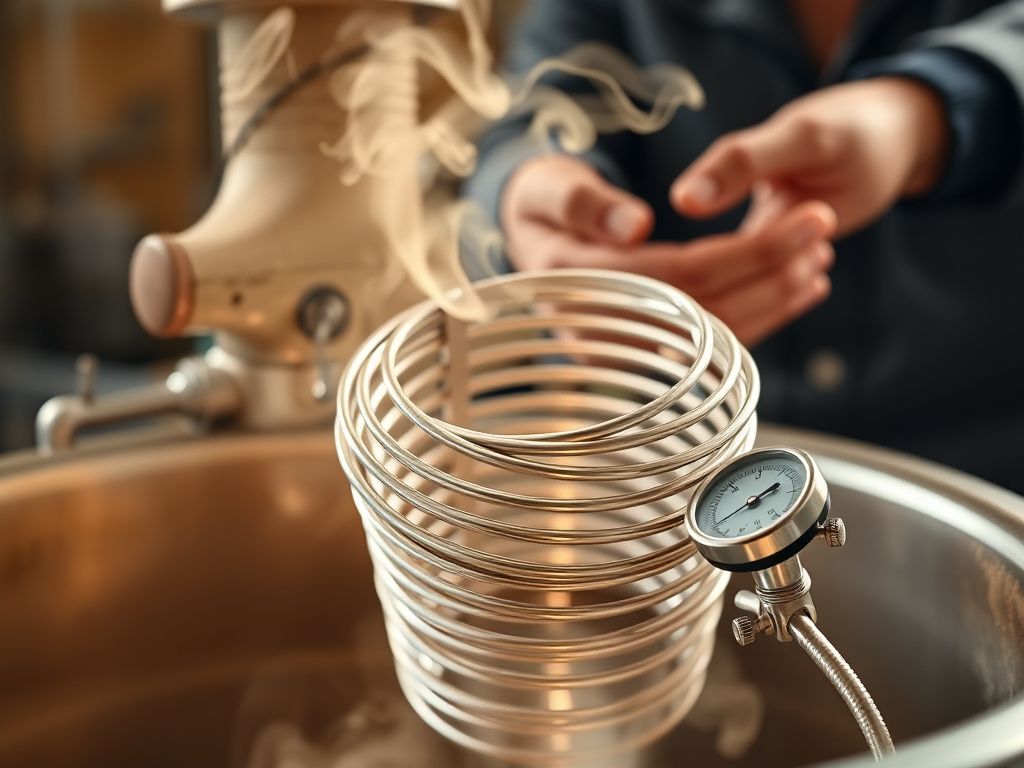
How counterflow chillers work: A counterflow chiller (CFC) passes hot wort through an inner tube while cold water flows in the opposite direction through the outer jacket, this counter-directional flow maximises heat exchange efficiency. The wort exits the CFC already chilled to pitching temperature without stopping the flow. This is fundamentally different from an immersion chiller, which sits in the kettle in stagnant wort and relies on convection and stirring. Counterflow advantages: chilling happens as wort moves from kettle to fermenter, no standing and waiting. Faster chill time (8–15 minutes vs. 30–60 minutes for immersion). Better cold break formation (proteins precipitate more completely with rapid chilling). Closed transfer: wort moves directly from kettle to fermenter without open-air exposure, reducing contamination and oxidation risk. Counterflow disadvantages: requires a pump to move wort (gravity flow alone is too slow through the CFC restriction). More complex setup, hoses, pump, connections. More to clean and sanitise. Higher cost than equivalent immersion chillers. Top 5 counterflow chillers for homebrewers: 1. Duda Diesel Copper Counterflow Chiller (25-foot): The most popular entry-level counterflow chiller. 25 feet of 1/2″ copper inner tube with garden hose fittings. Price: USD 60–90 (₹5,000–₹7,500). Very effective for 20–25L batch sizes. Easy to connect with standard garden hose and pump. Widely available via Amazon US. Not available directly in India but importable. 2. Exchilerator MAXX Counterflow Chiller: Premium copper counterflow with improved flow characteristics. Price: USD 120–160. Higher throughput than basic Duda. Better build quality and longer-lasting copper. 3. Spike Brewing Counterflow Chiller: Stainless steel outer jacket, premium build quality, easier to clean and sanitise than copper. Tri-clamp fittings for clean brew setup integration. Price: USD 250–350. Best for serious brewers with stainless brew systems. 4. Shirron Plate Chiller: Plate chiller design (brazed stainless steel plates) rather than traditional tube-in-tube. Very compact, extremely efficient (chill 20L in 5–7 minutes). Price: USD 90–130. Requires careful cleaning after each use (hop material and proteins can clog the tight channels). 5. Northern Brewer Therminator Plate Chiller: Similar to Shirron, brazed plate design, compact, very effective. Price: USD 150–180. One of the most popular homebrew chillers in the US. Counterflow vs. plate chiller comparison: Traditional counterflow (tube-in-tube): easier to clean, handles unfiltered wort well (hops won’t clog it), slightly less efficient than plate chillers. Plate chiller: more compact, faster chilling, harder to clean, can clog with dry hop matter, best used with a hop spider or filtered wort. DIY counterflow chiller for Indian homebrewers: Counterflow chillers are straightforward to build from plumbing supplies available in India: 7–10 metres of 12mm copper tube (from plumbing supply stores, ₹600–₹1,000). Garden hose or silicone hose for the outer jacket. End caps and fittings from plumbing supply. Total DIY cost: ₹1,500–₹3,000 versus USD 60–90 (₹5,000–₹7,500) for the Duda Diesel imported. The DIY approach produces a functional counterflow chiller at 30–50% of import cost. Pump requirement: A counterflow chiller requires a pump to move wort from the kettle through the chiller to the fermenter. Food-grade magnetic drive pumps (March 809 or equivalent, or local Indian aquarium-rated pumps for smaller batches) are needed. A pump costs USD 80–150 (March 809 imported) or ₹2,000–₹5,000 for Indian-sourced alternatives.
Common Questions
Should I get a counterflow or plate chiller, and what’s the best choice for Indian homebrewers?
Counterflow vs. plate chiller is a genuine functional choice with different strengths, the best option depends on your batch size, how you handle hops, and how much time you’re willing to invest in cleaning. The objective comparison: counterflow chillers (tube-in-tube): larger internal flow path means hop pellets, trub, and whole hops pass through without clogging. Easy to clean by flushing with hot water then sanitiser solution before and after use. Slightly slower than plate chillers (10–15 minutes for 25L vs. 5–8 minutes for plate). Heavier and bulkier. Better for brewers who use lots of hops or don’t filter their wort. Plate chillers: more compact and efficient, faster chill time, higher heat exchange area. Hop matter, protein chunks, and cold break material can clog the tight channels between plates. Requires careful cleaning (backflush with hot water immediately after use, do not allow proteins and hop matter to dry in the plates). Better for brewers who use a hop filter or whirlpool to clarify wort before chilling. Recommendation by brewing style: Heavy dry hop or whole hop user: counterflow. Hoppy beers without pre-filtering: counterflow. Lager brewer wanting fastest possible chill: plate chiller (use a hop spider during the boil). Space-constrained: plate chiller (significantly more compact). Indian market recommendation: for Indian homebrewers, the most practical option is to build a DIY counterflow chiller from local copper plumbing supplies, ₹1,500–₹3,000 total, equivalent performance to imported models, no customs duty. This is the cheapest route to counterflow chilling and produces excellent results. Copper counterflow is the traditional choice for homebrewers and works exceptionally well for 15–25L batch sizes. If you want a purchased option: the Duda Diesel 25-foot copper counterflow (importable from Amazon US, approximately ₹7,000–₹9,000 landed) is the best value import for this application.