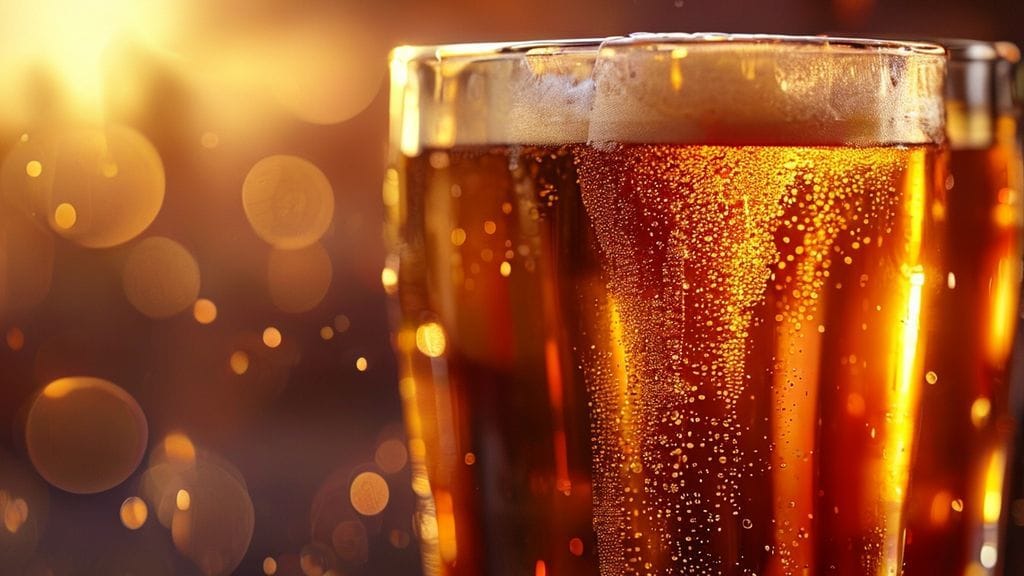
Barleywine, a beer style revered for its strength and complexity, fundamentally diverges into American and English archetypes. The English variant champions malt-forward richness, dried fruit esters, and a warming alcohol presence with subdued bitterness. In stark contrast, the American Barleywine aggressively balances potent malt character with significant hop bitterness and aroma, presenting a bolder, often resinous profile.
| Metric | English Barleywine | American Barleywine |
|---|---|---|
| Original Gravity (OG) | 1.080 – 1.120+ | 1.080 – 1.120+ |
| Final Gravity (FG) | 1.018 – 1.030 | 1.010 – 1.020 |
| Alcohol By Volume (ABV) | 8.0% – 12.0%+ | 8.0% – 12.0%+ |
| International Bitterness Units (IBU) | 35 – 65 | 60 – 100+ |
| Standard Reference Method (SRM) | 8 – 22 (Golden to Dark Copper) | 10 – 19 (Copper to Light Brown) |
| Fermentation Temp. | 18°C – 22°C (64°F – 72°F) | 17°C – 20°C (62°F – 68°F) |
| Malt Focus | Rich, complex, toffee, bread, dried fruit | Strong malty backbone, less caramel, often drier finish |
| Hop Focus | Minimal aroma, balancing bitterness, earthy/floral (Noble) | Aggressive aroma/flavor, citrus, pine, resin (C-hops) |
| Yeast Character | High ester production, fruity, phenolic notes (often) | Clean, attenuative, allowing malt/hop expression |
The Brewer’s Hook: Embracing the Big Beer Divide
When I first dipped my toes into the heady waters of brewing strong ales, the concept of a “Barleywine” felt almost mythical. I remember brewing my inaugural batch, attempting to straddle the line, thinking I could make a universally appealing strong ale. What I ended up with was a confused beast – too bitter for an English purist, not hoppy enough for an American hop-head. It was a pivotal moment for me; I realized that understanding the fundamental stylistic distinctions wasn’t just about ticking boxes, it was about deliberate ingredient selection, process manipulation, and a clear vision for the final product. My journey since then has been a deep dive into appreciating the unique characteristics of each style, learning to craft them with precision and intent. I’ve ruined batches, sure, but each one was a lesson in how tiny adjustments in the brew house can lead to vastly different, yet equally magnificent, beers.
The Math: Crafting the Backbone of Your Barleywine
Brewing Barleywine isn’t just about throwing a lot of grain into a kettle; it’s about precise calculations to achieve specific gravity, alcohol content, and the delicate balance of flavor. Here’s how I approach the numbers, focusing on the distinct profiles for American and English styles.
Malt Bill Formulation (Typical Percentages)
My approach to the grist fundamentally shifts based on whether I’m chasing a robust American profile or a complex English one.
| Malt Type | English Barleywine (%) | American Barleywine (%) |
|---|---|---|
| Pale Malt (Maris Otter for English, 2-Row for American) | 80-90% | 75-85% |
| Crystal/Caramel Malt (40-120L) | 5-15% (Often higher L for richer color/flavor) | 5-10% (Often lower L for cleaner sweetness) |
| Biscuit/Amber Malt | 2-5% (For biscuity/toasty notes) | 0-3% (If seeking some complexity without sweetness) |
| Specialty Malt (e.g., Victory, Munich) | 0-3% (For added depth) | 0-5% (For color or specific malt notes) |
| Adjuncts (Dextrose/Corn Sugar) | 0-5% (Rarely for attenuation) | 2-10% (Commonly used to boost ABV without adding body) |
For an English Barleywine, I lean heavily into Maris Otter for its inherent biscuity, bready character. I might use a blend of Crystal 60L and 120L to build layers of dried fruit and toffee. For an American version, I typically start with a clean 2-Row base and use less crystal malt, often aiming for 40L or 60L to provide just enough caramel sweetness to support the hops without cloying.
IBU Calculation and Hop Balance
The bitterness calculation is crucial for defining the style. I use the following simplified formula for estimating bitterness contribution, though in practice, I rely on brewing software for precision:
$$ \text{IBU} = (\text{Utilization} \times (\text{Alpha Acid \%} \times \text{Weight in grams})) / (\text{Volume in liters} \times 10) $$
* **English Barleywine:** I target an IBU range of 35-65. My bitterness additions are typically a single charge of a traditional hop like East Kent Goldings or Fuggle at 60 minutes, aiming for balance, not dominance. For example, to hit 45 IBU in 20 liters with 5% AA hops and 25% utilization:
* `45 = (0.25 * (0.05 * X)) / (20 * 10)`
* `45 = (0.25 * 0.05 * X) / 200`
* `45 * 200 = 0.0125 * X`
* `9000 = 0.0125 * X`
* `X = 720 grams` (This is a simplified calculation and demonstrates the significant hop quantity needed for high IBUs, or why higher alpha acid hops are preferred). More realistically, using a 10% AA hop, you’d need less. My point is, I dial in for a specific bitterness, not just ‘some hops.’
* **American Barleywine:** Here, my target is 60-100+ IBU. I’ll use high alpha acid hops like Chinook, Centennial, or Columbus for bittering (60-minute addition). Then I layer in significant flavor (20-10 minute additions) and aroma (flameout/whirlpool and dry-hopping) additions of citrusy, piney, or resinous hops. It’s about a calculated hop assault. I might use an early addition of 1.5 oz (42g) of Chinook (13% AA) for bittering, followed by 2 oz (56g) of Centennial (10% AA) at 15 minutes, and then 3 oz (84g) of Simcoe (13% AA) as a whirlpool addition. The sheer volume and timing differentiate it significantly.
ABV Calculation
This is standard across both styles, but crucial for ensuring you hit your target potency.
$$ \text{ABV} = (\text{OG} – \text{FG}) \times 131.25 $$
For a beer with an OG of 1.100 and an FG of 1.020, my ABV would be:
`ABV = (1.100 – 1.020) * 131.25 = 0.080 * 131.25 = 10.5%`
Step-by-Step Execution: Bringing Your Barleywine to Life
Brewing Barleywine is a marathon, not a sprint. Every step needs careful consideration due to the high gravity and extended conditioning periods.
Malt Selection & Milling
- **English Barleywine:** I opt for high-quality Maris Otter as my base malt, making up 80-90% of the grist. I might include 5-15% crystal malts (60-120L) for color, body, and dried fruit notes, and perhaps a touch of biscuit or amber malt. I ensure a fine crush to maximize extract efficiency.
- **American Barleywine:** My base is typically a clean, two-row pale malt (75-85%). I keep crystal malt additions lower, usually 5-10% of 40-60L, to avoid excessive sweetness that could clash with the hops. Sometimes, I’ll add 2-10% dextrose or corn sugar to boost attenuation and ABV without adding body, ensuring a drier finish.
Mashing
- **English Barleywine:** I often employ a single infusion mash at a slightly higher temperature, typically **68°C (154°F)** for **90 minutes**. This promotes a richer, less fermentable wort, contributing to a fuller body and residual sweetness characteristic of the style. I’ve found this temperature range yields more dextrins.
- **American Barleywine:** I target a slightly lower mash temperature, around **65°C (149°F)** for **90 minutes**. This encourages higher fermentability, leading to a drier finish which allows the aggressive hop character to shine without being cloying. I’m always chasing that balance between malt strength and hop bitterness.
Lautering & Sparge
- High gravity mashes can be notoriously slow. I take my time, recirculating until the runnings are clear. I sparge slowly with water at **77°C (170°F)**, aiming for a consistent flow rate to avoid compacting the grain bed and a stuck sparge. Efficiency is key; I aim for at least 75-80% extract efficiency for these large grain bills.
Boil
- **Duration:** I typically boil for **90-120 minutes** for Barleywines. This helps achieve a higher gravity through evaporation and contributes to desired color and melanoidin development. For American Barleywines, a longer boil also helps isomerize more hop acids.
- **Hop Additions:**
- **English:** A single bittering addition of a traditional hop (e.g., East Kent Goldings, Fuggle) at **60 minutes** is often sufficient. I’m looking for a balancing bitterness, not a dominant hop flavor. Total IBUs often range from 35-65.
- **American:** Multiple hop additions are the norm. I’ll make a substantial bittering addition (e.g., Chinook, Magnum) at **60 minutes** to hit 60-100+ IBUs. Then, I’ll layer in flavor hops (e.g., Centennial, Cascade) at **20-10 minutes**, and finally, significant aroma additions at **flameout/whirlpool**. Dry hopping is almost always a part of my American Barleywine regimen, adding up to 2-4 oz (56-112g) per 5 gallons (19L) for a vibrant hop bouquet.
- **Clarity:** I use a fining agent like Irish Moss or whirlfloc during the last 15 minutes of the boil to promote trub compaction.
Chilling & Aeration
- Rapid chilling to my target fermentation temperature is critical to prevent off-flavors. Once chilled, proper aeration is non-negotiable for high-gravity worts. I use pure oxygen with a diffusion stone for **60-90 seconds** at a flow rate of 1 liter per minute, ensuring optimal yeast health. A strong, healthy yeast pitch is paramount for these big beers.
Fermentation
- **Yeast Pitch Rate:** For a 1.100 OG wort, I pitch at least **1 million cells/mL/°Plato**, which often means a 2-3 liter yeast starter for a 5-gallon batch, or multiple packets of liquid yeast. Underpitching is a common pitfall.
- **Temperature Control:**
- **English:** I ferment warmer, **18°C – 22°C (64°F – 72°F)**, to encourage the ester production characteristic of the style.
- **American:** I keep fermentation cooler, **17°C – 20°C (62°F – 68°F)**, using a cleaner attenuating yeast to let the malt and hop character dominate.
- **Primary vs. Secondary:** After 2-3 weeks in primary, once fermentation is complete (indicated by stable FG over several days), I transfer to a secondary fermenter or keg for conditioning. This minimizes yeast autolysis and allows the beer to clean up.
Conditioning & Aging
- Barleywines demand patience. I typically condition for **2-4 months** at cellar temperatures before packaging. Once packaged, they truly shine with age. I’ve found English Barleywines benefit immensely from 6-12 months, or even years, in the bottle, developing sherry-like complexity. American versions can be enjoyed younger, but also evolve gracefully over 3-6 months as the hop bitterness mellows and integrates with the malt. I store them in a cool, dark place, ideally around **10°C-15°C (50°F-59°F)**.
Troubleshooting: What Can Go Wrong and How I Fix It
Brewing high-gravity beers like Barleywine presents unique challenges. Here’s what I’ve encountered and my usual remedies:
- **Stuck Fermentation / Under-attenuation:** This is common with dense worts.
- **My Fix:** First, ensure a massive, healthy yeast pitch. If fermentation stalls, I’ll gently rouse the yeast by swirling the fermenter. If that fails, I’ll pitch a fresh, highly attenuative yeast strain (e.g., a champagne yeast or a robust American ale yeast) as a “clean-up crew.” Increasing the fermentation temperature by a few degrees (e.g., to 22°C/72°F) can also kickstart a sluggish fermentation.
- **Oxidation:** Barleywines are meant for aging, making them extremely susceptible to oxidation, which can manifest as sherry or cardboard notes.
- **My Fix:** I minimize oxygen exposure at every step after chilling. Closed transfers, purging kegs/bottles with CO2, and careful packaging practices are non-negotiable. I use oxygen barrier caps for bottling. This is one area where I never compromise; it can ruin months of work. You can find more tips on oxidation prevention at BrewMyBeer.online.
- **Harsh Bitterness (American Barleywine):** Sometimes the hop character can be overwhelmingly astringent, especially when young.
- **My Fix:** Aging helps significantly. Over time, the harshness mellows. I also adjust my water chemistry; reducing sulfate levels if they are too high can mitigate perceived bitterness. Ensuring a proper mash pH (typically 5.2-5.4) can also prevent polyphenolic extraction from the husks, which can contribute astringency.
- **Diacetyl (Buttery off-flavor):** Can occur if yeast doesn’t have enough time to clean up diacetyl precursors.
- **My Fix:** I always include a diacetyl rest. After primary fermentation slows, I’ll raise the temperature by 2-3°C (3-5°F) for 2-3 days before crashing. A healthy yeast pitch and sufficient contact time are the best defenses.
- **Lack of Body/Thinness:** Can happen if too much fermentable sugar is produced or adjuncts are overused.
- **My Fix:** For my next batch, I’ll adjust my mash temperature slightly higher (e.g., from 65°C to 68°C) to produce more unfermentable dextrins. I’ll also re-evaluate my adjunct usage, reducing simple sugars if they were too prominent. Using malts like Carapils or Vienna can also contribute to body without excessive sweetness.
Sensory Analysis: The Heart and Soul of Barleywine
This is where the true character of each style shines through, differentiating them in distinct and beautiful ways.
English Barleywine
- **Appearance:** Often deep copper to mahogany, sometimes with ruby highlights. It should be clear, though aging can introduce a slight haze. A thick, off-white to tan head, often with moderate retention, is typical.
- **Aroma:** A rich, complex bouquet of dried fruit (raisins, plums, figs), caramel, toffee, and bready malt. Esters from the English ale yeast contribute notes of stone fruit and marmalade. There’s a distinct warming alcoholic presence, often resembling sherry or port, especially with age. Hop aroma is minimal, possibly earthy or floral from traditional hops.
- **Mouthfeel:** Full-bodied, chewy, and viscous. It has a smooth, warming alcoholic sensation without harshness. Carbonation is typically moderate to low, allowing the malt richness to dominate. It can have a slight stickiness or residual sweetness.
- **Flavor:** A powerful assertion of malt complexity. Layers of rich caramel, treacle, toffee, and toasted bread. The dried fruit notes from the aroma carry through strongly, often with sherry-like oxidation characters in aged examples. Hop bitterness is present but balanced, providing just enough counterpoint to the sweetness. The finish is long, complex, and warming, with a lingering sweetness and fruitiness.
American Barleywine
- **Appearance:** Ranges from golden amber to medium copper, typically brighter than its English cousin. It should also be clear, with a persistent, off-white head that can sometimes be quite dense due to the higher hopping rates.
- **Aroma:** Dominated by a bold interplay of hops and malt. Expect significant hop aroma – citrus (grapefruit, orange), pine, resin, and sometimes tropical fruit notes from modern hop varieties. The malt provides a strong backbone of caramel, toasted bread, and sometimes a hint of biscuit, but it often plays a supporting role to the hops. A clean, alcoholic warmth is present.
- **Mouthfeel:** Full-bodied, but often with a drier finish than its English counterpart due to higher attenuation and hop bitterness. The carbonation can be slightly higher, adding a crispness that cuts through the richness. The alcoholic warmth is evident and can be quite pronounced, sometimes verging on a pleasant prickle.
- **Flavor:** A powerful fusion of intense hop bitterness and robust malt sweetness. The hop character mirrors the aroma, bringing forth assertive notes of citrus peel, pine needles, and dank resin. The malt provides a firm foundation of caramel, toasted sugars, and sometimes a subtle nuttiness, but it’s often drier and less fruity than an English Barleywine. The finish is long, bitter, and often has a distinct hop lingering, occasionally with a slight alcoholic bite that mellows with age.
Frequently Asked Questions About Barleywine
Why is aging so important for Barleywine, especially English versions?
Aging is critical for Barleywines because their high alcohol content and complex malt bills benefit from significant time for flavors to meld and mature. For English Barleywines, this means developing sherry-like notes, dried fruit complexity, and a smoother mouthfeel as hop bitterness fades and malt flavors deepen. American versions also benefit from aging as the aggressive hop character softens and integrates, allowing the malt backbone to shine through more elegantly. Over time, harsh alcohol notes mellow, and new esters and oxidation products (when controlled) contribute to a more nuanced profile. I rarely bottle condition mine for less than three months, and often much longer for my English variants.
Can I use the same yeast for both American and English Barleywine?
While you *can* use a generic ale yeast for both, I strongly advise against it if you’re aiming for stylistic accuracy. English Barleywines thrive with traditional English ale yeasts that produce significant esters and contribute to their fruity, bready character, often with a lower attenuation. For American Barleywines, I typically choose a cleaner, more attenuative American ale yeast that allows the pronounced malt and hop profile to take center stage without a lot of competing yeast esters. Selecting the right yeast is paramount to achieving the desired flavor profile. You can explore various yeast strains and their profiles at BrewMyBeer.online.
What’s the ideal serving temperature for a Barleywine?
Barleywines, like fine spirits, are best served at cellar temperature, typically **10°C – 15°C (50°F – 59°F)**. Serving too cold will mute the intricate malt complexities and delicate hop nuances. Serving too warm can emphasize the alcoholic harshness. I pull my bottles from the cellar about 20-30 minutes before pouring, allowing them to warm slightly in the glass to reveal their full spectrum of aromas and flavors.
How do I manage hop bitterness in an American Barleywine without it being overly harsh or astringent?
Achieving aggressive bitterness without harshness in an American Barleywine involves several strategies I’ve honed over the years. First, focus on clean bittering hops like Magnum or Warrior for your 60-minute addition; these provide high alpha acids with minimal vegetal character. Second, ensure your mash pH is within the optimal range of 5.2-5.4 to prevent excessive tannin extraction. Third, consider using a portion of dextrose or corn sugar in your fermentables to increase attenuation, which results in a drier finish that better supports the high bitterness. Lastly, adequate aging is your friend; it will smooth out any initial harshness, allowing the bitterness to integrate more gracefully with the robust malt profile.