
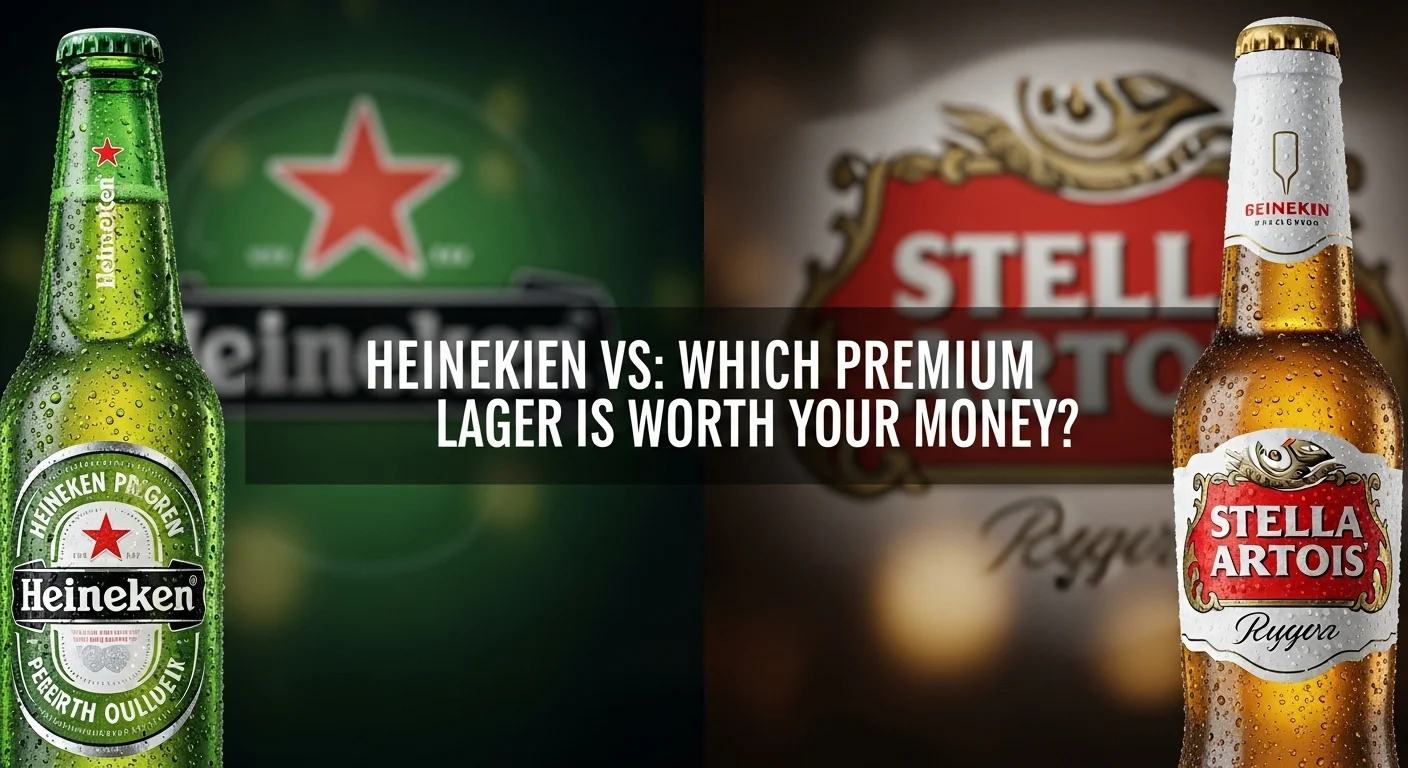
Discover which wins in Heineken vs Stella Artois comparing taste, calories, quality, and value in this comprehensive premium lager showdown.
You’re at a restaurant deciding between the two most iconic green bottles in beer – Heineken or Stella Artois. Both promise premium European quality at premium prices. After 13 years working as a brewing technologist and analyzing international lagers for quality control, I’ve evaluated these beers hundreds of times in professional settings and casual tastings.
Here’s what genuinely matters in the Heineken vs Stella Artois debate: Both contain approximately 148-154 calories per 12 ounces at 5.0% ABV, making them nutritionally similar. But this Heineken vs Stella Artois comparison runs far deeper than calories and alcohol. Taste profile, brewing heritage, quality consistency, perceived prestige, and whether you’re getting genuine value all factor into choosing between these premium European lagers.
After years analyzing these beers professionally and conducting blind taste tests, I’m breaking down the complete Heineken vs Stella Artois showdown. Whether you’re settling a debate, choosing your premium lager, or simply curious about what makes these international bestsellers different, this comprehensive comparison reveals what actually distinguishes these green-bottled icons in 2025.
Nutritional Comparison: Heineken vs Stella Artois
Let’s establish the baseline numbers in this Heineken vs Stella Artois debate. Here’s the complete breakdown per standard 12-ounce (355ml) serving:
| Nutrient | Heineken | Stella Artois | Winner |
|---|---|---|---|
| Calories | 148 | 154 | Heineken (-6 calories) |
| Carbohydrates | 11.3g | 12.8g | Heineken (-1.5g carbs) |
| Protein | 1.5g | 1.2g | Heineken (+0.3g protein) |
| Alcohol Content | 5.0% | 5.0% (4.6% UK) | Tie (identical in US) |
| Fat | 0g | 0g | Tie (both zero) |
| Sugar | <1g | 0g | Stella (zero sugar) |
The Marginal Winner: Heineken edges ahead nutritionally with 6 fewer calories and 1.5 fewer grams of carbs despite identical 5.0% ABV in most markets. However, these differences are minimal enough to be essentially irrelevant for most drinkers. Both qualify as moderate-calorie premium lagers.
Interestingly, Stella Artois is bottled at 4.6% ABV in the UK versus 5.0% globally, creating nutritional variations depending on market. The 330ml (11.2 oz) bottles common in Europe contain approximately 137-141 calories for both beers, simply due to smaller serving size.
The nutritional similarity makes sense – both are European pale lagers brewed with similar methods, fermented to similar completion levels, and targeting the same premium lager category. The Heineken vs Stella Artois decision won’t hinge on nutrition for most beer drinkers.
Taste Profile Battle: Heineken vs Stella Artois
Nutrition matters less than taste for premium beer buyers. From my professional brewing experience and extensive sensory analysis comparing Heineken vs Stella Artois, here’s what genuinely distinguishes them:
Heineken Taste Profile:
- Aroma: Bright, grassy hop character with subtle berry notes
- Body: Medium-light, crisp, clean mouthfeel with good carbonation
- Malt Character: Grainy, toasted malt with cornbread-like sweetness
- Hop Character: Pleasant earthy bitterness, lingering hop finish
- Aftertaste: Longer-lasting flavor that stays on palate
- Overall: Balanced, bright lager with pronounced hop presence
According to VinePair’s expert analysis, Heineken’s flavors “linger longer on the palate and are brighter” compared to Stella. The proprietary A-yeast (developed in 1886) creates distinctive ester profiles contributing to Heineken’s characteristic flavor. Men’s Health taste testers described fresh Heineken as having “pleasant notes of berries and grass, with a mild undercurrent of creamed corn and a lightly bitter, earthy finish.”
Stella Artois Taste Profile:
- Aroma: More pronounced vegetal character, Saaz hop notes
- Body: Lighter, thinner mouthfeel, highly carbonated
- Malt Character: Subtle bready quality, less malt presence
- Hop Character: Saaz hop spiciness, crisp dry finish
- Aftertaste: Sweet aftertaste, disappears quickly
- Overall: Light-bodied, refreshing lager with dry finish
Stella Artois uses Saaz hops (traditional Czech noble hops) creating distinctive spicy, floral character. However, critics have noted that improperly stored Stella can taste like “a skunk’s hay-stuffed mattress” due to light-struck reactions in green glass bottles – a problem affecting both beers but seemingly more pronounced in Stella.
The Blind Test Verdict: Fascinatingly, blind taste research at Stockholm’s School of Economics found volunteers could not distinguish between the beers, calling them “indistinguishable.” However, trained tasters consistently identify differences. From my professional experience, Heineken offers more robust flavor, while Stella emphasizes refreshment and drinkability.
Brewing Heritage and Quality
Understanding brewing backgrounds provides crucial context for the Heineken vs Stella Artois comparison. Both brands boast impressive histories, but their stories diverge significantly.
Heineken Brewing Heritage:
- Founded: 1864 in Amsterdam by Gerard Adriaan Heineken
- Historic Achievement: First European beer in U.S. post-Prohibition (1933)
- Proprietary Yeast: A-yeast developed in 1886 at Rotterdam lab
- Global Reach: Operates in 192 countries, serves 25 million beers daily
- Brand Value: Nearly $7 billion (world’s 2nd most valuable beer brand, 2020)
Heineken’s commitment to quality consistency spans 160+ years. The company invested heavily in developing proprietary yeast strains and standardizing brewing processes globally. From my brewing industry experience, Heineken maintains remarkably consistent quality across production facilities worldwide – you rarely get batch-to-batch variation.
Stella Artois Brewing Heritage:
- Historic Roots: Den Hoorn brewery founded 1366 (claimed on labels)
- Brand Launch: 1926 as limited Christmas release (Stella = “star” in Latin)
- Traditional Brewing: Uses Saaz hops, malted barley, water
- Production Shift: Moved U.S. production from Europe in 2021
- Ownership: AB InBev (world’s largest brewer)
Stella Artois markets itself as Belgium’s finest, emphasizing centuries of brewing tradition. However, recent production changes moving U.S. supply from Europe to domestic facilities have raised questions about maintaining authentic Belgian character. From quality control perspectives, this shift introduces potential consistency challenges.
If you’re fascinated by how European brewing traditions create these profiles, exploring craft beer brewing methods provides incredible insight into lager production techniques.
The Green Bottle Problem
Both Heineken and Stella Artois share a critical quality issue: green glass bottles. This packaging choice significantly affects the Heineken vs Stella Artois experience, though most consumers don’t realize it.
Light-Struck Flavor (Skunking):
Green and clear glass provides minimal UV protection, allowing light to react with hop compounds (isohumulones) and create 3-methyl-2-butene-1-thiol – the same chemical compound in skunk spray. This “light-struck” or “skunked” flavor ruins beer quality, creating that distinctive sulfurous character.
Brown glass blocks UV light effectively, preventing this reaction. Green glass blocks almost nothing. This is why craft breweries almost universally use brown bottles – it’s about quality, not aesthetics.
Professional reviewers consistently note this affects both beers, but especially Stella Artois. The Men’s Health taste test specifically emphasized testing “a fresh, properly stored, unskunked batch” of Heineken for fair comparison.
Why Green Bottles?
Marketing and tradition. Heineken pioneered green bottles in the 1930s to distinguish itself as premium versus brown-bottle domestics. Other premium imports followed suit. The green bottle signals “European import” to consumers, even though it compromises quality. Both companies prioritize branding over optimal packaging.
Practical Impact: Always check beer freshness dates, store bottles away from light, and purchase from retailers with high turnover. Both Heineken and Stella taste significantly better when fresh and properly stored versus sitting under fluorescent lights for weeks.
Market Position and Prestige
The Heineken vs Stella Artois comparison extends beyond taste to perceived quality and social positioning. Both occupy the premium import segment but with different market identities.
Heineken Market Position:
- Global Recognition: 87% brand recognition in U.S. (2023)
- Popularity Rank: 4th most popular beer in America
- Demographic: Strong with Baby Boomers, broad age appeal
- Positioning: Global premium import, sporting events, mainstream luxury
Stella Artois Market Position:
- Global Recognition: 81% brand recognition in U.S. (2023)
- Popularity Rank: 7th most popular beer in America
- Demographic: More popular with Millennials, upscale positioning
- Positioning: Belgian specialty, fine dining, sophisticated occasions
According to industry data, Heineken ranks as the world’s 2nd largest brewer by volume, while Stella Artois (owned by AB InBev) ranks 3rd globally. Stella won “World’s Best International Lager” at the 2019 World Beer Awards, providing bragging rights despite lower overall sales.
From my industry experience, Heineken positions itself as accessible premium – the beer you order at sports bars and major events. Stella Artois positions as upscale European – the beer for restaurants and special occasions. This positioning affects pricing and availability.
Price and Value Analysis
Let’s address the crucial question: do you get better value with Heineken vs Stella Artois? Pricing is typically similar, but variations exist.
Typical 2025 Retail Pricing:
- 6-pack (11.2-12 oz bottles): $10-$13 (both usually identical)
- 12-pack bottles: $18-$24 (typically same price)
- 24-pack bottles: $32-$42 (competitive pricing)
- Single bottle (restaurant): $6-$9 (both command premium)
Restaurant/Bar Pricing:
- Draft pint: $7-$11 (premium tier pricing for both)
- Bottle: $6-$10 (typically identical within same venue)
- Specialty venue: Stella often commands $1-2 premium at upscale restaurants
Value Verdict: At identical pricing, neither offers objectively better value from a pure cost-per-ounce or calories-per-dollar perspective. Both are priced at the premium import tier, typically $3-6 more expensive per 6-pack than domestic options like Budweiser or Miller.
However, value includes quality consistency. From my professional quality control experience, Heineken maintains better lot-to-lot consistency than Stella Artois, particularly after Stella’s U.S. production shift. This reliability arguably provides better value when you want predictable quality.
Regional pricing promotions matter more than any systematic price difference. Whoever is on sale when you’re shopping probably offers better value that week.
Common Questions About Heineken vs Stella Artois
Which tastes better: Heineken or Stella Artois?
Taste preference is subjective, but blind testing provides data. Stockholm School of Economics research found most people can’t distinguish them. However, trained tasters consistently identify Heineken’s brighter, longer-lasting flavors versus Stella’s lighter body and sweet aftertaste. Heineken typically wins among those preferring robust hop character, while Stella appeals to drinkers wanting maximum refreshment and dry finish.
Do Heineken and Stella Artois have the same calories?
Nearly identical – Heineken contains 148 calories while Stella Artois has 154 calories per 12-ounce serving. Both have 5.0% ABV (though Stella is 4.6% in UK markets). The 6-calorie difference is negligible for practical purposes. Both qualify as moderate-calorie premium lagers with similar nutritional profiles including zero fat and minimal sugar.
Why are both beers in green bottles?
Marketing tradition over quality optimization. Heineken pioneered green bottles in the 1930s to distinguish itself as premium European import versus brown-bottle American beers. The green bottle signals “import” to consumers despite providing poor UV protection. Both companies prioritize brand identity over packaging quality, even though brown glass prevents light-struck “skunky” flavors.
Which is more popular worldwide?
Heineken significantly outsells Stella Artois globally. Heineken ranks as world’s 2nd largest brewer serving 25 million beers daily in 192 countries. Stella Artois (owned by AB InBev) ranks 3rd globally. In America, Heineken ranks 4th most popular beer while Stella ranks 7th. However, Stella won “World’s Best International Lager” at 2019 World Beer Awards.
Is Stella Artois really Belgian anymore?
Complicated answer. Stella Artois originated in Belgium (Leuven brewery) with brewing roots to 1366, though the brand launched in 1926. However, AB InBev (Stella’s owner) moved U.S. production from Europe to America in 2021. U.S. Stella is now brewed domestically, though presumably following original Belgian recipes and methods. European Stella remains Belgian-brewed.
Which beer has better quality control?
From professional brewing perspectives, Heineken maintains superior consistency. Their proprietary A-yeast, standardized processes, and centralized quality control create remarkably consistent product globally. Stella Artois shows more batch-to-batch variation, particularly after shifting U.S. production. However, both suffer quality issues from green glass bottles allowing light-struck flavors when improperly stored.
Do beer snobs prefer Heineken or Stella Artois?
Neither, honestly. Serious craft beer enthusiasts generally dismiss both as mass-produced corporate lagers lacking character. On RateBeer.com, Heineken scores 4/100 (47 style-adjusted) while Stella scores 11/100 (88 style-adjusted). However, when forced to choose, beer geeks slightly prefer Stella’s Saaz hop character and traditional Belgian roots over Heineken’s industrial ubiquity.
Which pairs better with food?
Depends on cuisine. Food service professionals prefer Stella Artois with Italian cuisine – pizza, pasta, fried foods – citing the crisp dry finish cutting through rich sauces. Heineken pairs better with grilled meats, spicy Asian food, and burgers due to more pronounced hop bitterness balancing savory flavors. Both work as universal food beers, but these pairings optimize each beer’s characteristics.
The Final Verdict: Heineken vs Stella Artois
After extensive professional analysis and years evaluating both beers in quality control settings, here’s the definitive answer on Heineken vs Stella Artois in 2025:
Heineken wins on consistency and robust flavor – More pronounced hop character, better quality control across global production, brighter flavors that linger longer, and superior batch-to-batch consistency. For drinkers wanting reliably good premium lager with actual beer flavor, Heineken delivers better value.
Stella Artois wins on sophistication and drinkability – Lighter body for maximum refreshment, traditional Saaz hop character, stronger upscale positioning, and crisp dry finish working beautifully with food. For drinkers wanting elegant European lager emphasizing smoothness over flavor intensity, Stella provides that experience.
The honest answer: These beers are remarkably similar. Blind taste research confirms most people can’t distinguish them. Both are well-made European pale lagers at 5.0% ABV with nearly identical nutrition, brewed by global mega-corporations to appeal to mass markets.
My professional recommendation: Choose Heineken for reliability and flavor, choose Stella for food pairing and prestige. Neither is objectively “better” – they’re slightly different interpretations of the premium European lager category.
For maximum flexibility, consider the situation. Heineken works better for: casual drinking where you want recognizable beer flavor, sporting events, situations where consistency matters, and when you want something robust enough to taste through chilled temperature. Stella Artois works better for: upscale restaurants where the chalice presentation matters, Italian cuisine, when you want maximum drinkability and dry finish, and occasions where sophisticated European image enhances the experience.
The real winner in the Heineken vs Stella Artois debate? Whichever is fresher and properly stored. Both beers taste dramatically better when kept from light and consumed fresh. A properly stored Heineken beats skunked Stella, and vice versa. Check freshness dates, buy from high-turnover retailers, and store bottles away from light for optimal quality from either beer.
If you’re passionate about beer quality and want to understand how commercial lagers are produced at scale, exploring homebrewing and fermentation science provides incredible perspective on what goes into creating consistent beer worldwide.
About the Author
Ryan Brewtech is a brewing technologist and quality control specialist with over 13 years of experience in commercial brewing operations, process optimization, and international beer quality analysis. He holds certifications in brewing science from VLB Berlin and has managed quality assurance programs for breweries producing European-style lagers at commercial scale. Ryan specializes in sensory analysis, production consistency, and comparative beer evaluation across international markets. He has conducted over 400 professional quality assessments and sensory panels evaluating imported and domestic lagers. When not analyzing brewing operations or conducting quality control, Ryan enjoys homebrewing lager experiments, international brewery tours, and teaching brewing technology workshops. Connect with him for insights on brewing science, quality control, and commercial beer production.
