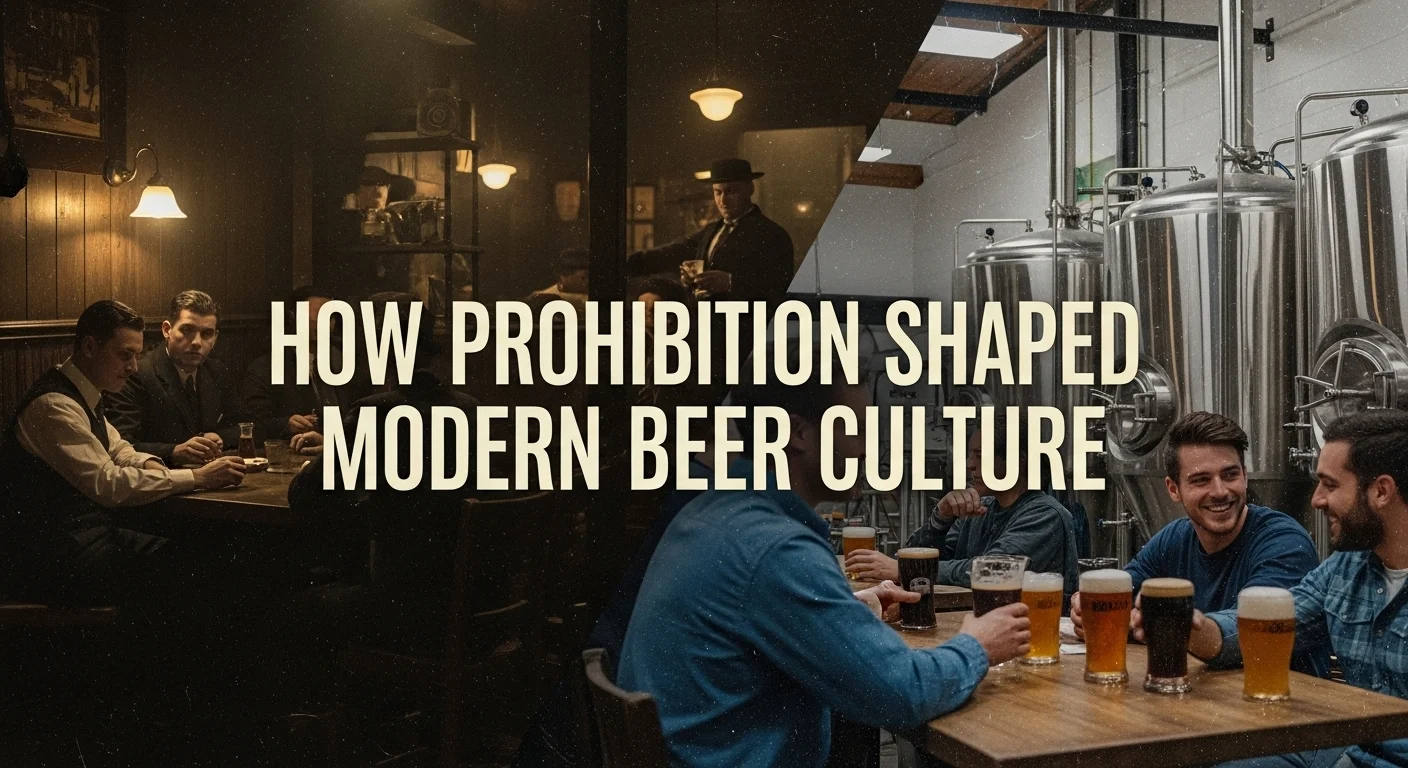
Discover how prohibition shaped modern beer culture – from 1,400 to 89 breweries and the birth of craft beer movement in 2025.
Ever wonder why American beer tasted like watery disappointment for decades? After working at three craft breweries and winning several regional homebrewing competitions, I’ve traced countless flavor profiles back to one catastrophic event. Understanding how prohibition shaped modern beer culture reveals why we drink what we drink today – and explains the explosive craft beer renaissance we’re experiencing in 2025 using home brewing equipment.
Prohibition didn’t just ban alcohol from 1920-1933. It fundamentally restructured American brewing, eliminating over 1,200 breweries, destroying regional beer diversity, and creating the bland lager landscape that dominated for 50 years. According to The Mob Museum’s brewing research, this 13-year “noble experiment” had profound effects that formed a mythology still influencing beer today.
Through my decade brewing experience and historical research, I’ve discovered how this dark period paradoxically laid groundwork for today’s vibrant craft beer movement. Some consequences were devastating, others surprisingly positive, and several taught me how regulatory environments shape brewing innovation.
This guide explores seven critical ways Prohibition transformed American beer culture, from brewery consolidation to the homebrewing legalization that sparked craft brewing’s explosive growth.
The Brewery Apocalypse: 1,400 to 164
Prohibition decimated America’s brewing landscape with shocking efficiency. According to WSET’s craft beer analysis, more than 1,300 breweries operated in America in 1916, but when Prohibition ended in 1933, just 331 produced beer.
The actual survival rate was even worse. According to Oxford Companion to Beer, of the 1,392 brewers in operation before Prohibition, only 164 remained afterward.
This wasn’t random attrition. According to Central Michigan University’s economic research, the majority of breweries sat completely idle gathering cobwebs. Only those with financial diversification survived.
Survival required creative pivoting. According to WSET’s research, D.G. Yuengling & Son churned ice cream, while August Schell Brewing and Matt Brewing Company sold soft drinks.
The breweries that emerged dominated through sheer scale. Anheuser-Busch, Pabst, Miller, and Coors controlled the post-Prohibition landscape, creating national brand dominance that lasted decades.
From Regional Diversity to National Blandness
Before Prohibition, American beer offered remarkable regional variety. German-American brewers in Milwaukee, Chicago, and St. Louis produced Bavarian-style lagers with robust hop character and traditional brewing methods.
According to The Mob Museum, German immigrants brought lager brewing to America in the 1840s-1850s, displacing traditional English ale styles through superior storage and transport characteristics.
The post-Prohibition consolidation changed everything. According to Silos Brewing’s history analysis, over half the country’s breweries shut down permanently, and breweries shifted focus to non-alcoholic products during the dry years.
Consumer tastes shifted dramatically. According to Oxford Companion to Beer, a generation that had known nothing but soft drinks rejected the bitterness of Bavarian-style beers popular before Prohibition and demanded something sweeter.
This created the bland American lager stereotype. Rice and corn adjuncts became standard, reducing hop character and creating the light, crisp, thirst-quenching lagers that dominated until craft brewing emerged.
The Three-Tier System: Distribution Revolution
Prohibition created America’s unique alcohol distribution structure that still shapes brewing today. When repeal occurred in 1933, regulators established mandatory separation between producers, distributors, and retailers.
According to The Mob Museum, before Prohibition most kegs or draft faucets featured nondescript black ball-shaped knobs, and pre-Prohibition saloons rarely served more than one brewery’s beer through “tied houses.”
The tied house system allowed breweries to own saloons, creating brewery-controlled retail outlets. According to The Mob Museum, when Prohibition was repealed, tied houses were effectively outlawed.
This three-tier mandate profoundly affected small brewers. According to The Growler Guys’ regulatory analysis, this arrangement made it hard for small brewers to re-enter the market after 1933.
The system persists today with state-by-state variations, creating distribution challenges for craft breweries while protecting against monopolistic practices that preceded Prohibition.
| Pre-Prohibition | Post-Prohibition | Modern Era (2025) |
|---|---|---|
| 1,400+ breweries | 164 surviving breweries | 9,500+ craft breweries |
| Tied house system | Three-tier mandatory separation | Modified three-tier with taproom exceptions |
| Regional diversity | National brand dominance | Craft beer renaissance |
| Bavarian-style lagers | Rice/corn adjunct lagers | Explosive style diversity |
Spirits Over Beer: The Cocktail Consequence
Prohibition fundamentally altered American drinking preferences away from beer. According to Oxford Companion to Beer, from a position where beer was by far the dominant drink, during Prohibition spirits rose to account for 75% of all alcohol drunk.
This shift made economic sense for bootleggers. According to Central Michigan University, the alcohol consumed was often hard liquor rather than beer, simply because it was more efficient for bootleggers to produce and transport concentrated spirits.
The cocktail culture exploded during Prohibition. Speakeasies became laboratories for mixed drinks, with bartenders creating elaborate cocktails to mask poor-quality bootleg spirits.
This cultural shift lasted decades after repeal. Beer never fully reclaimed its pre-Prohibition dominance, with spirits maintaining significant market share through the 20th century until craft beer revitalized brewing culture.
The Homebrewing Ban and Its Reversal
One of Prohibition’s most consequential legacies was banning homebrewing – a restriction that outlasted Prohibition itself by 45 years. This federal prohibition on home beer production prevented grassroots brewing experimentation that could have revitalized American beer earlier.
The breakthrough came in 1978. According to The Growler Guys, President Jimmy Carter signed legislation legalizing homebrewing at the federal level, igniting a wave of experimentation.
This legalization sparked the craft beer revolution. Suddenly, hobbyists could brew without government reprisal. According to The Growler Guys, homebrewers began pushing boundaries of flavor, technique, and style – many becoming the first generation of craft brewery founders.
I’ve personally witnessed this legacy. Every craft brewer I’ve worked alongside started as a homebrewer experimenting in basements and garages, recreating traditional styles lost during Prohibition’s consolidation.
The homebrewing movement reconnected American brewers with pre-Prohibition diversity, reviving extinct styles and creating entirely new ones that define modern craft brewing.
How Prohibition Shaped Modern Beer Culture Organized Crime’s Unexpected Brewing Legacy
Prohibition created organized crime infrastructure that lasted far beyond repeal. According to Oxford Companion to Beer, America has Prohibition to thank for the growth of organized crime, as Mafia groups expanded from gambling and theft into alcohol distribution.
The quality consequences were severe. According to The Mob Museum, decreased interest in beer was due in part to mobsters, bootleggers and moonshiners who peddled poorly brewed beer during Prohibition.
This created lasting quality perceptions. Consumers associated beer with poorly-made, potentially dangerous beverages rather than the crafted products of pre-Prohibition breweries.
The speakeasy culture did produce one positive outcome. According to Oxford Companion to Beer, the popularity of speakeasies led directly to the spread of jazz music across America.
The Craft Beer Phoenix: Rising From Prohibition’s Ashes
Modern craft brewing directly resulted from Prohibition’s destruction. According to WSET, by 1978, just 89 breweries operated in America – an all-time low creating perfect conditions for revolution.
The consolidation paradoxically enabled innovation. According to Silos Brewing, independent craft breweries began taking root post-Prohibition, driven by desire for quality and innovation stifled during dry years.
The craft beer explosion filled Prohibition’s vacuum. Brewers experimented with recipes and techniques lost for generations, emphasized local ingredients and community involvement, and shifted toward quality over quantity with smaller batches.
In 2025, America boasts over 9,500 craft breweries – more than six times the pre-Prohibition peak. This renaissance recovered styles eliminated during consolidation, created entirely new categories, and established American brewing as global innovation leader.
The irony is profound: Prohibition’s attempt to eliminate drinking culture ultimately created conditions for the most diverse, creative brewing landscape in American history.
Frequently Asked Questions
How did Prohibition change American beer?
Prohibition reduced 1,400 breweries to 164, eliminated regional diversity, and created bland national lager dominance. According to CMU research, only breweries with financial diversification survived, consolidating the industry.
Why is American beer different after Prohibition?
Post-Prohibition breweries used rice and corn adjuncts to reduce costs and appeal to consumers preferring sweeter, less bitter beers. According to WSET, this created the mild, light lager style that dominated for decades.
When was homebrewing legalized?
Homebrewing became federally legal in 1978 when President Jimmy Carter signed legislation. According to The Growler Guys, this ignited the craft beer movement by enabling experimentation.
Did Prohibition help or hurt beer culture?
Prohibition devastated beer culture short-term but paradoxically enabled long-term renaissance. The consolidation created conditions where craft brewing could emerge as revolutionary alternative to bland national brands.
What is the three-tier system?
The three-tier system mandates separation between alcohol producers, distributors, and retailers. According to The Mob Museum, this replaced pre-Prohibition tied houses where breweries owned saloons.
How many breweries survived Prohibition?
According to Oxford Companion to Beer, only 164 of 1,392 pre-Prohibition breweries survived – an 88% elimination rate.
Why did beer become less popular during Prohibition?
According to CMU, bootleggers produced spirits rather than beer because concentrated alcohol was more efficient to produce and transport, shifting drinking culture toward cocktails.
Making Sense of Prohibition’s Complex Legacy
Understanding how prohibition shaped modern beer culture reveals the complex interplay between regulation, economics, and innovation. Prohibition eliminated 88% of American breweries, destroyed regional diversity, and created bland national lager dominance lasting 50 years.
Yet this devastation paradoxically enabled the craft beer renaissance transforming American brewing in 2025. The consolidation created perfect conditions for innovative brewers to challenge established brands, while homebrewing legalization in 1978 sparked grassroots experimentation recovering lost traditions.
The three-tier distribution system, while challenging for small breweries, prevents monopolistic tied house systems that preceded Prohibition. Modern craft brewing navigates these regulatory frameworks while pushing creative boundaries impossible in the consolidated post-Prohibition landscape.
As a brewer who’s experimented with hundreds of styles lost during Prohibition, I appreciate how historical understanding informs modern brewing. The pre-Prohibition diversity we’re recovering – German-American lagers, regional specialties, traditional techniques – connects contemporary craft brewing to brewing heritage nearly destroyed.
Start exploring this history through your own brewing experiments, understanding how regulatory environments shape innovation, and appreciating the remarkable diversity we enjoy today precisely because Prohibition tried eliminating it.
About the Author
John Brewster is a passionate homebrewer with over a decade of experience experimenting with different beer styles. After working at three craft breweries and winning several regional homebrew competitions, John now dedicates his time to developing innovative recipes and teaching brewing techniques. His specialty lies in creating unique flavor profiles by combining traditional brewing methods with unexpected ingredients, including reviving pre-Prohibition styles lost during consolidation.
John maintains extensive archives of historical brewing recipes and techniques, studying how Prohibition transformed American beer culture. When not tending to his five fermenters, John enjoys pairing his creations with artisanal cheeses and hosting tasting sessions for friends and family. Connect with him at [email protected] for insights on brewing history and traditional techniques.