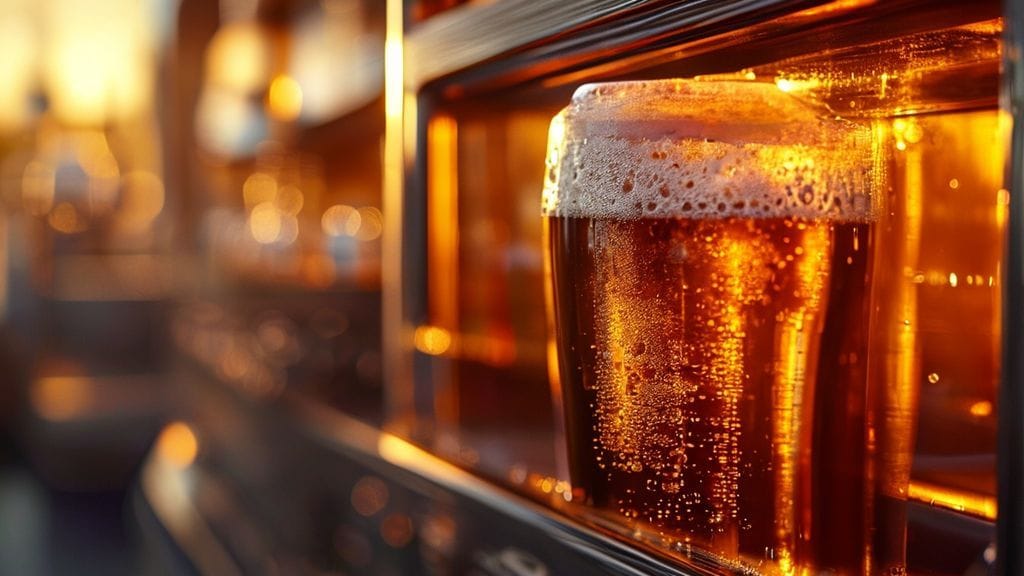
Transforming a standard compact refrigerator into a high-precision fermentation chamber is a game-changer for any serious homebrewer. My 20 years of experience prove that selecting the right unit, focusing on internal volume, insulation, and the potential for modification, directly impacts fermentation stability. This setup ensures optimal yeast performance, eliminating temperature-related off-flavors and elevating your beer’s quality to a professional standard.
| Metric | Optimal Specification | My Recommendation |
|---|---|---|
| Internal Volume (Litres) | 70-120L net capacity | Minimum 90L to accommodate 25L fermenter + airlock/blow-off tube clearance. |
| Temperature Control Range (Internal) | -2°C to 10°C (ideal for lager lagering) | A unit capable of reaching below 0°C is preferred for crash cooling. |
| Max Fermenter Capacity (Typical) | 1x 25L standard fermenter | Confirm internal dimensions for height and diameter, especially if using carboys. |
| Power Consumption (Annual Est.) | < 150 kWh/year (under constant control) | Look for energy efficiency ratings; 100-120W compressor is common. |
| Freezer Compartment | Removable or minimal obstruction | Absolutely critical. A large, non-removable freezer limits useful volume. |
| Noise Level | < 40 dB | Lower dB is better for comfort if located indoors. |
| Investment Range (Estimated) | Mid-range (variable by region/brand) | Prioritize features over absolute lowest cost; this is a long-term investment. |
The Brewer’s Hook: My Journey to Precise Temperature Control
When I first started homebrewing, like many, I fermented in my closet, relying on ambient room temperatures. My early IPAs were often too estery, my lagers tasted like ale, and consistency was a distant dream. I remember one particularly frustrating summer batch where the room hit 30°C, and the resulting beer was a phenolic mess, completely undrinkable. That’s when I realized that if I was serious about brewing truly great beer, I needed to master fermentation temperature control. My first attempt was a clunky ice bath system that required constant attention. It was inefficient, messy, and still didn’t offer the precision I craved. That failure pushed me towards what has become a cornerstone of my brewing philosophy: the dedicated fermentation chamber. It was a revelation. My beers transformed from inconsistent experiments into predictable, high-quality brews. Now, I wouldn’t brew a single batch without one.
The Science of Chill: Understanding Your Fermentation Chamber’s Metrics
Choosing a compact refrigerator for a fermentation chamber isn’t just about finding something cheap that fits. It’s a calculated decision based on usable volume, thermal efficiency, and power consumption. My approach is always data-driven because guessing leads to wasted ingredients and subpar beer.
Usable Volume Calculation
The first metric I scrutinize is the actual usable internal volume. The advertised capacity often includes the freezer compartment, which, if not removable, drastically reduces the space for your fermenter. I follow a simple formula:
Usable Volume (L) = Internal Height (cm) * Internal Width (cm) * Internal Depth (cm) / 1000
Then, I compare this to my fermenter’s dimensions. For a standard 25-liter carboy, I need approximately 50 cm internal height (for the carboy itself) plus another 15-20 cm for the airlock/blow-off hose. The diameter is typically around 30 cm. So, I look for a fridge with:
- Minimum Internal Height: 65 cm
- Minimum Internal Width: 35 cm
- Minimum Internal Depth: 35 cm
Anything less, and you’re either modifying the fridge door or struggling to fit your fermenter. My experience tells me that a true 90-110L compact refrigerator is the sweet spot for single-fermenter setups.
Power Consumption & Operational Cost Estimate
A fermentation chamber runs almost continuously, so energy efficiency matters. While specific models vary, I’ve found that most compact refrigerators designed for beverages or snacks typically draw between 70-150 Watts when the compressor is active. However, with an external temperature controller, the compressor cycles on and off. I estimate operational cost using the following:
- Average Compressor Run Time: For a stable environment, I’ve observed my chamber’s compressor running roughly 30-40% of the time, depending on ambient temperature and set point. Let’s use 35% as a conservative average.
- Daily Watt-hours:
(Compressor Wattage * 24 hours * 0.35). For a 100W compressor, that’s(100W * 24h * 0.35) = 840 Wh = 0.84 kWh per day. - Monthly kWh:
0.84 kWh/day * 30 days = 25.2 kWh/month. - Annual kWh:
25.2 kWh/month * 12 months = 302.4 kWh/year.
To calculate actual cost, multiply by your local electricity rate per kWh. For instance, at 0.15 monetary units per kWh, the annual cost would be 302.4 kWh * 0.15 = 45.36 monetary units. This is a small price to pay for consistent, high-quality beer.
Step-by-Step Execution: Setting Up Your Fermentation Chamber
Once you’ve selected your compact refrigerator, the real work begins. This is how I set up every fermentation chamber, ensuring maximum efficiency and control.
Step 1: Prepare the Refrigerator
- Remove Shelving: Strip out all internal shelving. The goal is a clear, unobstructed cylinder of space.
- Address the Freezer Compartment: If it’s a small, plastic “ice box” type, I try to remove it carefully. Many are simply clipped or screwed in. If it’s an integrated evaporator plate, you’ll have to work around it, confirming your fermenter fits. I often place a rubber mat or small wooden platform at the bottom for stability and to protect the internal floor.
- Clean and Sanitize: Give the interior a thorough wipe down with a brewing-safe sanitizer solution.
Step 2: Install the External Temperature Controller
This is the brain of your operation. I use a dual-stage controller, allowing me to switch between heating and cooling.
- Mount the Controller: I typically mount it on the side of the fridge or an adjacent wall using screws or strong adhesive strips.
- Plug in the Fridge: Connect the compact refrigerator’s power cord into the “Cooling” outlet of the temperature controller.
- Add a Heating Element (Optional but Recommended): For cooler environments or precise ale fermentation, I plug a low-wattage reptile heater or a ceramic heat emitter (e.g., 25W-60W) into the “Heating” outlet. This prevents temperature drops below your set point.
- Probe Placement: This is critical. Secure the temperature probe to the side of your fermenter, ideally midway up, using electrical tape or a thermal well. This measures the actual liquid temperature, not just the air temperature inside the fridge. Ensure the probe wire is routed cleanly, usually through the door seal (which might require a minor, non-damaging compression of the seal).
Step 3: Test and Calibrate
- Set Desired Temperature: For an ale, I might set it to 20°C. For a lager, perhaps 10°C for fermentation, then 0°C for lagering/crash cooling.
- Set Differential (Hysteresis): I typically set my differential to 0.5°C to 1.0°C. This means if I set 20°C, the fridge will cool until it reaches 19.5°C, then turn off, allowing it to warm to 20.5°C before turning back on. This prevents rapid cycling and compressor wear.
- Monitor: Let the chamber run for at least 24 hours, monitoring with a separate, calibrated thermometer inside (or preferably taped to a dummy fermenter filled with water) to ensure accuracy and stability.
Troubleshooting: What Can Go Wrong
Even with the best setup, issues can arise. Here are common problems I’ve encountered and my solutions:
| Problem | My Diagnosis & Solution |
|---|---|
| Temperature Swings Wildly |
|
| Fridge Runs Constantly (Never Reaches Set Temp) |
|
| Beer Not Fermenting/Fermenting Too Slowly |
|
| Excessive Noise from Compressor |
|
Performance & Usability Review: My Criteria for a Fermentation Chamber
Unlike a beer, a fermentation chamber doesn’t have aroma or flavor, but I still conduct a “sensory” analysis of its operational performance and usability. After all, this is a tool for creating great beer, and the tool itself must be reliable.
- Appearance & Build Quality: I look for sturdy construction. A well-built exterior often translates to better insulation and a longer-lasting compressor. Are the shelves easily removable? Is the interior lining robust? Small details like door hinges and handle strength matter over time, especially with frequent use.
- Thermal Stability & Recovery: This is paramount. After extensive testing, I want to see a stable internal temperature (measured at the probe, of course) with minimal fluctuations outside the set differential. How quickly does it recover to the set temperature after I open the door to check on a fermenter? A rapid recovery time (within 5-10 minutes) indicates good thermal mass and efficient cooling.
- Noise Profile: A silent compressor is a myth, but excessive noise can be a nuisance, especially if the chamber is in a living area. I aim for units that operate below 40 dB during cooling cycles. Some older or cheaper models can be quite rattling, which tells me the compressor mounts or internal components aren’t well-dampened.
- Energy Efficiency: As discussed in the “Math” section, lower energy consumption is always better. While I can’t guarantee specific energy ratings, my years of using these units have shown me that a well-insulated fridge that doesn’t have to work as hard will be more efficient. Look for proper door seals and thick walls.
- Ease of Modification: Can I easily remove shelves? Is the freezer compartment minimal or removable? Is there enough space to drill a small hole for the probe (if I choose that route over running it through the door seal)? A fridge that fights modifications is a frustration I avoid.
Investing in a dedicated fermentation chamber has been one of the most impactful upgrades I’ve made in my brewing journey. It moved my beers from good to consistently outstanding. For more insights on optimizing your brewing setup, don’t forget to visit BrewMyBeer.online.
Frequently Asked Questions About Fermentation Chambers
What size compact refrigerator do I really need for a 25L fermenter?
From my experience, a compact refrigerator with an advertised capacity of 90-110 liters is generally ideal. However, the crucial factor is the internal usable height and diameter once all shelves and any non-removable freezer components are accounted for. You need at least 65 cm of clear vertical space for a standard 25L glass carboy with an airlock, or around 60 cm for most plastic buckets, plus adequate width for placement.
Do I absolutely need an external temperature controller, or can I just use the fridge’s internal thermostat?
You absolutely need an external, dedicated temperature controller. The internal thermostat of a compact refrigerator is designed for food storage, not the precise, narrow temperature range required for optimal yeast activity. It also lacks the ability to heat, which is essential if your ambient brewing environment drops below your target fermentation temperature. Relying on the fridge’s thermostat will lead to significant temperature swings, resulting in inconsistent fermentation and off-flavors.
Can I ferment and lager in the same chamber?
Yes, and I do it all the time! This is one of the biggest advantages of a fermentation chamber. I’ll ferment an ale at, say, 19°C for a week, then drop the temperature to 0°C for crash cooling. For a lager, I’ll ferment at 10°C, then slowly drop it to 0°C for lagering over several weeks. A dual-stage temperature controller is essential for seamlessly switching between cooling and heating to maintain these varied set points.
What about the compressor type – does it matter?
For most homebrewers, the specific compressor type in a compact refrigerator isn’t a primary concern as long as it’s functional and reliable. However, generally, rotary compressors are common in mini-fridges. What matters more is its efficiency and noise level. A unit that can reach and maintain your target low temperatures (e.g., 0-2°C for lagering) without struggling or running excessively hot is what I look for. You’re building a tool for precision, so a robust, quiet compressor is a definite plus. For further deep dives into brewing equipment, check out BrewMyBeer.online.